

Getting onto the first page of Google in Malaysia isn't about some secret trick or magic formula. It’s about building a focused, localized strategy that blends technical excellence with content that actually connects with what Malaysians are searching for. You also have to understand how Google's AI-driven algorithms see and reward your work.
Your Guide to Google Page 1 in Malaysia

For any business with a digital footprint in Malaysia, landing on Google's first page is the goal. This isn't just about getting seen; it's about being there for a real, engaged audience right when they need you most. This guide will walk you through the practical steps you need to take, cutting through the generic advice to give you a roadmap built specifically for the Malaysian market.
Success here is a marathon, not a sprint. It's built on the consistent application of a few core principles. You have to really get what your local audience wants, make sure your website is a breeze for search engines to crawl, and create content that cements your authority.
Key Focus Areas for Malaysian SEO
Before you dive in, you need to get a handle on the main pillars that will hold up your entire SEO campaign in this region. Think of these as the non-negotiables.
- Localized Keyword Research: You've got to dig up the specific phrases, slang ('Manglish'), and multilingual terms that Malaysians throw around every day.
- High-Quality, Relevant Content: Your content needs to directly answer people's questions and solve their problems in a way that feels culturally on-point.
- Technical & On-Page Excellence: A speedy, mobile-friendly site that sends clear signals to Google isn't just nice to have—it's essential for a good user experience.
- Local Authority Building: Earning trust through local business listings and backlinks from Malaysian sites proves you're a real player in the local scene.
For a quick reference, here's a breakdown of what really matters for ranking in Malaysia. This table summarizes the core pillars we'll be diving into throughout this guide, giving you a scannable overview of where to focus your energy for the best results.
Core Pillars of Malaysian SEO Success
| Pillar | Why It Matters in Malaysia | Quick Action |
|---|---|---|
| Local Keyword Research | Malaysians search using a mix of English, Bahasa Melayu, and local slang ('Manglish'). Generic keywords miss huge opportunities. | Brainstorm local terms for your product. Try adding words like "murah," "terbaik," or city names to your keywords. |
| Culturally Relevant Content | Content must resonate with local values, holidays, and trends. Generic content feels disconnected and untrustworthy. | Create a blog post around a major Malaysian festival (e.g., Hari Raya, Deepavali) related to your business. |
| Technical & On-Page SEO | With high mobile internet penetration, a fast, mobile-first site is non-negotiable for keeping users and Google happy. | Run a mobile-friendly test on your site using Google's tool. Check your site speed on PageSpeed Insights. |
| Local Link Building | Backlinks from Malaysian news sites, blogs, and directories signal to Google that you are relevant to a Malaysian audience. | Get your business listed on local directories like Malaysia Central or Yellow Pages Malaysia. |
Focusing on these pillars will put you leagues ahead of competitors who are still using generic, one-size-fits-all SEO tactics.
Adapting to Google's Evolving AI
Understanding Google’s AI is more critical now than ever. In a competitive market like Malaysia, getting to page one means having a smart grasp of the latest algorithms, especially AI-powered features like the Search Generative Experience (SGE). These new systems are all about natural language and context, which makes old-school tricks like keyword stuffing completely useless.
You need to optimize for how people actually talk. Think about optimizing for "kedai perabot murah dekat saya" instead of just "furniture shop." It’s a subtle but crucial shift. You can learn more about how to get ahead of these changes from these SEO insights for Malaysia.
The main takeaway is this: To rank on Google page 1 in Malaysia, your strategy must be all about the user. Google's one and only job is to satisfy the searcher. Your job is to create the most helpful, relevant, and authoritative resource to help Google do its job.
Uncovering Keywords Malaysians Actually Use
To get anywhere near page 1 on Google in Malaysia, you have to understand the language your audience actually speaks. This goes way beyond just translating English keywords into Bahasa Melayu. It's about getting a feel for the unique mix of English, BM, and local slang—what we all know as 'Manglish'—that people use every single day.
Generic keyword research will only get you so far. The real wins come when you dig up the exact phrases Malaysians are typing into that search bar.
Think about it. There’s a world of difference between someone searching for "affordable furniture shop" and someone else looking for "kedai perabot murah." They might seem similar, but that second search tells you the user is comfortable with local terms and is probably looking for deals that are popular within the local community. Nailing this nuance is your first big advantage.
This is where search intent becomes absolutely critical. Are people just looking for information? Comparing their options? Or are they ready to pull out their wallet and buy? Each stage of that journey uses different language.
Decoding Local Search Intent
A search for "best nasi lemak in KL" is clearly informational. The user is hunting for reviews, top-10 lists, and food blogs. But a search for "nasi lemak delivery near me" is transactional. That person is hungry right now and wants to order. Your content has to match the intent, or it’s going to miss the mark completely.
To find these local keyword gems, start by brainstorming how a real Malaysian would talk about your product or service. Put yourself in their shoes.
- Instead of "car workshop," they’d probably search for "bengkel kereta."
- Instead of "cheap flights," they’re looking for "tiket kapal terbang murah."
- And rather than "best mobile plan," they're likely typing "plan phone terbaik."
This simple shift in perspective can unlock a goldmine of high-intent keywords that your competitors are probably ignoring. The goal is to find phrases that bring in qualified traffic—people who are actively searching for what you sell. While broad terms have their place, mastering long-tail keywords is what will really boost your chances of attracting a hyper-targeted audience, often with much less competition.
Finding Gaps in Your Competitor’s Strategy
One of the smartest ways to build your keyword list is to see what's already working for the competition. Seriously, just analyze their top-ranking pages. This shows you exactly which keywords are driving their traffic. This isn't about blindly copying them; it's about spotting valuable gaps they've missed.
Maybe they rank really well for "digital marketing agency Malaysia" but have zero content targeting "SEO services for small business." Boom. That's your opening. Tools like Ahrefs or Semrush are perfect for this. Just plug in a competitor's domain and you can see a full breakdown of their organic keyword performance.
Pro Tip: Don't just look at the keywords. Pay close attention to the type of content that ranks. Is it blog posts? Service pages? Videos? This tells you what format Google prefers for that specific query, giving you a ready-made blueprint for your own content.
Once you’ve got a solid list of potential keywords, you need to validate them. A good keyword generator will show you search volume and difficulty, specifically for the Malaysian market. For example, a quick search for "baju kurung" instantly reveals related searches like "baju kurung moden" and "baju kurung raya 2024."
These variations give you a clear roadmap. You can create targeted content around modern styles and specific festive seasons, directly answering what Malaysian shoppers are looking for. You can find tons of opportunities just like this by checking out our complete guide on how to find low competition keywords with massive potential.
Ultimately, your keyword strategy is the foundation for your entire effort to rank on Google page 1 in Malaysia. Get this right by focusing on local nuances, analyzing competitor gaps, and backing your choices with data. Do that, and you'll build a powerful content plan that speaks directly to your ideal customer.
Creating Content That Connects with Malaysians

Okay, you’ve nailed your local keyword research. Now for the real work: creating content that genuinely clicks with a Malaysian audience. Great content is the engine of any successful SEO campaign, but "great" means something very specific here. It must be culturally aware, linguistically flexible, and delivered in the formats Malaysians actually love.
If you want to land on page one of Google in Malaysia, generic articles just won't cut it. Your content needs to prove you get the local context—from public holidays to popular slang. This is how you build trust and signal to Google that you're a relevant authority for Malaysian searchers.
Speak Their Language—Literally
Malaysia is a melting pot of languages, and your content should reflect that. So many businesses get stuck deciding between English and Bahasa Melayu, but the smart answer is often "both." And you can't forget the informal, everyday language that blends the two: Manglish.
For instance, a property website might have its formal service pages in English and BM, but then publish a blog post titled "5 Things to Check Before You Beli Rumah." That’s the kind of mix that feels natural and authentic.
- English: Perfect for reaching a broad, often urban and business-focused crowd.
- Bahasa Melayu: Absolutely essential if you want to connect with a wider national audience, especially outside of the major cities.
- Manglish: Dropping in phrases like "best tak?" or "memang power" can add a ton of personality. This works wonders for B2C brands trying to connect with younger Malaysians.
Just make sure you implement this correctly. Using hreflang tags tells Google you have equivalent content in different languages, which prevents duplicate content penalties and ensures the right version shows up for the right user.
Dominate with Video, The Malaysian Way
You simply cannot ignore video if you want to win in Malaysia. It’s not just another popular format; it’s a dominant force in how Malaysians consume everything from news to entertainment. This is where so many businesses have a massive, untapped opportunity to get ahead.
The numbers don't lie. By early 2025, YouTube's ad reach hit 25.1 million users in Malaysia. That’s 70.2% of the entire population. This platform is an absolute powerhouse for connecting with a huge audience, with 51.4% of its adult ad audience being male and 48.6% female. Optimizing your videos for YouTube is a direct line to boosting your brand's visibility on Google itself.
A killer video strategy isn't just about uploading clips to YouTube. It's about full integration. You need to embed your relevant YouTube videos directly into your blog posts and service pages. This skyrockets the time visitors spend on your site—a huge positive signal to Google—and provides incredible value to your audience.
Smart Video Optimization for Google Rankings
To turn those video views into search rankings, here are a few practical steps:
- Keyword-Optimized Titles: Treat your video title like a blog post headline. Instead of a generic "Car Buying Guide," go for something like "Panduan Beli Kereta Pertama di Malaysia."
- Detailed Descriptions: Use the YouTube description box to write a text summary of your video. Weave in your keywords and, most importantly, include links back to your website.
- Accurate Captions: Add captions in both English and Bahasa Melayu. This not only makes your content more accessible but also allows search engines to "read" your video, dramatically improving its chances of ranking.
This approach ensures your videos pull double duty, showing up in both YouTube searches and Google's video results. You get twice the exposure for the same effort.
Build Authority with Topic Clusters
To truly establish your website as the go-to expert, you need to think beyond single articles. The topic cluster model is an incredibly powerful way to organize your content and show Google you have deep expertise on a subject. The structure is simple: a central "pillar page" covers a broad topic, which then links out to more detailed "cluster pages."
For example, a financial services company could build this out:
- Pillar Page: The Ultimate Guide to ASB Financing in Malaysia
- Cluster Pages:
- ASB Financing Calculator: How to Use It
- Comparing ASB Loan Rates from Malaysian Banks
- Risks of ASB Financing You Must Know
- How to Apply for an ASB Loan Online
This structure is a win-win. It helps users find everything they need on your site, and it signals to Google that you have comprehensive knowledge of the topic. This methodical approach is fundamental, and you can learn more about how to write a good article that will form the core of these clusters.
When you thoroughly cover a subject like this, you make your website the single most helpful result for a whole range of related searches—a key ingredient for locking in that page-one ranking.
Technical SEO Essentials for the Malaysian Market
Great content is the heart of your strategy, but it’s only half the battle. If Google can't find, crawl, and properly understand your website, all that hard work goes to waste. This is where technical SEO comes in. It’s the engine under the hood, making sure your site is a high-performance machine ready to compete for those top spots.
If you're serious about ranking on Google's first page in Malaysia, getting the technical details right isn't just an option—it’s a must.
Think of it this way: you could have the most stunning showroom, but if the doors are locked and the lights are off, no one will ever see your products. Technical SEO is what unlocks those doors and flips the switch for search engine crawlers.
Mobile-First Is Not a Suggestion—It’s the Rule
Let's be blunt: in Malaysia, the internet is overwhelmingly mobile. Ignoring this is one of the fastest ways to become invisible on Google. Mobile-first indexing is now the standard, which means Google primarily uses the mobile version of your site for indexing and ranking.
This is especially critical in Malaysia, where mobile internet usage is through the roof. As of 2025, Google's indexing is almost entirely based on mobile site versions. Your website must load fast, have a responsive design, and offer a flawless user experience to meet the Core Web Vitals criteria, which measure loading performance, interactivity, and visual stability.
Simple fixes like optimizing your images and improving server response times can slash bounce rates and give your rankings a much-needed boost.
A great place to start is with Google's own PageSpeed Insights tool. It gives you a clear, no-nonsense look at how your site performs.
The report provides a score and pinpoints specific issues you need to fix, like slow-loading images or scripts that block rendering. It’s an actionable to-do list handed to you on a silver platter.
Secure Your Site With HTTPS
Site security isn't just a "nice-to-have" anymore; it's a fundamental requirement. Google has been very clear that having a secure site (HTTPS) is a ranking signal. It builds trust with your users and protects their data.
If your website's URL still starts with HTTP, you are actively hurting your SEO efforts. Switching to HTTPS with an SSL certificate is a straightforward fix that directly improves user trust and your search ranking potential.
Encrypting the data between a user's browser and your server is a basic step every website needs to take. If you’re not sure where to begin, there are plenty of guides on how to install an SSL certificate that walk you through the process.
This simple change is vital for security and can even resolve certain technical hiccups. You can learn more about this in our guide on what technical SEO issue an SSL certificate can solve.
Guide Crawlers With Sitemaps and Schema
Finally, you need to give Google a clear map of your website and explicitly tell it what your content is about. This is where sitemaps and structured data come into play.
- XML Sitemaps: This is essentially a list of every important page on your website. Submitting it to Google Search Console ensures that Google knows about all your content, especially pages that might not be found through normal crawling.
- Schema Markup (Structured Data): This is code you add to your site to help search engines understand the context of your information. For a Malaysian business, this is a huge advantage. You can use it to specify your business address, opening hours, customer reviews, and even product prices in MYR. This helps you show up in rich results, like map packs and review snippets, which are incredibly valuable in local search.
By getting these technical SEO essentials right, you’re building a solid foundation. It’s what allows your fantastic, Malaysian-focused content to truly shine and reach its full ranking potential.
Building Authority with Local Backlinks and Citations
To really start climbing the ranks and land on page one in Malaysia, your website needs more than just sharp content and a solid technical foundation. It needs authority.
In Google's world, authority is basically a measure of your reputation, and that reputation is built on what other credible websites say about you. This is where a smart, locally-focused link-building strategy becomes your most powerful asset.
Think of backlinks as votes of confidence. When a respected Malaysian blog or news site links to you, it's a signal to Google that says, "Hey, this business knows what they're talking about and is a trusted player in Malaysia." The more of these high-quality, relevant votes you collect, the more trustworthy and authoritative your site becomes.
This isn't a numbers game. It’s not about grabbing any link you can from anywhere on the web. It's about earning links from sources that actually matter within the Malaysian digital ecosystem. A single link from a well-known industry portal in Malaysia is worth more than a hundred generic links from random international sites.
Master the Local Map Pack with Google Business Profile
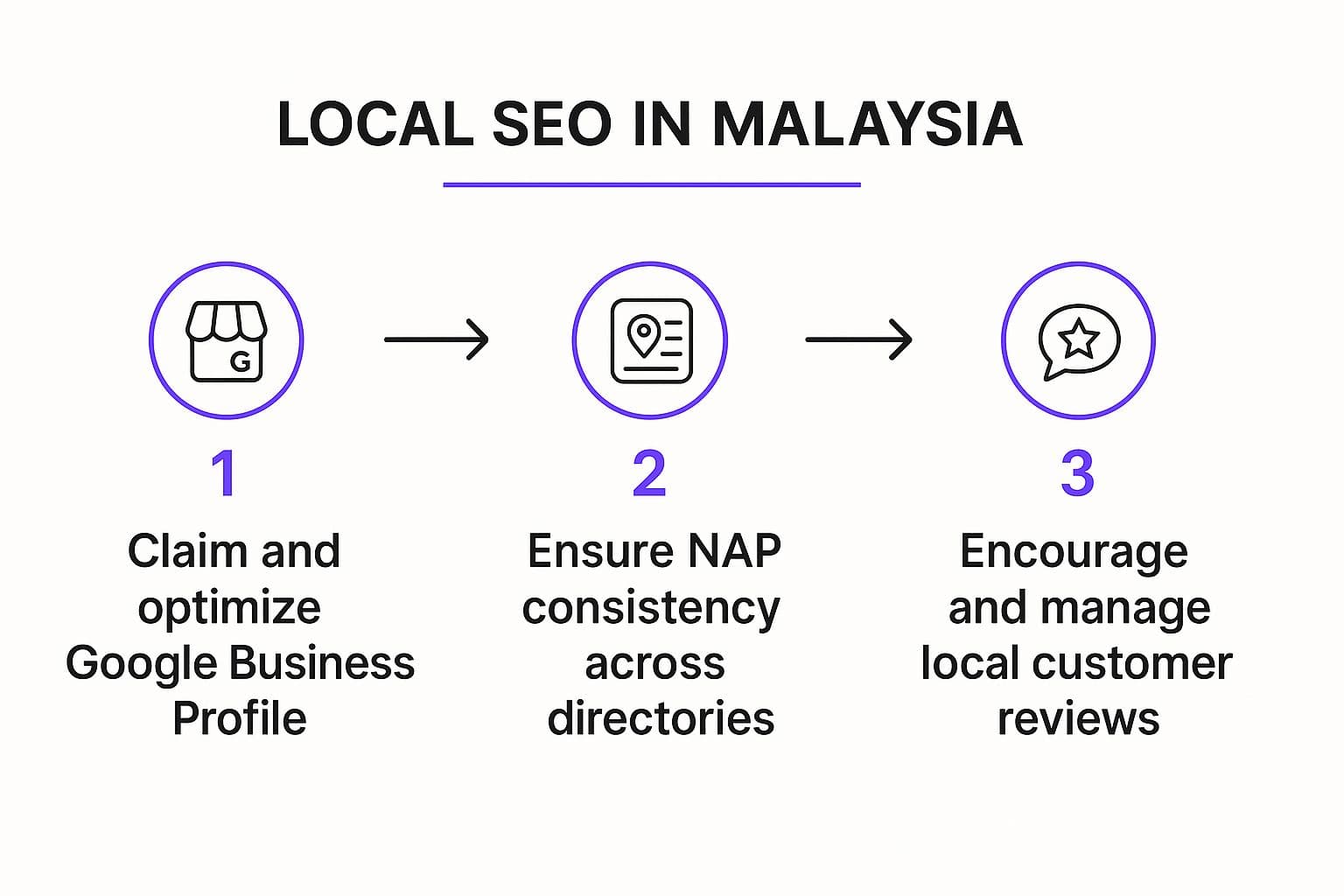
Before you even think about building links, your first port of call must be your Google Business Profile (GBP). Honestly, this is the single most important tool for dominating local search results—that little map box that pops up for searches like "cafe near me" or "bengkel kereta Shah Alam."
Optimizing your GBP is completely non-negotiable. Make sure every single section is filled out accurately. We're talking business name, address, phone number (your NAP), hours, services, and—critically—plenty of high-quality photos. An incomplete profile is a huge missed opportunity.
A fully optimized Google Business Profile is your digital storefront for local search. It doesn’t just help you rank; it directly converts searchers into customers by providing them with all the information they need to visit, call, or make a purchase.
Once your profile is locked in, shift your focus to encouraging customer reviews. Positive reviews are a massive ranking signal for local SEO. They build social proof and tell Google that real people in Malaysia are happy with your business.
Secure Foundational Local Citations
Okay, with GBP sorted, it's time to build your presence across the wider web with local citations. A citation is simply any online mention of your business's Name, Address, and Phone number (NAP).
The golden rule here is consistency. Your NAP details must be identical—down to the last comma—everywhere they appear online. Inconsistencies confuse Google and dilute your local authority.
Start by getting listed in reputable Malaysian directories. These aren't just for show; they provide foundational backlinks and send powerful local trust signals to search engines.
- Malaysia Central: A long-standing, general business directory.
- Yellow Pages Malaysia: The modern, digital version of the classic business book.
- Industry-Specific Portals: This is key. If you're a clinic, get listed on the Malaysian Medical Association site. A real estate agent? Find the top property portals.
These listings confirm to Google that you are a legitimate, local entity, which goes a long way in strengthening your relevance for Malaysian searches.
Earn High-Value Local Backlinks
Now that your foundational citations are in place, you can move to the next level: actively earning backlinks from other Malaysian websites. This is less about filling out forms and more about strategic outreach and providing real value. A good understanding of how to build backlinks is your best friend here, as this is the core of any serious off-page SEO effort.
Here are a few practical ideas to get you started:
- Collaborate with Local Bloggers: Find the influential food, fashion, or tech bloggers in Malaysia who speak to your audience. Don't just ask for a link. Instead, offer them a product to review, a service to experience, or co-create a guide that their readers would genuinely love.
- Sponsor Local Events: Getting involved in the community is a fantastic way to earn natural links. Sponsoring a small local festival, a webinar, or even a neighborhood sports team almost always gets you a backlink from the event's website. It's authentic and highly relevant.
- Create "Linkable Assets": This is the pro move. Develop a piece of content so valuable that other sites want to link to it. Think a deep-dive research report on Malaysian consumer trends, a detailed guide to a local attraction, or a sharp infographic on the Kuala Lumpur property market. Journalists, bloggers, and industry experts actively seek out this kind of content to cite in their own work.
Building a powerful local backlink profile doesn't happen overnight. It's a long-term strategy that's all about building real relationships and cementing your place as a trusted voice in the Malaysian online community.
Common Questions on Ranking in Malaysia
Even with the best roadmap, a few questions always come up when you’re trying to figure out how to rank on Google page 1, especially in Malaysia. Let's tackle the big ones with some straight, no-nonsense answers based on what we see every day.
How Long Does It Take to Rank on Page 1 in Malaysia?
This is the classic "how long is a piece of string?" question, but I'll give you a real-world answer. Ranking on the first page is a marathon, not a sprint. Anyone who tells you otherwise is selling something.
For a brand-new website targeting low-competition keywords, you might start seeing some life within 3 to 6 months. I’m talking about popping up on pages 2-5, maybe grabbing a few clicks. It’s a sign you’re on the right track.
But if you’re in a tough space like finance or e-commerce, a realistic timeline is closer to 6 to 12 months of consistent, high-quality work. Your site's authority, content quality, link-building muscle, and technical SEO health are all massive factors. It’s a long-term investment where slow and steady absolutely wins the race.
Do I Need Content in Bahasa Melayu to Rank Well?
The answer comes down to one thing: who are you trying to sell to?
If your target customers are searching primarily in Bahasa Melayu, then yes, creating content in BM is non-negotiable. Think about a property developer targeting first-time Bumiputera homebuyers—they’d be crazy not to have strong BM content.
For most businesses, though, a bilingual approach is the smartest play. This means creating both English and Bahasa Melayu versions of your most important pages.
My advice? Do your keyword research and see what language your customers are actually using. Let that data drive your content strategy.
What's the Most Important Factor for Ranking in Malaysia?
If I had to bet all my money on one thing, it would be this: creating high-quality, locally relevant content that actually satisfies the user's search.
Google's algorithms are getting scarily good at understanding intent. All the other stuff—technical SEO, backlinks, mobile-friendliness—is crucial, but it's all there to support and amplify great content.
Without content that genuinely helps, informs, or solves a problem for your Malaysian audience, everything else falls flat. You can have the fastest site with the most backlinks in the world, but if your content sucks, you won't get sustainable page-one rankings. It all starts with a user-first approach.
Ready to take the guesswork out of your content strategy? Outrank uses powerful AI to help you create SEO-optimized articles and on-brand images automatically, driving more organic traffic to your site. Simplify your content creation and start outranking the competition today.