
Long Tail Pro is no longer available, so the choice today is between Semrush and the tools that replaced Long Tail Pro. For finding low-competition long-tail keywords, Semrush's Keyword Magic Tool does everything Long Tail Pro did: filter a seed keyword's ideas to phrases of four or more words with a KD% of 0 to 29 ("very easy" and "easy" in Semrush's own bands). The catch is price: Semrush's entry SEO plan costs $139.95 a month ($117.33 billed annually). If you only need long-tail research, KWFinder ($29.90 a month billed annually) or KeySearch ($24) are closer to what Long Tail Pro cost.
Key takeaways
- Long Tail Pro is offline: in October 2026, longtailpro.com shows an unrelated business and the app does not load.
- In Semrush, long-tail research means Keyword Magic Tool + Word count 4+ + KD% 0–29 + an intent filter.
- Semrush rates KD% 0–14 as "very easy" and 15–29 as "easy", achievable on a new domain with intent-focused content.
- Semrush's SEO plan costs $139.95 a month; budget replacements are KeySearch ($24), KWFinder ($29.90 billed annually) and Ahrefs Starter ($29).
- 63% of the keywords Outrank targeted in the last 90 days had a difficulty under 20; low-competition long tail is where new sites win.
What happened to Long Tail Pro?
Long Tail Pro was a keyword research tool for finding long, low-competition phrases, built around its Keyword Competitiveness (KC) score. It was a favourite of bloggers and niche site builders.

When we checked on October 19, 2026, longtailpro.com loaded the website of an insurance adjusting and investigations firm, the old pricing and blog URLs returned 404 errors, and the app subdomain didn't respond. We couldn't find an official shutdown announcement, so we won't guess at a date. If you have saved CSV exports from Long Tail Pro, keep them: there is no other copy.
Long Tail Pro vs Semrush: how they compared
| Long Tail Pro (offline) | Semrush (October 2026) | |
|---|---|---|
| Scope | Keyword research focused on long-tail phrases | Full suite: keywords, competitors, backlinks, rank tracking, audits, ads, content, AI visibility |
| Difficulty metric | Keyword Competitiveness (KC) | KD%, from referring domains, link mix and authority of ranking pages plus SERP features |
| Long-tail workflow | The whole product | Keyword Magic Tool filters: word count, KD%, intent, questions |
| Competitor research | Basic | Organic Research and Keyword Gap across any domain |
| Price | No longer sold | SEO plan $139.95/month ($117.33 billed annually); free plan with 10 reports a day |
For pure long-tail research, Semrush does more than Long Tail Pro ever did. Whether it's worth paying for depends on whether you'll use the rest of the suite.
How to find long-tail keywords in Semrush (with low competition)
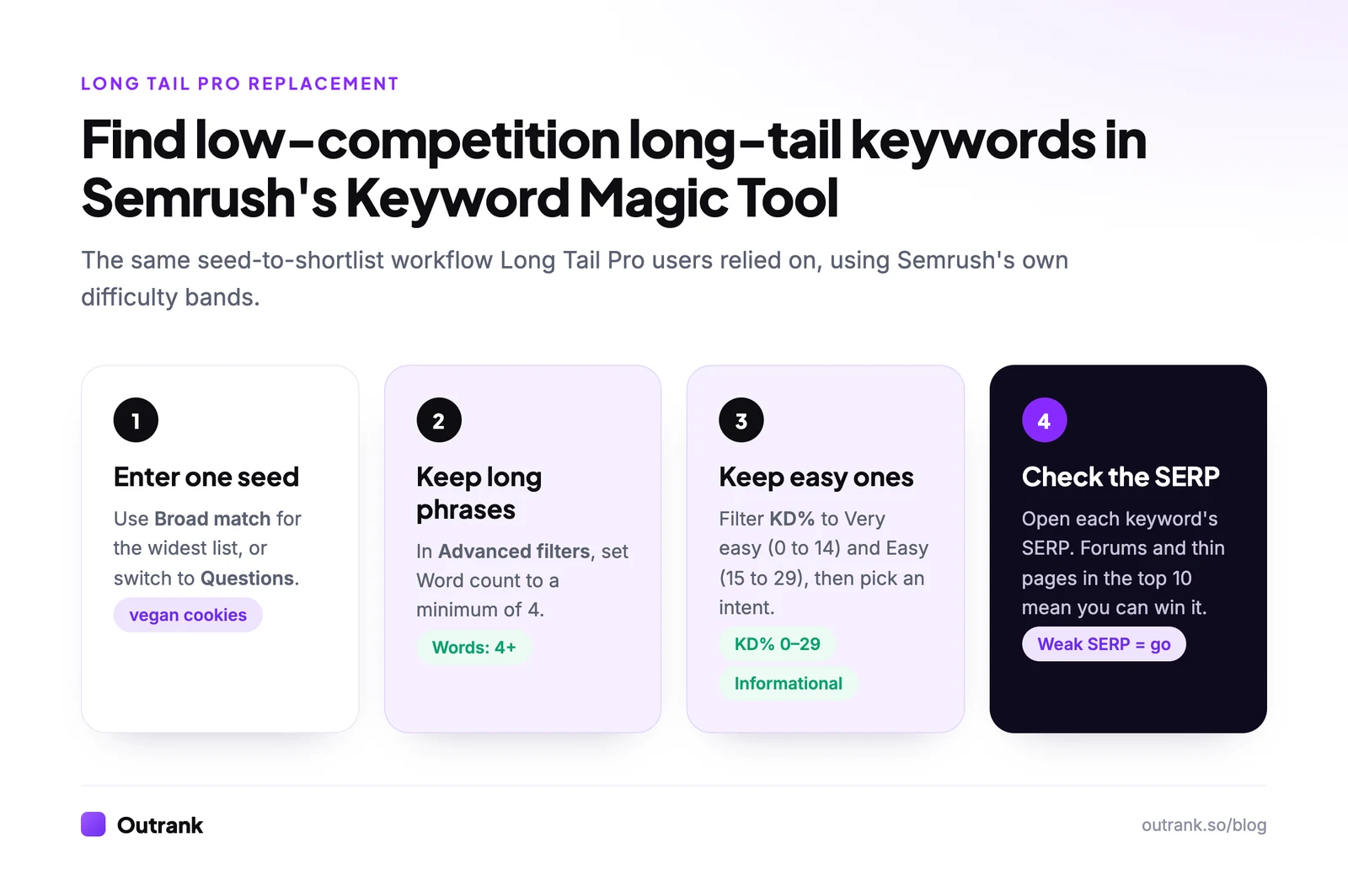
- 1
Enter one seed in the Keyword Magic Tool
Type a broad seed (for example "vegan cookies") and choose your country database. Start with Broad match for the widest list; switch to Questions to see only question queries. - 2
Keep only long phrases
Open Advanced filters and set Word count to a minimum of 4. This is the closest thing to Long Tail Pro's default view. - 3
Keep the low-competition ones
Filter KD% to 0–29. Semrush calls 0–14 "very easy" (the best opportunities for quick rankings) and 15–29 "easy" (achievable on a new domain with quality, intent-focused content). - 4
Filter by intent
Use the Intent filter. Informational keywords suit blog posts; commercial ones suit comparison and "best" pages. - 5
Read the SERP before you commit
Open each shortlisted keyword's SERP. Forums, Q&A sites and thin pages in the top 10 mean you can win; ten dedicated pages from big brands mean you probably can't, whatever the KD% says. - 6
Group, then write
Long-tail variations with the same intent belong on one page. Semrush's Keyword Strategy Builder can cluster them, or group by hand to avoid keyword cannibalization.
Semrush's KD% documentation explains the score: it uses the median number of referring domains pointing to the ranking URLs, the dofollow/nofollow ratio, the authority of the ranking domains, and SERP characteristics. That makes it a reasonable proxy for "less competition", but not a guarantee. Calibrate it against your own site: if you rank for KD 25 keywords easily, you can stretch the filter.
Why low-competition long-tail keywords are worth it
Long-tail keywords are longer, more specific searches with lower individual volume, usually easier to rank for and closer to a concrete need. They're the default strategy for new and mid-sized sites, and our own data reflects it. Of the 183,540 articles Outrank wrote with a known keyword difficulty in the last 90 days, most targeted low-difficulty keywords:
Keyword difficulty of keywords targeted by Outrank articles
KD 0–9
32.4%
KD 10–19
30.8%
KD 20–29
17.5%
KD 30–39
9.4%
KD 40–49
4.7%
KD 50–69
4.1%
KD 70+
1.1%
The upside of that approach shows up over time. On our results page, the median Outrank site reached 2.04× its pre-Outrank Google clicks after seven months, and sites publishing 30 or more articles a month grew faster (2.27×) than those publishing fewer than five (1.07×), a correlation rather than proof of cause. Long-tail pages compound because each one is cheap to win. For the method in more depth, read our guides to long-tail keyword research and finding low-competition keywords.
Long Tail Pro alternatives compared
Long Tail Pro alternatives for long-tail keyword research
| KeySearch Starter | $24/mo | $20/mo | Keyword research with live SERP analysis | 7-day trial |
| Ahrefs Starter | $29/mo | — | Words, KD, volume, Questions, Traffic Potential | Ahrefs Free for own sites |
| Mangools KWFinder Basic | $49/mo | $29.90/mo | KD, volume, local data for about 65,000 locations | 5 free lookups a day |
| Moz Pro Standard | $99/mo | $79/mo | Keyword Explorer, 150 queries a month | Free trial on Medium plan |
| Outrank | $99/mo | $83.25/mo | Picks low-KD long-tail keywords and writes the articles | 3-day trial |
| Semrush (SEO plan) | $139.95/mo | $117.33/mo | Word count, KD%, intent, questions | Free plan, 7-day trial |
Click a column header to sort.
KWFinder: closest to Long Tail Pro's simplicity
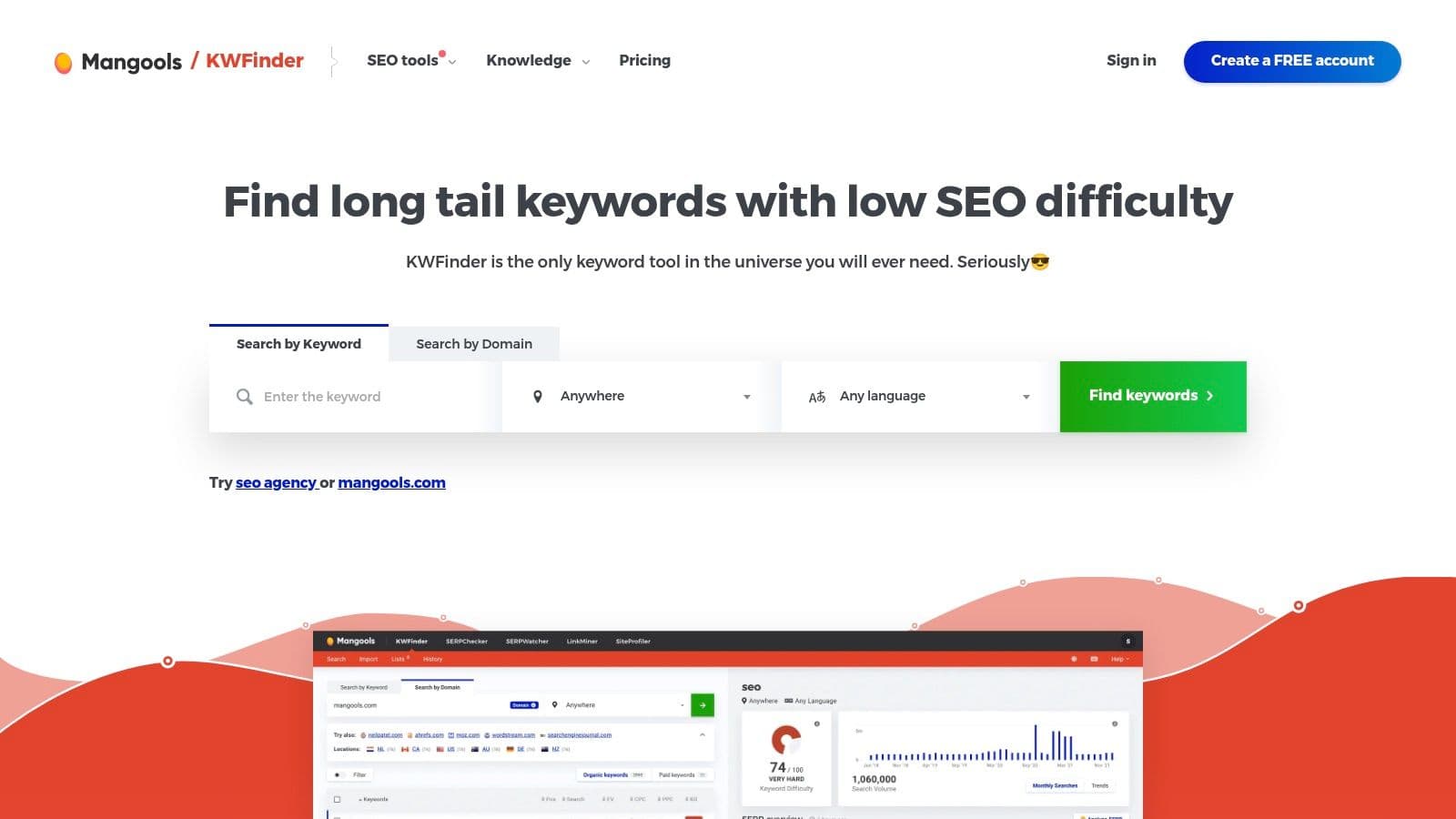
KWFinder is built for exactly what Long Tail Pro users did: type a seed, get related keywords with a colour-coded difficulty score and the page-one SERP on one screen. Mangools Basic costs $49 a month or $29.90 billed annually and includes four other tools. See our Ahrefs vs KWFinder comparison.
Ahrefs: the strongest data per keyword

Ahrefs Keywords Explorer adds Traffic Potential and Parent Topic, which tell you whether a long-tail keyword deserves its own page. Starter ($29) covers keyword research; Lite ($129) adds backlinks, audits and rank tracking. We walk through the long-tail workflow in Long Tail Pro vs Ahrefs.
KeySearch: the cheapest serious option
At $24 a month for 200 keyword searches a day, KeySearch is the closest match to Long Tail Pro's price point, with SERP analysis, competitor and backlink checks, an auditor and rank tracking included.
Outrank: when the bottleneck is writing, not research

Every tool above ends with a spreadsheet of keywords. Outrank (our product) takes the next step: it picks long-tail keywords your site can rank for, writes a long-form article for each one with images, internal links and FAQ, and publishes it to WordPress, Webflow, Shopify, Wix, Framer, Notion, Ghost, Next.js or a webhook every day. The Organic Growth plan costs $99 a month for 30 articles, unlimited keyword research and backlinks through our exchange, with a 3-day free trial. It doesn't replace Semrush's competitor, ads or audit tools; it replaces the hours between keyword list and published post.
Which should you choose?
- You want one tool for keywords, competitors, audits and ads: Semrush. Use the SEO plan and the long-tail workflow above.
- You only did long-tail research in Long Tail Pro: KWFinder or KeySearch. Both cost a fraction of Semrush.
- You want the best keyword data and also build links: Ahrefs.
- You have plenty of keywords and no time to write: Outrank.
If you're weighing Semrush against other full suites, our Semrush alternatives guide compares ten of them with October 2026 prices.
FAQ
Is Long Tail Pro better than Semrush?
Long Tail Pro is no longer available, so it can't be bought or used. When it existed, it was a simpler, cheaper keyword-only tool; Semrush is a full SEO suite. Today, Semrush's Keyword Magic Tool covers Long Tail Pro's long-tail workflow, and KWFinder or KeySearch match its simplicity and price better.
How do I find long-tail keywords in Semrush?
Open the Keyword Magic Tool, enter a seed keyword, and use Advanced filters to set a minimum word count of 4. Then filter KD% to 0–29 and pick an intent. Check the SERP for each shortlisted keyword before writing, and group close variations onto one page.
How do I find long-tail keywords with lower competition in Semrush?
Filter the Keyword Magic Tool by KD% 0–14 ("very easy") and 15–29 ("easy"), which Semrush describes as achievable on a new domain with quality, intent-focused content. Then confirm in the SERP that the top results include forums, small sites or thin pages you can beat.
What are the best Long Tail Pro alternatives?
KWFinder ($29.90 a month billed annually) is the closest in simplicity, KeySearch ($24 a month) is the cheapest, and Ahrefs (Starter $29, Lite $129) and Semrush (SEO plan $139.95) are the full-suite options. Google Keyword Planner is free but shows only volume ranges without an SEO difficulty score.
Is Semrush good for long-tail keywords?
Yes. The Keyword Magic Tool can generate thousands of variations from one seed and filter them by word count, KD%, intent and question format, which is everything a long-tail workflow needs. Its limit is cost: the SEO plan is $139.95 a month, and the free plan allows only 10 reports a day.