You make money with a blog by sending its readers to something that pays: affiliate links that earn a commission, ads that pay per impression, sponsored posts that brands pay for, and products, services or memberships you sell yourself. Affiliate links and ads are where most bloggers earn their first dollars. Your own products earn the most per reader. Whichever you choose, income follows traffic, and traffic takes time: in a 2025 survey of 187 bloggers, the median took 12 months to earn a first dollar and 36 months to reach a full-time income.
Below are the seven income streams with what each pays, the order to add them, and real income figures by traffic, post count and blog age. To estimate what your own traffic could earn, use the calculator in our guide to website monetization.
Key takeaways
- Seven streams pay bloggers. Affiliate marketing, display ads, sponsored posts, digital products, services, memberships and physical products.
- Your own digital products paid the most per reader in a 2025 survey of 187 bloggers ($283.64 per 1,000 pageviews), about 8 times ad-led blogs ($33.80).
- Ad network matters. Average ad RPM was $2.34 on AdSense and $31.55 to $34.86 on Mediavine and Raptive in the same survey.
- Volume pays. Surveyed blogs with 300 to 499 posts averaged $5,086 a month; blogs under 50 posts averaged $17.
- Add streams in order. Affiliate links and an email list first, ads when traffic qualifies for a good network, your own product once readers ask you for help.
How much do bloggers actually make?
The most useful public data comes from Productive Blogging's annual Blogging Income Survey. The 2025 edition has 187 responses, mostly from bloggers in the US and UK, all self-reported. Averages are pulled up by a few big earners, so read the shape of each chart rather than the exact dollar figure.
Average monthly blog income
Hover or tap the chart for exact values.
Three things jump out. Income climbs slowly, then jumps once a blog passes about 50,000 monthly pageviews or 300 posts. First-year blogs average almost nothing. And post count is the lever you control: you can't speed up time, but you can publish more.
The 7 ways to make money blogging
They're listed in the order most bloggers should add them.
1. Affiliate marketing
You link to a product with a tracked link and earn a commission when a reader buys. It's the best first stream because it works at any traffic level, as long as the post catches readers who are choosing what to buy. "Best accounting software for freelancers" converts. "What is accounting" doesn't.
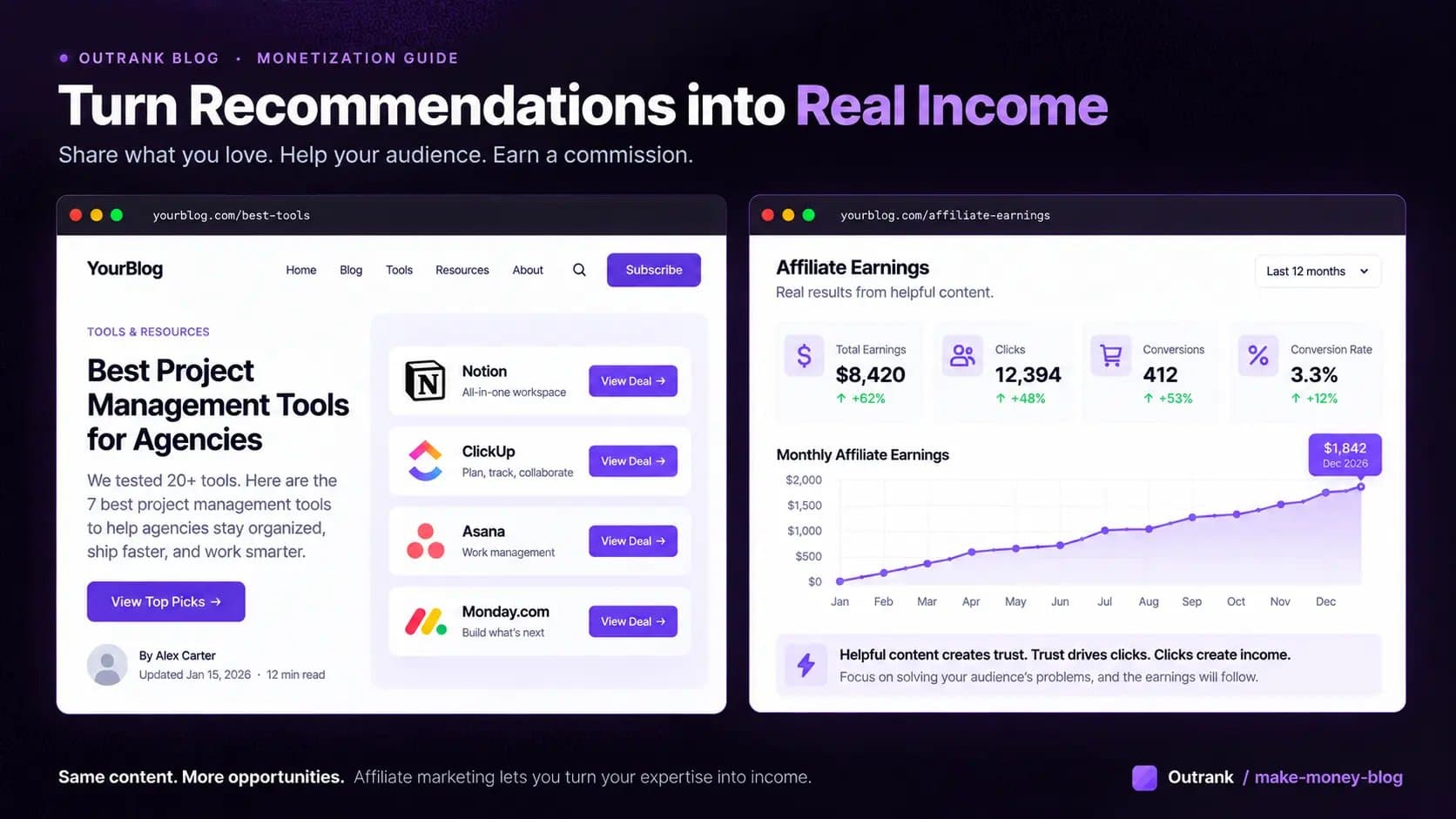
What it pays: Amazon Associates pays 0% to 10% depending on category, 4% for most. Software companies often pay recurring commission; Outrank's affiliate program, for example, pays 30% of every payment for as long as the customer stays. Surveyed bloggers who lived mainly on affiliate income averaged a $40.24 RPM.
Do it right:
- Write posts that help someone decide: comparisons, "best X for Y", honest reviews with your own photos or test results. Google's spam policies call out thin affiliate pages and name original reviews, testing and comparisons as what good affiliate pages add.
- Disclose next to the link. The FTC's guidance suggests wording like "I get commissions for purchases made through links in this post" and says "affiliate link" alone isn't enough.
- Add
rel="sponsored"to affiliate links, as Google asks.
2. Display ads
You add an ad network's code and get paid per 1,000 ad impressions. It's passive and pays everything that visits, but the rate depends heavily on which network accepts you.
| Network | Entry bar (October 2026) | Average ad RPM in the survey |
|---|---|---|
| Google AdSense | No traffic minimum, original content, 18+ | $2.34 |
| Journey by Mediavine | 1,000 sessions from Tier 1 countries in 30 days | $11.15 |
| Mediavine | $5,000 in annual ad revenue | $31.55 |
| Raptive | 25,000 monthly pageviews, mostly US/CA/UK/AU/NZ readers | $34.86 |
Requirements come from Mediavine and Raptive directly. The jump from AdSense to Journey is the first one worth chasing: at 20,000 pageviews, the survey averages work out to roughly $47 a month on AdSense and $223 on Journey. Our guide to the best ad networks for bloggers compares more options, and the website monetization platforms table lists entry rules and fees for 15 platforms.
3. Sponsored posts
A brand pays you a flat fee to publish a post or mention. It needs an audience a brand wants to reach, which is more about niche than size. US and Canadian bloggers in the survey charged an average of $275 per sponsored post under 10,000 monthly pageviews, $420 at 10,000 to 49,999 and $1,525 at 50,000 to 99,999.
To land the first one, write down exactly who reads you, build a one-page media kit (traffic, top countries, email list size, three best posts), and pitch brands whose products your readers already use. Label sponsored content clearly and mark the links rel="sponsored". Our guide to blog advertising rates covers pricing in more detail.
4. Digital products
You sell something you made once: a template, a spreadsheet, a course, an ebook, a preset pack. It posted the highest RPM in the survey, $283.64 per 1,000 pageviews for bloggers whose main income was digital products, because no middleman takes a cut beyond the checkout fee.
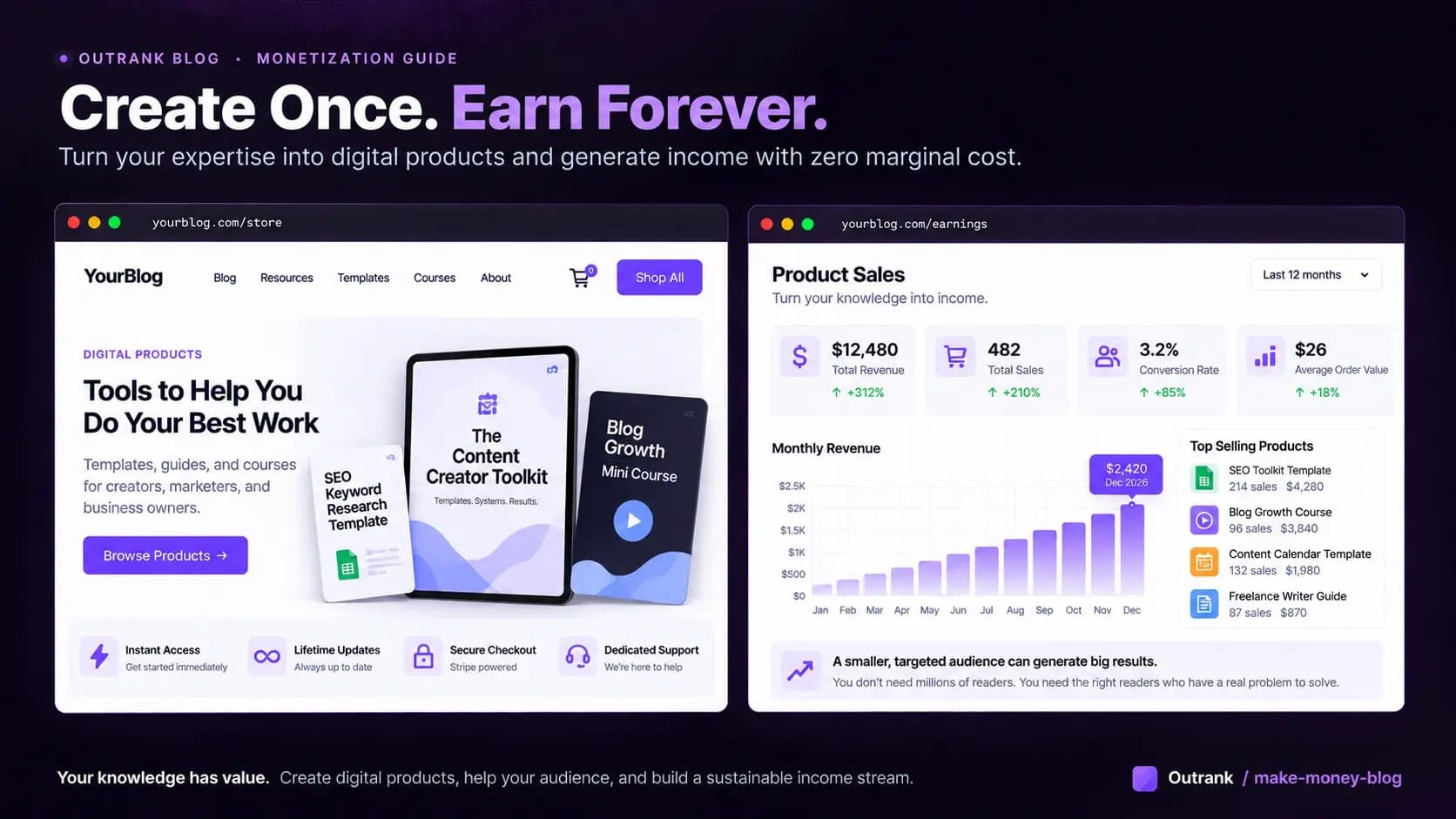
The product brief is already in your inbox and comments: the question readers ask you most often. Start small (a template or checklist that saves an hour), sell it through a checkout like Gumroad (10% + $0.50 per direct sale) or Lemon Squeezy (5% + 50¢), and promote it inside the posts that rank for that problem.
5. Services, coaching and freelancing
Your blog proves you know the subject, and readers hire you: consulting, done-for-you work, coaching calls, writing for other sites. It needs no traffic threshold, only a clear "work with me" page and posts that show your method. A handful of the right visitors a month can be worth more than thousands of casual readers.
6. Memberships and paid newsletters
Readers pay monthly for extra posts, a community or early access. Substack keeps 10% of paid subscriptions plus card fees; Ghost(Pro) takes 0% on its paid plans. It works when readers follow you for your voice or expertise, less so for a blog built on search traffic from one-off questions. Our Substack vs blog comparison covers which to build on.
7. Physical products and merch
Some blogs sell physical goods: printed planners, kits, branded merch, or their own product line. Surveyed bloggers whose main income was physical products averaged a $91.69 RPM. It adds inventory and shipping, so it usually comes last unless the blog was built to sell a product from day one.
The order to add them
Don't switch everything on at once. A practical sequence for a new blog:
- 1
From day one
Add an email signup form and one or two affiliate programs that fit your niche. Write your first buying-intent posts alongside the informational ones. - 2
When traffic starts arriving
Turn on Google AdSense, or apply to Journey by Mediavine once you pass 1,000 monthly sessions from Tier 1 countries. - 3
When readers start asking questions
Package the most common answer into a small digital product or a service offer, and link it from the posts that rank for that problem. - 4
As traffic and the list grow
Apply to Raptive at 25,000 pageviews or Mediavine at $5,000 a year in ad revenue, and start pitching sponsors with a media kit.
Diversifying pays: bloggers with five or more revenue streams averaged an RPM of $62.47 in the survey, about double the $29.79 of single-stream bloggers. On WordPress, each of these steps maps to a plugin; see how to monetize a WordPress blog.
The part that decides everything: traffic
Every stream above multiplies traffic, and most blog posts get none. Ahrefs found that 96.55% of pages get no organic traffic from Google. The posts that do tend to target specific, low-competition questions on a blog that covers its topic in depth.
So the practical work is unglamorous: find low-competition keywords a new blog can win, publish on a schedule, and keep going past the quiet first months. The survey's income-by-posts curve is the argument for volume.
That's what Outrank automates. It researches keywords your blog can rank for, writes and publishes an SEO article every day with images and internal links, and builds backlinks through its exchange. On our results page, sites publishing 30 or more articles a month reached a median 2.27× their pre-Outrank Google clicks, against 1.07× for sites publishing fewer than five. Observational data, and growth is slow for the first three months, but volume clearly helps.
If you're starting from zero, Outrank Blogs gives you a hosted blog on your own domain, free up to 10,000 visits a month, with newsletter forms built in. Our step-by-step guide on how to start a blog and make money covers the launch.
Is blogging still worth it in 2026?
Yes, with a different mix than five years ago. AI answers now sit above many search results: Pew found Google users clicked a traditional result in 8% of visits with an AI summary, against 15% without. Quick factual questions send fewer clicks, which hurts ad-only blogs most.
What still works: posts for people deciding what to buy or do, first-hand experience AI can't summarize, an email list you own, and your own products. Blogs built on those earn more per visitor and depend less on any single traffic source.
FAQ
How do blogs make money?
Blogs make money from affiliate commissions, display ads, sponsored posts, and products, services or memberships the blogger sells. Most start with affiliate links and ads, then earn the most per reader from their own products. In a 2025 survey, bloggers with five or more income streams averaged about double the RPM of single-stream bloggers.
How much money can you make blogging?
It ranges from nothing to a full-time income. In Productive Blogging's 2025 survey, blogs under 5,000 monthly pageviews averaged $47 a month, blogs with 25,000 to 50,000 averaged $1,034, and blogs with 100,000 to 500,000 averaged $9,396. Averages are skewed by top earners, so the median blogger earns less.
How long does it take to make money from a blog?
The surveyed bloggers took a median of 12 months to earn their first dollar and 36 months to reach a full-time income, though just over a quarter earned something within six months. Publishing more posts on low-competition keywords is the main way to shorten that.
Can you make money blogging without ads?
Yes. Affiliate links, sponsored posts, digital products, services and memberships all work without display ads, and most of them pay more per reader. Bloggers whose main income was digital products averaged a $283.64 RPM in the 2025 survey, against $33.80 for ad-led blogs.
Can you make money with a free blog?
Yes, within the host's rules. A free Outrank blog lets you use affiliate links and collect email subscribers, and Outrank never puts its own ads on it; custom ad scripts need the paid plan. On WordPress.com, free sites show WordPress.com's ads and WordAds requires the Premium plan.
What type of blog makes the most money?
In the survey, personal finance ($480) and online business ($374.81) blogs reported the highest average RPMs, far ahead of most lifestyle niches. The author notes small samples per niche and found blog age, post count and revenue streams mattered more than niche itself.