

SEO for education is all about getting your institution’s website to show up when people search for it on Google. The goal is simple: when a potential student looks for a program, a degree, or a specific college, your institution should be right there at the top of the search results. Think of it as your most effective digital recruitment tool.
Why SEO for Education Is Your New Admissions Officer

Imagine your institution is a world-class library, but it's tucked away in a basement with no signs to lead anyone there. That’s exactly what your website is like without a smart SEO strategy. These days, the path to higher education almost always starts with a search engine.
Prospective students, whether they're high school seniors exploring their options or professionals looking for advanced degrees, turn to Google first. They’re typing in things like "best online MBA programs" or "biomedical engineering degrees near me." If your institution isn't on that first page of results, you might as well be invisible.
This makes SEO much more than just a technical marketing chore. It's a core part of modern student recruitment. It's your 24/7 digital admissions officer, guiding motivated applicants straight to your program pages, financial aid info, and application portals.
The Digital Shift in Student Recruitment
Traditional recruitment methods like college fairs and direct mail still have their place, but they aren't the powerhouses they once were. The initial research phase has moved almost entirely online, and institutions that don't keep up are leaving a huge opportunity on the table.
A strong SEO plan makes a direct impact on your institution’s bottom line:
- More Applications: By ranking for the right search terms, you bring in a steady flow of students who are already looking for the exact programs you offer.
- Stronger Credibility: A high ranking on Google builds trust. It signals to students and their families that your institution is an authority in its field.
- Better Marketing ROI: Unlike paid ads that vanish the moment you stop paying, SEO builds a lasting asset. It generates organic traffic and leads for years.
"SEO is the new front door to your campus. If students can't find you online, they won't be walking through your physical doors."
Sadly, many institutions are still behind the curve. One study revealed that a staggering 51% of universities worldwide still don’t have an established SEO plan. This is a massive blind spot, especially when you consider that Google handles over 95% of mobile search traffic—the primary way students start their college search.
Establishing Your Digital Footprint
To build a solid SEO foundation, you have to start treating your website as your most valuable recruitment asset. Every single program page, faculty bio, and student testimonial is a chance to connect with a potential applicant. For a deeper dive into boosting your school's online visibility, you can explore more resources on SEO for education websites.
Let's break down the essential components that make up a successful SEO strategy for any educational institution.
Core Pillars of Educational SEO at a Glance
This table provides a quick summary of the key areas we'll be focusing on. Each pillar plays a unique role in building a comprehensive and effective strategy.
| Pillar | Primary Goal | Key Action Example |
|---|---|---|
| Keyword Research | Discover what potential students are searching for. | Identify long-tail keywords like "part-time nursing programs in Texas." |
| On-Page SEO | Optimize individual web pages for search engines. | Write compelling title tags and meta descriptions for program pages. |
| Technical SEO | Ensure your website is easy for Google to crawl and index. | Improve site speed and make sure the site is mobile-friendly. |
| Content Strategy | Create valuable content that answers student questions. | Develop a blog series on "how to choose the right major." |
| Link Building | Build authority by earning links from other reputable sites. | Get featured on a well-known higher education resource website. |
| Performance Tracking | Measure what's working and identify areas for improvement. | Use Google Analytics to monitor organic traffic to application pages. |
By optimizing your digital presence, you ensure that when a student searches for their future, your institution is there to give them the answer. This isn't just about having a website; it's about turning that website into an active, lead-generating machine that fuels enrollment and supports long-term growth. The following sections will show you exactly how to build this engine.
Finding the Keywords That Drive Enrollment
Keyword research is really about learning to speak your future students' language. It's the art of figuring out the exact words and phrases they type into Google when they're looking for a program like yours. You have to move past the huge, competitive terms like "best colleges" and dig deeper to find the specific, high-intent phrases that tell you a serious applicant is on the other end.
Think of it like this: you're listening in on the conversations students are having with the search bar. Once you know what they're asking, you can tailor your website content to give them the perfect answer. This is the bedrock of any solid SEO for education strategy, making sure your programs show up the moment a prospective student starts looking.
Moving Beyond Generic Searches
The real magic is in focusing on long-tail keywords. These are longer, more descriptive search phrases. They might not get a ton of searches, but the people using them are much closer to making a decision. A student searching for "college" is just window shopping. But a student searching for "online data science master's for working professionals" knows precisely what they need.
Let’s look at a couple of real-world examples:
- Broad Keyword: "business degree"
- Long-Tail Keyword: "affordable part-time MBA program in Boston"
- Broad Keyword: "nursing school"
- Long-Tail Keyword: "accelerated BSN programs for non-nurses in Florida"
These specific phrases tell you so much more—the user's intent, their location, and their unique situation. Attracting this kind of visitor is far more valuable than getting thousands of clicks from people who are just browsing.
Understanding Student Search Intent
Every search has a "why" behind it. This is what we call search intent, and it tells you where a student is in their decision-making journey. If you can understand their intent, you can create content that gives them the right information at the right time.
There are three main types of search intent to keep in mind:
- Informational: The student is just starting out. They're exploring options and looking for answers. They might search for things like "what can you do with a psychology degree" or "how does financial aid work."
- Navigational: The user already knows about your school and is trying to get to a specific page. Think "University of X application portal" or "State College course catalog."
- Transactional: The student is ready to make a move. Their searches are very specific and show they want to apply or enroll. You'll see queries like "apply for mechanical engineering program" or "schedule a campus tour."
Aligning your content with these intents is how you guide students smoothly from their first question to their final application.
For a deeper dive into attracting potential students through unpaid efforts, explore effective sustainable organic lead generation strategies.
This simple flowchart breaks down the core steps of keyword research, from brainstorming ideas to figuring out if they're actually viable.
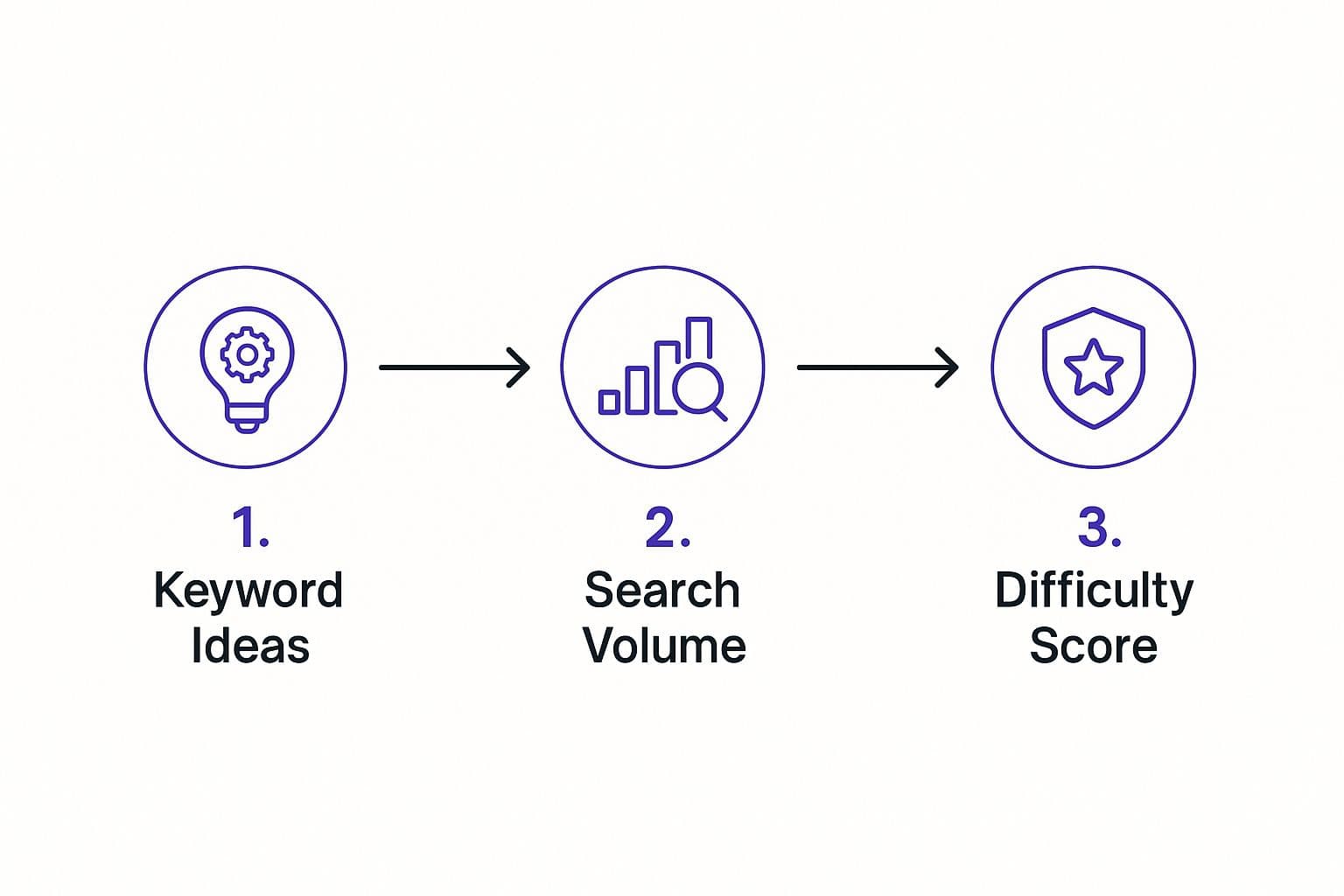
As you can see, choosing the right keywords is a balancing act between what students are looking for (volume) and whether you can realistically rank for it (difficulty).
How to Find High-Value Keywords
So, how do you actually find these game-changing keywords? This is where SEO tools like Ahrefs or Semrush come in. Even Google's free Keyword Planner can be a great starting point.
Here’s a straightforward approach to get you started:
- Brainstorm Seed Keywords: Begin with the big-picture topics related to your institution. Think about your degree programs ("computer science"), your school's identity ("liberal arts college"), and what students need ("scholarships for veterans").
- Use Keyword Research Tools: Plug those seed keywords into your tool of choice. It will spit back hundreds, sometimes thousands, of related long-tail variations. This is where you'll uncover the hidden gems.
- Analyze the Metrics: Look closely at two key numbers for each keyword: Search Volume (how many people search for it each month) and Keyword Difficulty (how tough it is to get on the first page of Google). The sweet spot is usually a keyword with solid search volume and a low difficulty score.
This process gives you the data to make smart decisions, helping you prioritize the keywords that give you the best shot at attracting qualified applicants. To build a truly effective strategy, you'll want to get more granular. For a complete walkthrough, check out our guide on https://www.outrank.so/blog/how-to-keyword-research.
In the end, finding the right keywords comes down to empathy. It’s about putting yourself in the shoes of a prospective student and understanding their questions, their worries, and their ambitions. When you get that right, you create a digital presence that doesn't just get traffic—it builds connections and drives enrollment.
Creating Content That Connects with Students

Think of your website's content as a 24/7, always-on digital campus tour. It's so much more than a stuffy collection of course catalogs and faculty headshots. Your content is your single best tool for building a genuine connection and inspiring someone to take that next step.
A smart content strategy for SEO for education doesn't just list facts—it answers a prospective student's questions before they even know they have them. By creating an engaging and helpful experience, you'll keep visitors on your site longer, guiding them naturally from casual interest to a completed application.
Building on the Foundation of E-E-A-T
For any school or university, Google’s E-E-A-T (Experience, Expertise, Authoritativeness, and Trustworthiness) isn't just a best practice; it's the gold standard. Your website has to prove, without a doubt, that you are a credible and reliable institution. This is where your content really gets to work.
You demonstrate E-E-A-T through the quality and depth of what you share. It's built by showcasing your faculty's real-world experience, the deep expertise behind your academic programs, and the authoritative voice you have in your field. Trust, the final piece of the puzzle, is earned by being transparent and authentic.
A website that nails E-E-A-T doesn't just rank higher—it converts better. It sends a clear message to prospective students and their families that choosing your institution is a sound investment in their future.
To really pull this off, every piece of content needs to be crafted with these qualities in mind. For example, don't just list a professor's degrees. Create a dynamic faculty profile that features their published research, links to interviews, and highlights their hands-on industry experience.
Crafting Essential Content for Applicants
Your website needs to be the go-to resource hub for anyone considering your school. A few types of content are absolutely critical for grabbing their attention and keeping them engaged.
Here are the must-have content pillars every educational website should build:
- In-Depth Program Pages: Don't just give them a course list. Go deep on learning outcomes, potential career paths, unique internship opportunities, and the cool facilities they'll get to use. Even better, embed video testimonials from current students to bring the program to life.
- Authentic Student Success Stories: Feature alumni who are out there doing amazing things. Tell their story—from their first day on campus to their current career. These journeys provide powerful social proof and help applicants see themselves succeeding with you.
- Faculty Research and Expertise: Is there groundbreaking research happening on your campus? Shine a spotlight on it! Blog posts or articles that break down complex topics show off your faculty as true thought leaders in their fields.
- Clear Guides on Campus Life: Answer the practical questions weighing on their minds. Create content about housing, financial aid, student clubs, and what there is to do in town. This shows you care about the entire student experience, not just the academics.
When you create content that speaks to every stage of their journey, you build a relationship long before they ever click "apply." A fantastic way to strengthen this bond is by using ideas from our guide on what is content personalization to make the experience feel unique to each visitor.
Structuring Content for Maximum Impact
How you present information is every bit as important as what you're presenting. A cluttered, poorly structured page can send a visitor packing, even if the content itself is fantastic. The secret is creating a clear visual flow that makes your information a breeze to read.
You want to design a page that guides a visitor's eye right where you want it to go.
- Start with a Compelling Headline: Your main H1 tag should be crystal clear. It needs to include your main keyword and tell the visitor exactly what the page is about.
- Use Descriptive Subheadings (H2, H3): Break up those big walls of text. Subheadings act like signposts, letting users scan the page and find the specific information they're looking for in seconds.
- Incorporate Rich Media: Text alone can be a bit dry. Weave in high-quality images, engaging videos, and maybe even a virtual campus tour to create a much more immersive and memorable experience.
- End with a Clear Call-to-Action (CTA): Don't leave them hanging! Every page should point to a clear next step. Whether it’s "Apply Now," "Request More Information," or "Schedule a Tour," make it completely obvious what you want them to do next.
This kind of thoughtful structure does more than just improve the user experience. It also helps search engines understand what your pages are about, giving your overall SEO a healthy boost.
Building Your School's Digital Reputation
In the academic world, credibility is everything. A research paper's authority skyrockets when it's cited by other respected journals. Think of backlinks as the digital equivalent for your school's website. A backlink is just a link from another website pointing to yours, and it acts like a powerful vote of confidence.
When a reputable site links to your content, it’s signaling to search engines like Google that your institution is a trustworthy source of information. The more of these high-quality "votes" you gather, the better your website will perform in search results. This entire process is called link building, and it’s a non-negotiable part of any serious SEO for education strategy.
Earning Links The Right Way
Let's be clear: not all backlinks are created equal. A link from a local newspaper covering your latest research breakthrough is worth far more than a hundred random links from unrelated blogs. The real goal is to earn links from sources that are both authoritative and relevant to what you do.
This has nothing to do with buying links or using spammy tricks. It’s all about creating content and resources so valuable that other organizations genuinely want to reference and link to them. This is how you build a rock-solid digital reputation that will benefit your institution for years to come.
"Think of each high-quality backlink as an endorsement from a respected peer. The more endorsements you have, the more Google sees your institution as a leading authority worth showing to its users."
The data on this is incredibly clear. Research consistently shows a direct line between the number of backlinks a page has and how high it ranks. In fact, top-ranking pages in higher education have, on average, 3.8 times more backlinks than pages ranking lower. That’s a massive difference. You can dive deeper into the numbers with these SEO statistics and findings.
Proven Link Building Strategies for Education
Building a great backlink profile takes a bit of creativity and proactive effort. You have to figure out what makes your institution special and then turn those unique assets into things people want to link to. Here are a few strategies that work exceptionally well for schools.
- Showcase Faculty Expertise: Your faculty are producing incredible work. When they publish research or speak at a conference, don't just let it sit in an academic journal. Turn it into an easy-to-read blog post or a press release and share it with industry publications, news outlets, and academic blogs.
- Create a Go-To Scholarship Page: A well-organized scholarship page is a link-building goldmine. High schools, scholarship directories, and community groups are always on the lookout for resources to help students. Make your page easy to find and share, and the links will start coming in naturally.
- Collaborate on Helpful Guides: Team up with other organizations—like local non-profits or government agencies—to create a comprehensive resource. Imagine a "College Readiness Guide for First-Generation Students" co-created with local high schools. It's instantly valuable and highly linkable.
- Announce Campus News & Events: Are you opening a new science building or launching a groundbreaking program? Pitch these stories to local news stations and community bloggers. They are often hungry for local content and will gladly link back to your announcement or event page.
If you want a more detailed playbook on this, our guide on how to build backlinks walks you through the entire process step-by-step.
Turning Your Reputation into Rankings
At the end of the day, building your school's digital reputation is about much more than just numbers on an SEO report. It’s about showcasing the amazing work happening on your campus and making sure prospective students, fellow researchers, and your community can actually find it.
When you focus on creating real value and building genuine relationships, you kickstart a powerful cycle. Great content earns high-quality links, which boosts your search rankings. Higher rankings bring more of the right students to your website, cementing your institution's place as a leader in education.
Strengthening Your Website's Technical Foundation

Think of technical SEO as the very foundation and layout of your digital campus. If your content is your world-class curriculum and your backlinks are your sterling academic reputation, then technical SEO is the campus itself—the buildings, the pathways, and the signposts that guide everyone around. It’s what ensures both search engines and prospective students can find what they need without hitting a dead end or a locked door.
Without a solid technical backbone, even the most compelling content can get lost. It’s like having a beautiful, modern library with broken elevators and confusing floor plans. People might hear it's amazing, but they'll just give up if they can't actually find the books. This is exactly why getting the technical side of SEO for education right is so critical.
Why Site Speed Is a Dealbreaker for Students
Let’s be honest: today’s students live on their phones. They’re browsing for information between classes, on the bus, or during a study break. They expect pages to load in a snap. If your program page takes more than a few seconds to appear, they won't wait. They’ll just hit the back button and check out the next university on their list.
A slow website isn’t just a minor annoyance—it’s a direct barrier to enrollment. Google understands this behavior perfectly, which is why page speed is a major ranking factor. A fast, responsive website simply provides a better experience, which means lower bounce rates for you and higher rankings from Google.
Making Your Site Easy to Navigate
An educational website can easily become a sprawling maze of departmental pages, old course catalogs, and forgotten event announcements. The fix? A logical site architecture. This is all about organizing your content into a clear hierarchy that makes sense to both human visitors and search engine crawlers.
Imagine your homepage as the main campus entrance. From there, you need clear signs pointing to major colleges (like Arts & Sciences or Engineering), which then lead to specific department buildings (Psychology, Computer Science), and finally to individual classroom doors (the actual program pages). This intuitive structure helps Google figure out which of your pages are the most important.
A huge part of this is your XML sitemap. This file is literally a map of your website that you hand directly to search engines, showing them where all your important pages are located. For a simple walkthrough, you can learn how to make a sitemap in our detailed guide.
Using Schema to Stand Out in Search Results
Structured data, also known as Schema markup, is a bit like a secret code you add to your website. It doesn't change how the page looks to a student, but it gives search engines incredibly specific information about your content. Think of it as adding clear, descriptive labels to your files so the search engine "librarian" knows exactly what's inside without having to guess.
For a school, this is a game-changer. You can use it to highlight critical details right there in the search results:
- Course Schema: Display program costs, important dates, and campus locations.
- Event Schema: Showcase upcoming open houses or application deadlines.
- FAQ Schema: Answer common questions directly on the search results page.
Essential Technical SEO Checklist for Education Sites
Getting started with technical SEO doesn't have to be overwhelming. This simple checklist covers the most common—and most critical—issues that can hold an educational website back.
| Technical Element | Why It Matters for Students | How to Check |
|---|---|---|
| Mobile-Friendliness | Most students are on their phones. A clunky mobile site is an instant turn-off. | Use Google's free Mobile-Friendly Test tool. Just enter your URL. |
| HTTPS Security | Secures student data on forms ("Request Info") and builds essential trust. | Look for a padlock icon and "https://" at the start of your URL. |
| Broken Links | A 404 error on a program or application page is a complete dead end. | Use a free tool like Ahrefs' Broken Link Checker to scan your site. |
| Page Speed | A slow site means students will leave before they ever see what you offer. | Get a performance score and suggestions using Google's PageSpeed Insights. |
By running through these checks regularly, you ensure your digital campus is always welcoming, fast, and easy to explore. This background work creates a smooth journey that guides students from their first Google search right to your application page.
Alright, let's talk about the big question: how do you prove your SEO work is actually putting students in seats? A solid SEO for education strategy goes way beyond just counting website visits. To show real value, you need to connect your efforts directly to what your stakeholders care about most—applications and enrollment.
Think of it like this: tracking website traffic is like counting how many people walk past your campus. It's a nice number to have, but it doesn't tell you who actually stepped inside for a tour. We need to measure the actions that show a prospective student is genuinely interested in your school.
This means we have to get laser-focused on the key performance indicators (KPIs) that track a student's journey through the enrollment funnel. These are the numbers that will tell a powerful story about your return on investment (ROI).
From Traffic to Tangible Results
To prove that SEO is making a difference, your focus needs to shift from traffic to conversions. A conversion is simply any meaningful action someone takes on your site. For a school, these are the critical steps a potential student takes on their way to applying.
Start by tracking these essential KPIs:
- Goal Completions: This is your bread and butter. Using a tool like Google Analytics, you can track exactly how many users fill out a "request more information" form, sign up for a virtual tour, or download a program brochure.
- Organic Traffic to Program Pages: Don't just look at overall traffic. You need to know how many people from search engines are landing directly on your high-value degree and program pages. This is a clear sign you're attracting a qualified audience.
- Keyword Rankings for High-Intent Terms: Keep a close eye on where you rank for valuable keywords like "online MBA for finance professionals" or "apply to nursing program in [Your City]." Moving up in the rankings for these terms directly leads to more qualified inquiries.
Building Your SEO Impact Report
Turning all this data into a story that leadership can understand is the final, crucial step. You can build a surprisingly powerful report using free tools like Google Analytics and Google Search Console that really visualizes your success.
Your report should connect the dots. Show how better rankings for specific keywords led to more organic traffic on key program pages, which then resulted in a spike in "request info" form submissions. This simple cause-and-effect narrative makes your impact crystal clear.
For a complete walkthrough, our guide on creating an SEO report gives you a step-by-step roadmap.
This data-driven approach takes the guesswork out of the equation. It proves that SEO isn't just another marketing expense—it's a powerful engine for student recruitment.
A Few Common Questions About SEO for Education
Let's be honest, diving into SEO can feel a little overwhelming, especially when you're juggling admissions cycles and a dozen other marketing priorities. Here are some straightforward answers to the questions we hear most often from school marketing teams.
How Long Does This SEO Thing Actually Take?
It’s the million-dollar question, isn't it? The most honest answer is, it depends. SEO isn't a light switch you can flip on for instant results; it's much more like planting a garden. You'll probably start seeing the first sprouts of progress—like a bit more traffic to key program pages—within 3 to 6 months.
But for the really meaningful results, like ranking on page one for your most competitive degrees or programs, you'll need to be patient. That usually takes anywhere from 6 to 12 months of consistent, focused work. Think of it like building your school's reputation—it doesn't happen overnight. It’s the result of steady, quality effort over time.
Should We Do SEO Ourselves or Hire an Agency?
This really boils down to your team's bandwidth, in-house expertise, and budget. It’s absolutely possible for a school to handle the SEO basics internally, especially with a bit of training and the right software.
Here’s a simple way to think about it:
- The DIY Route: This can work well if you have a marketing person who can dedicate a few solid hours each week to learning and doing the work. It’s a great fit for things like optimizing page content, writing blog posts, and managing your local listings.
- Hiring an Agency: This is probably your best bet if you're facing tricky technical problems, need to build links in a competitive space, or if your team is just plain maxed out. An agency brings a ton of specialized knowledge to the table and can get you moving faster.
A lot of schools land on a hybrid approach that works really well. They handle the day-to-day content and on-page tweaks themselves and bring in an agency for the heavy lifting like technical audits and high-level strategy.
What Matters More: Content or Technical SEO?
Ah, the classic "chicken or the egg" debate of the SEO world. The truth is, you can't have one without the other. They are completely intertwined, like two sides of the same coin.
Think about it this way: you could write the most brilliant, persuasive program page ever created (amazing content). But if your website is slow, full of broken links, or structured in a way that Google can't understand it (terrible technical SEO), then no prospective student is ever going to find it.
On the flip side, you could have a technically flawless website that’s lightning-fast and perfectly coded. But if the content is thin, uninspired, and doesn't answer any real questions, it’s not going to rank because it offers zero value. You absolutely have to nail both.
Ready to create compelling, high-ranking content for your institution? Outrank provides AI-powered tools to generate SEO-optimized articles and manage your content strategy effortlessly. Start attracting more qualified applicants today.