

Keyword clustering is all about grouping related keywords together and targeting them with a single, comprehensive piece of content. Gone are the days of the "one keyword, one page" strategy. Now, one powerful page can rank for hundreds—sometimes thousands—of related search queries.
So, What Exactly Is Keyword Clustering?

Let’s use an analogy. Think of your keyword list as a giant, messy pile of books. The old way of doing SEO was like trying to find a separate shelf for every single book—a chaotic and inefficient process.
Keyword clustering is like being a smart librarian. You create a dedicated section, like "Beginner's Guide to Gardening." In that section, you'd place books on "best soil for vegetables," "how to plant tomatoes," and "easy garden setup." The titles are different, but they all serve the same person: someone just starting their gardening journey.
This is exactly how search engines like Google think now. They understand that the person searching for any of those phrases is really after the same thing.
It's All About Intent, Not Just Keywords
At its heart, keyword clustering is a shift away from obsessing over exact-match words and toward understanding user search intent. The big question is, "What is this person really trying to do?" When you group keywords that share the same goal, you can build one authoritative page that answers all their related questions at once.
This approach lines up perfectly with how modern search algorithms operate. Google wants to deliver the most complete and helpful answer possible. A single, in-depth page that covers a topic from multiple angles is always going to be more valuable than a dozen thin pages that each tackle a tiny fragment of the topic.
This table shows a clear breakdown of the two approaches:
Single Keyword Targeting vs Keyword Clustering
| Aspect | Single Keyword Approach | Keyword Clustering Approach |
|---|---|---|
| Focus | One primary keyword per page. | A group of semantically related keywords. |
| Content Strategy | Creates many separate, narrowly focused pages. | Creates fewer, but more comprehensive pages. |
| Search Intent | Often targets only one specific intent. | Addresses multiple, related user intents on one page. |
| SEO Outcome | Can lead to keyword cannibalization and thin content. | Builds topical authority and avoids keyword conflicts. |
| Ranking Potential | Ranks for the target keyword and a few variations. | Ranks for a massive number of long-tail variations. |
As you can see, clustering is a much more strategic way to think about content, aligning your efforts with what both users and search engines want.
The Real-World Impact
The shift to clustering has a massive impact. For example, a single, well-optimized page built around a keyword cluster can rank for thousands of keyword variations. Data from Semrush shows that a single page can rank for around 2,200 keywords and pull in over 183,100 organic visits every month from the U.S. alone. That’s the power of this method.
How Clustering Shapes Your Entire SEO Strategy
Before you can cluster, you need to understand what keyword research entails, as this is where your journey begins. After you’ve gathered a list of potential keywords, clustering is the step that brings order to the chaos. It groups terms based on their semantic relationship—their meaning and context, not just the words they share.
This process transforms a messy spreadsheet of keywords into a clear content roadmap. Each cluster points to a new piece of content you can create, giving you a smarter, more efficient way to build authority and dominate the search results. To get a better handle on how search engines connect these ideas, check out our guide on semantic SEO.
Why Keyword Clustering Is Essential for Modern SEO

So, we know what keyword clustering is. But the real question is, why should you care? The truth is, this isn't just another SEO trend—it's a fundamental shift in how we should approach content. Moving to a clustering model has real, measurable benefits that change how you create content and, more importantly, how search engines see your website.
Think about the old way: targeting one keyword with one page. This often led to creating dozens of thin, disconnected articles that barely scratched the surface. It was a messy, inefficient way to work and did little to build real credibility. Keyword clustering flips that entire strategy on its head. It’s all about depth over sheer volume, and that simple change can have a massive ripple effect on your entire SEO performance.
Build Deep Topical Authority
Topical authority is a big deal. It’s basically your website's reputation as an expert on a specific subject. When you consistently publish in-depth, high-quality content that covers a topic from every conceivable angle, Google starts to see you as the go-to source.
Keyword clustering is the roadmap to building that authority. Instead of having a bunch of scattered, loosely related posts, you create a tightly woven content hub. Each page, built around a specific cluster, becomes a pillar of information that signals to search engines that you own that topic.
The bottom line: A site with strong topical authority doesn't just rank for one keyword at a time; it starts to rank for the entire topic. This means any new content you publish on that subject gets a head start, often ranking much faster because you've already proven you know your stuff.
Once you’ve earned Google’s trust, your content gets more weight across a whole range of related searches. It's a powerful advantage to have.
Create a Superior User Experience
Let's be honest, modern SEO is all about user experience. Search engines want to show people pages that actually help them. A well-clustered page does exactly that, and it does it brilliantly.
When someone lands on your page, they don't just find the answer to their initial question. They find the answers to the next three questions they haven't even thought of yet. This keeps them on your site longer, which lowers your bounce rate and sends all the right engagement signals to Google.
Imagine someone searches for "how to start a podcast." They're also probably wondering about:
- Best microphones for beginners
- Podcast editing software
- How to upload a podcast to Spotify
If your single page covers all these related subtopics, you've created a one-stop resource. They don’t need to hit the back button and search again. You’ve anticipated their entire journey and given them a complete solution, which is exactly what a great piece of content should do.
Maximize Your Content ROI
Every article you publish costs time, money, and effort. Keyword clustering is how you get the absolute best return on that investment. A single, well-researched article built from a keyword cluster can pull in organic traffic from hundreds, sometimes even thousands, of different search queries.
This is a massive efficiency win. Instead of writing ten separate articles to target ten keywords, you write one powerhouse article that ranks for all of them—plus countless long-tail variations you never would have targeted on their own.
This approach frees up your team to tackle new topics instead of constantly churning out thin, repetitive content. If you want to get a real edge, it's smart to learn how to run competitive analyses of keywords and see what clusters your competitors are winning with.
Ultimately, keyword clustering turns each article from a simple blog post into a hardworking, traffic-driving asset. It's a smarter way to build a content strategy that works with how both people and search engines discover information today.
The Method Behind Keyword Clustering
So, how does keyword clustering actually work? It’s not just guesswork. The whole process is driven by data, using what the search engines themselves tell us to find real connections between keywords.
The secret sauce is a concept called SERP overlap. Put simply, if Google shows a lot of the same top-ranking pages for two different search terms, it sees those terms as being about the same thing. This is how we can tap directly into Google’s brain to understand what searchers are really looking for.
Unpacking SERP Overlap Analysis
Let’s use an example. Say you search for "best running shoes for beginners" and then "comfortable sneakers for jogging." If you notice that seven of the top ten results are identical for both searches, that's a huge clue. It tells you Google thinks the intent behind both phrases is practically the same.
This is the bedrock of automated keyword clustering. Powerful tools run this check at scale, comparing the search engine results pages (SERPs) for thousands of keywords to measure how similar they are. Typically, they look at the top 10 results for each keyword and group together the ones that share a significant number of the same ranking URLs. You can discover more insights about how this works on Wikipedia.
The Automated Clustering Process
Imagine trying to manually check the SERPs for a list of 1,000 keywords. It's just not feasible. This is why we have specialized tools that can do all the heavy lifting in minutes, turning a messy spreadsheet into a structured content plan.
This infographic gives you a bird's-eye view of the main stages.
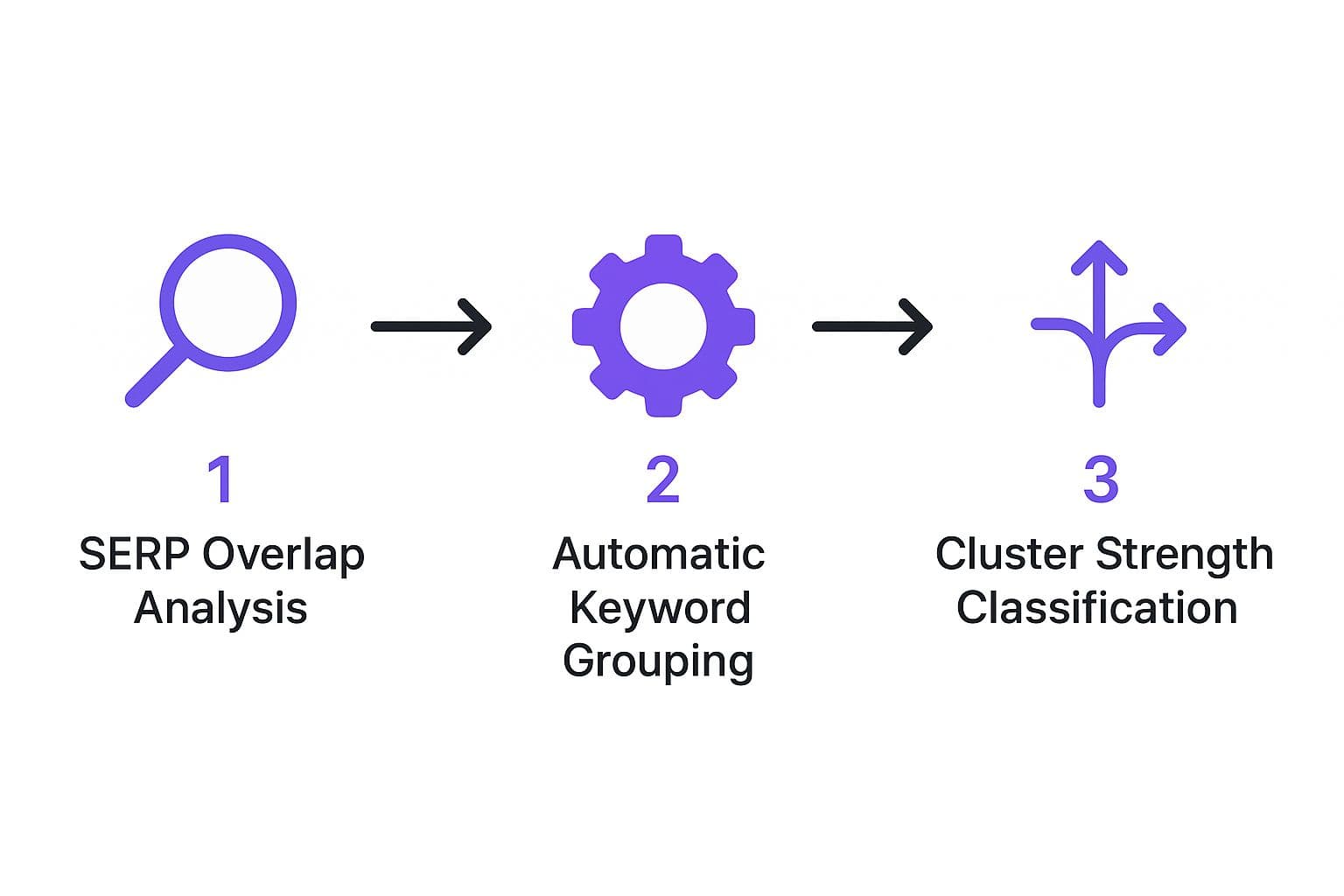
As you can see, it starts by pulling search results, then groups related keywords, and finally helps you understand how strong those relationships are.
Understanding Cluster Strength
Not every cluster is the same. The amount of SERP overlap between keywords determines the "strength" of their connection, which is a critical piece of information for planning your content.
Most clustering tools let you define a clustering level—the minimum number of shared URLs needed to group keywords together.
- Strong Clusters: These happen when you set a high clustering level, like requiring 6-8 overlapping URLs. Keywords in these groups are super-specific and share an almost identical search intent. They’re perfect for a single, focused article. Think "how to brew espresso at home" and "making espresso with a machine."
- Weak Clusters: These form with a lower setting, maybe just 3-4 overlapping URLs. The keywords are related, but they cover a broader topic with more diverse sub-topics. These are great for building out a big, comprehensive pillar page. A weak cluster might bring together terms like "best coffee beans," "coffee grinder settings," and "pour-over coffee technique."
Adjusting the cluster strength gives you direct control over your content strategy. You can decide whether to create a series of niche articles or a single, authoritative guide—all based on what the data shows.
The sophisticated algorithms doing this work often use Natural Language Processing (NLP) to really grasp the subtleties of human language. If you're curious about the tech behind it, you can dive deeper into how to use Python for NLP and semantic SEO. Ultimately, this approach provides a repeatable, data-backed system for content planning that gets you out of the guessing game and into creating content that search engines—and users—love.
Your Step-by-Step Guide to Creating Keyword Clusters
Alright, we’ve covered the "what" and "why" of keyword clustering. Now for the fun part: actually doing it. This is where a jumbled spreadsheet of keywords gets turned into a powerful, organized content strategy.
Don't worry, it's not as complicated as it sounds. I'm going to walk you through the entire process, from gathering your raw keyword data to mapping out your final content plan. Let's get started.
Step 1: Generate a Massive Keyword List
First things first, you need keywords. A lot of them. Think of this step as casting the widest net possible. Your goal is to pull in every potential phrase your audience might use to find what you offer.
Start with your "seed" keywords—the broad terms at the heart of your business, like "cold brew coffee" or "espresso machine." Then, use your favorite tools to expand on them. Find questions, long-tail variations, and what your competitors are ranking for. Be exhaustive. The more data you feed the clustering tool, the smarter and more accurate your final groups will be.
If you need a more detailed game plan for this stage, our guide on how to build a keyword list covers all the best tools and techniques from start to finish.
Step 2: Run Your List Through a Clustering Tool
Once you have your giant list, it's time to let technology do the heavy lifting. Trying to manually compare search results for thousands of keywords would be a nightmare. This is exactly what keyword clustering tools were built for.
You just upload your list, set your target country and language, and let the tool run. Behind the scenes, it’s doing that SERP overlap analysis we talked about earlier.
- It checks the top 10 search results for every single keyword.
- It compares the ranking URLs to see which keywords bring up the same pages.
- It groups keywords together based on a shared number of ranking URLs (this is often called "cluster strength").
What would take you weeks of manual work gets done in minutes. The result? A perfectly organized set of keyword groups, each one tied to a specific user intent.
Step 3: Analyze and Refine Your Clusters
The tool has done its job, and now it’s time for a bit of human expertise. You'll get a list of clusters, and your task is to make sense of them. The main thing you're looking for is the "parent" and "child" keywords in each group.
The parent keyword is the head of the family. It's usually the one with the highest search volume and best represents the cluster's main topic. This becomes the primary target for your page, likely your H1 title.
The child keywords are all the supporting terms—the long-tail queries, synonyms, and related questions. These are your subheadings (H2s, H3s) and the specific points you need to cover in your content.
Think of it this way: you’ve just been handed a ready-made content brief. The parent keyword is your topic, and the child keywords are your outline.
Step 4: Map Clusters to Your Content Calendar
This is the final and most important step. It’s where your research becomes an actual plan. Each cluster you’ve refined represents one single piece of content.
Remember the golden rule: one cluster, one page. This simple principle is your best defense against keyword cannibalization, ensuring every article on your site has a unique job to do.
Go through your finished clusters. The group around "how to froth milk at home" becomes one blog post. The cluster for "best non-dairy milk for lattes" becomes another. Map them out on your content calendar.
Suddenly, you're not guessing what to write about anymore. You have a data-driven roadmap for creating content that perfectly matches what people are searching for, giving every page a clear purpose and a much better shot at ranking.
How to Turn Clusters Into High-Ranking Content

Having a neat list of keyword clusters is a huge step forward, but it's only half the battle. The real work begins when you transform that raw data into a powerhouse piece of content that actually climbs the search rankings.
Think of your keyword cluster as a detailed recipe. It gives you all the essential ingredients. Now, it's time to follow the instructions and combine them into a final dish that satisfies both your audience and search engines.
It all comes down to methodically mapping your cluster to your content's structure. This ensures you cover every angle of the topic, leaving no gaps for competitors and signaling to Google that your page is the most comprehensive resource out there.
Building Your Content Blueprint from a Cluster
Every keyword cluster has a natural hierarchy just waiting to be turned into an article outline. You have a main topic, key subtopics, and a bunch of specific questions that users are asking. Your job is to arrange these pieces into a logical flow.
The cornerstone of this process is spotting the "parent" and "child" keywords within your group. This simple step turns a flat list of terms into a structured content skeleton.
Here’s the basic framework:
- Your Parent Keyword is Your H1 Title: The parent keyword—usually the one with the highest search volume—is the heart of your topic. This becomes the main title of your article (your H1 tag) and the central theme tying everything together.
- Your Main Child Keywords are Your H2 Subheadings: The most significant secondary keywords in the cluster are perfect for your main subheadings (H2 tags). These break down the core topic into the major sections of your article.
- Your Niche Child Keywords are Your H3 Subheadings: More specific, long-tail keywords or questions are ideal for H3 tags. These let you drill down into the finer details within each main section, making your content truly exhaustive.
This isn't just about organizing your thoughts. It’s about directly aligning your content structure with how people actually search. You're building a page that systematically answers the exact sequence of questions people have about a topic.
A Practical Example: Home Coffee Brewing
Let's make this tangible. Imagine you've built a cluster around "home coffee brewing." The tool has grouped dozens of related terms, and now it's time to make sense of them.
Your parent keyword is clearly "how to brew coffee at home." That’s your H1.
Next, you identify the main child keywords that represent the key stages of the process. These become your H2s:
- Choosing the Right Coffee Beans
- The Best Coffee Grinders for Home Use
- Popular Home Brewing Methods
- Step-by-Step Pour-Over Coffee Guide
Within those sections, you find even more specific keywords. Under "Popular Home Brewing Methods," your H3s might be:
- Using a French Press
- Mastering the AeroPress
- Getting Started with Cold Brew
By following this structure, you’re not just writing an article; you're building an authoritative guide. You’ve created a single, powerful resource that addresses the intent behind dozens of related queries. Someone searching for "best coffee grinders" and someone else looking for a "pour-over technique" can both land on the same page and find exactly what they need.
For a deeper look into creating these kinds of foundational articles, exploring some great pillar page examples can provide a ton of inspiration and show you how successful brands put this strategy into practice.
Ultimately, this methodical approach ensures you satisfy user intent completely. You answer their initial question and then proactively address all their follow-up questions. This creates a far better user experience, boosts engagement, and sends strong positive signals to Google, establishing your page as the definitive authority on the subject.
Got Questions About Keyword Clustering? We’ve Got Answers.
Jumping into any new SEO approach is going to bring up some questions. Keyword clustering is powerful, but a few common points of confusion can definitely slow you down if you're not careful.
Let's clear the air and tackle some of the most common questions people have. Think of this as your quick-start FAQ to help you get going with confidence.
How Many Keywords Should I Put in a Cluster?
This is probably the number one question I hear, and the honest answer is: there's no magic number. The right size for a cluster isn’t about hitting a specific keyword count; it’s all about user intent.
A cluster could have just 5-10 keywords for a super-specific topic or hundreds for a really broad one. The only thing that matters is that they all share the same search goal. The strength of the SERP overlap—how many of the same pages rank for all those terms—is a much better guide than the number of keywords.
For instance, a cluster built around "how to fix a leaky faucet handle" will probably be pretty small and focused. On the other hand, a cluster for "home renovation ideas" could be huge, with hundreds of related phrases. Both are perfectly valid because the user intent behind them is consistent.
Can I Do This Without a Paid Tool?
You can, but I wouldn't recommend it. It's a brutally manual and time-consuming process. To do it by hand, you'd have to Google every single keyword on your list, copy the top 10 URLs into a spreadsheet, and then meticulously compare everything to find the overlaps.
This might sound manageable if you’re only looking at 20 or 30 keywords, but it becomes an absolute nightmare at any real scale.
For anyone serious about using keyword clustering effectively, a paid tool isn't a luxury—it's essential. It gives you the speed and accuracy you need to actually make this strategy work.
Topic Clusters vs. Keyword Clusters—What’s the Difference?
These terms get thrown around a lot, sometimes interchangeably, but they represent two different stages of the same strategy. Think of it like a blueprint versus the actual building.
- A keyword cluster is your raw material. It's the data-driven group of keywords you get after analyzing the SERPs. It’s a list of terms that all point to a single user intent.
- A topic cluster is what you build with that data. It's the content architecture made up of a main "pillar page" (targeting a broad keyword cluster) and several supporting "cluster pages" (targeting more specific, related clusters), all linking together.
Simply put, keyword clustering is the research process you use to identify the right groups of terms. The topic cluster is the content plan you execute based on that research.
How Often Should I Refresh My Keyword Clusters?
SEO is never a "set it and forget it" game. Search intent changes, new subtopics pop up, and Google's algorithm is always getting smarter. Because of this, your clusters need a little maintenance from time to time.
A good rule of thumb is to revisit your main topic areas once a year or whenever you see major ranking shifts. Re-running your core keywords through a clustering tool can give you some incredible new insights.
You might find:
- New Content Gaps: Fresh questions or subtopics that people are searching for now that they weren't a year ago.
- Opportunities to Merge Content: You might realize that two of your articles are now competing for what Google sees as a single intent. Combining them is often the best move.
- Signals to Split Content: A broad article might cover a topic that has since grown, justifying splitting it into several more detailed pieces.
Regularly checking in on your clusters makes sure your content strategy is aligned with what searchers want today, not what they wanted last year.
Ready to stop guessing and start building a data-driven content strategy? Outrank uses AI to automate keyword clustering, generate SEO-optimized articles, and help you build topical authority faster. Start creating high-ranking content today.