

The best blog examples for students are written by students. Current undergraduates published nine posts on MIT Admissions Blogs between October 11 and 18, 2026, and Princeton's Undergraduate Student Blog and Tufts' Jumbo Talk are also written mostly by current students, under their own names. For proof that a student blog can grow into something big, look at Cal Newport's Study Hacks (launched in 2007, two years before he finished his PhD at MIT) and College Info Geek (started in 2010 by Thomas Frank while he was still at university).
Below you get 30 live blogs in a sortable table (every link checked on October 19, 2026), 14 individual blog post examples broken down by type, a sample blog post you can copy, six templates and 111 title ideas.
Key takeaways
- Study blogs written by people like you. MIT, Princeton and Tufts all publish posts by current students, and MIT students alone posted nine in one week of October 2026.
- Pick the post's job before the topic. Almost every good student post reflects, helps, documents, explains, argues or proves something.
- Narrow wins. Princeton's "48 Hours in Princeton, NJ" covers one weekend, hour by hour, instead of "my college experience".
- Most strong student posts run 500 to 1,200 words. Wix's writing guide calls 800 to 1,200 words the sweet spot and 300 to 600 words fine for short posts.
- You can start free. WordPress.com, Blogger, Medium and Outrank Blogs all have no-cost plans, and Outrank Blogs stays free up to 10,000 visits a month.
What is a blog? Examples of blogs vs examples of blog posts
A blog is a website, or a section of one, that publishes dated articles called posts, usually in a conversational first-person voice and listed newest first. A blog post is one of those articles.
So "MIT Admissions Blogs" or "Smitten Kitchen" are examples of blogs, while "48 Hours in Princeton, NJ" or James Clear's "Habit Stacking" are examples of blog posts. People searching "blog examples" usually want the first kind (sites to model). People searching "blog post examples" want the second (single articles to copy the shape of). This guide covers both.
The difference from school writing is tone. UNC's Writing Center describes blogs as a conversational genre, less formal than journal articles or academic papers, and its topic test is the best one we know: write about something you know, something you care about, and something someone else will want to read.
30 real blog examples, checked live in October 2026
Every blog below loaded on October 19, 2026. The first 11 are written by students or started as student projects. The other 19 are professional blogs worth studying for structure, voice and formatting. Sort by type or niche, or type in the filter box.
30 blog examples for students (all live October 19, 2026)
| Why it works | |||
|---|---|---|---|
| MIT Admissions Blogs | Student | College life | Current MIT students post several times a week in their own voice, from exam stress to frosh scavenger hunts. |
| Princeton Undergraduate Student Blog | Student | College life | Bylined students with class year and major. Topics range from weekend guides to thesis research. |
| Tufts Jumbo Talk | Student | College life | Current students write next to an admissions-staff section, so you can compare student voice with institutional voice. |
| Duke MQM Student Blog | Student | Graduate school | Master's students turn one hard adjustment (like arriving as an international student) into practical advice. |
| University of London Student Blog | Student | Distance learning | Students studying around the world, many remotely, write about their study experience for other students. |
| Bournemouth University Student & Graduate Stories | Student | College life | Its 'day in the life' tag holds 12 posts, each about one course, one campus or one routine. |
| Northwestern IPR SURA Student Blog | Student | Research | Three undergraduates reflect on a summer of policy research: the work, the skills and how it changed them. |
| Study Hacks by Cal Newport | Student-founded | Productivity | Launched in 2007 as a study-skills blog while Newport was a grad student. Still publishing essays today. |
| College Info Geek | Student-founded | Study tips | Thomas Frank started it in 2010 while working as an orientation assistant at his university. |
| Her Campus | Student-founded | Student media | Founded by and for college women, with student contributors on hundreds of campuses. |
| Austin Kleon | Professional | Creativity | Short, frequent posts on creativity, often built around a drawing, a quote or a book. Proof that a post can be brief and still worth reading. |
| Wait But Why | Professional | Explainers | Very long explainers made readable with stick-figure drawings, charts and a joke every few paragraphs. |
| Paul Graham Essays | Professional | Essays | Plain text, no images, no pop-ups. Clear thinking carries every post. |
| Seth's Blog | Professional | Marketing | Very short posts, published every day. The best model for building a writing habit. |
| James Clear | Professional | Habits | How-to articles that pair one named idea (habit stacking) with research and copyable examples. |
| Farnam Street | Professional | Thinking | Reference posts that explain ideas such as mental models with clear definitions and examples. |
| The Marginalian | Professional | Books and ideas | Reading notes turned into essays, heavy on quotes from the books discussed. A model for book-review blogs. |
| Zen Habits | Professional | Self-improvement | Simple language and short paragraphs about one habit at a time. |
| Mr. Money Mustache | Professional | Personal finance | A strong, funny personal voice plus real numbers. Shows that opinion and math mix well. |
| Nomadic Matt | Professional | Travel | Practical budget-travel guides organized by destination, the shape most travel blogs copy. |
| Smitten Kitchen | Professional | Food | Personal stories from a small New York kitchen, then a recipe that works. |
| Pinch of Yum | Professional | Food | Recipe posts with a Jump to Recipe button, process photos, an FAQ and a recipe card. |
| Minimalist Baker | Professional | Food | A tight promise in the format itself: simple recipes with few ingredients or little time. |
| Cup of Jo | Professional | Lifestyle | Warm, conversational posts and recurring series that readers come back for. |
| Young House Love | Professional | Home and DIY | Step-by-step DIY projects with before-and-after photos. |
| Kottke.org | Professional | Culture | A link blog: short posts that point to something interesting with a line or two of comment. |
| Daring Fireball | Professional | Tech | Opinionated commentary on Apple and tech, mostly short link posts with sharp takes. |
| Stratechery | Professional | Business | Deep analysis of tech business strategy, built around a few recurring frameworks. |
| Ahrefs Blog | Professional | SEO | Original data studies where the headline is the finding. |
| Backlinko | Professional | SEO | Long guides with screenshots, short sentences and lots of subheadings. |
Click a column header to sort.
Student blogs run by universities
MIT Admissions Blogs. The gold standard for student blogging. Bloggers are current students listed with their class year, and the voice is theirs: titles like "i miss home and what MIT feels like as exam season picks up" sit next to a liveblog of the frosh scavenger hunt. Steal this: write the post you'd want to read the night before your first exam.
Princeton's Undergraduate Student Blog. Each post carries the writer's name, class and major. Two posts worth reading in full: 48 Hours in Princeton, NJ, a Friday-to-Sunday guide that borrows the New York Times' "36 Hours" format, and From Pokémon Passion to Thesis, where an economics student explains how his childhood card collection became a senior thesis about the trading card market. Steal this: borrow a format readers already know, or connect a hobby to your coursework.
Tufts Jumbo Talk. Current students post in Jumbo Talk while the admissions team writes Inside Admissions on the same page. Reading both side by side is the fastest way to hear the difference between a personal blog voice and an institutional one.
Duke MQM Student Blog. Written by students in Duke's Master of Quantitative Management program. Surviving and Thriving: Tips for International Students at Fuqua turns a real adjustment into advice for the next cohort. Steal this: your hardest month is someone else's most useful post.
Bournemouth University Student & Graduate Stories. Its day-in-the-life posts, such as A day in my life on Talbot Campus, work because the scope is one day and one place. Steal this: narrow the scope until the post almost writes itself.
Northwestern's SURA 2025 Student Blog. Three undergraduates each describe a summer research project, the skills they built and why the research matters for policy. Steal this: explain the project and how you changed inside it.
Blogs that started as student projects
Study Hacks. Cal Newport launched it in 2007 to write about study skills (his MIT PhD came in 2009). Newport went on to write Deep Work and still publishes essays there. A blog about being a student was enough to start.
College Info Geek. Thomas Frank started it in summer 2010 while working as an orientation assistant at his school, and graduated from Iowa State in 2013. Posts like The Ultimate Guide To Building A Personal Website show how far a student how-to blog can go.
Her Campus. A publication founded by and for college women, with student contributors at hundreds of campuses. If you want editors, deadlines and a byline without running your own site, writing for a campus publication like this is a strong start.
Professional blogs worth copying from
The professional blogs in the table teach one skill each. Wait But Why shows how drawings make a hard topic readable. Seth's Blog proves a 150-word post can land. Paul Graham proves you need no design at all if the thinking is clear. Pinch of Yum and Smitten Kitchen show the anatomy of a recipe post, Nomadic Matt the anatomy of a travel guide (see our breakdown of travel blog examples), and Ahrefs and Backlinko the anatomy of a data study.
14 blog post examples by type
A blog is the container. These are single posts, grouped by the job they do, with what to copy from each. Word counts are approximate body text, measured on October 19, 2026.
| Type | Blog post example | Length | What to copy |
|---|---|---|---|
| Weekend guide | 48 Hours in Princeton, NJ (Princeton student blog) | ~1,000 words + photos | Day-by-day sections with timestamps ("Friday, 5 pm") and named places |
| Personal reflection | i miss home (MIT Admissions) | ~1,000 words | Opens with one plain sentence: "I took my first exam last week." |
| Hobby-to-academics | From Pokémon Passion to Thesis (Princeton) | ~550 words | One research question explained through a hobby readers recognize |
| Opinion | A Case for Majoring in Philosophy at Princeton (Princeton) | ~1,000 words | The argument is in the title; the body is the writer's own change of mind |
| Tips list | My Top Study Tips! (Anderson University) | ~700 words | Three numbered tips plus a bonus, each from the writer's own finals week |
| Advice post | Surviving and Thriving: Tips for International Students at Fuqua (Duke MQM) | ~900 words | Six numbered tips, each a lesson from the writer's own first months |
| Research reflection | SURA 2025 Student Blog (Northwestern) | ~1,200 words, three writers | Each student covers the work, the skills, and why it matters |
| How-to | Habit Stacking (James Clear) | ~2,100 words | One named method, a fill-in formula, then a long list of examples |
| Long explainer | The AI Revolution, Part 1 (Wait But Why) | ~8,000 words | Hand-drawn charts carry the hardest ideas |
| Essay | How to Do Great Work (Paul Graham) | 10,000+ words | No images, no subheads, just clear sentences |
| Numbers argument | The Shockingly Simple Math Behind Early Retirement (Mr. Money Mustache) | ~1,200 words | One table (savings rate vs. years of work) does the persuading |
| Original research | 96.55% of Content Gets No Traffic From Google (Ahrefs) | Long | The headline is the finding |
| Recipe | The Best Soft Chocolate Chip Cookies (Pinch of Yum) | Long | Jump to Recipe button, process photos, FAQ, recipe card |
| Reference guide | Mental Models (Farnam Street) | Very long | Around 100 ideas, each with a one-line definition |
Notice what the student posts have in common: one writer, one specific situation and a clear reason for a stranger to read it. None of them tries to cover "college" in general.
A sample blog post you can copy
Here is a short sample blog post written for this guide, followed by why each part is there. Swap in your own experience; the structure does the rest.
How I Study for Exams Without Pulling All-Nighters
Last spring I walked into my chemistry midterm after four hours of sleep and blanked on a question I had practiced twice. That was the last all-nighter I pulled.
If you're a first-year who studies in one panicked block the night before, this is the system that replaced mine. It takes about 30 minutes a day and starts a week before the exam.
Seven days out: make the list. I write every topic on the syllabus on one page and mark each one green, yellow or red.
Days six to two: red topics first. Two 25-minute sessions a day, phone in another room, then a 5-minute break.
The night before: practice, then stop. One timed practice test, check answers, bed by midnight.
The first time I tried it I still felt nervous, but I recognized every question. Pick your next exam, count back seven days, and make the list tonight.
Why it works:
- Title: a specific promise in the words a student would search.
- Hook: one concrete moment (blanking on a practiced question), not a general statement about stress.
- Reader and promise: says who it's for and what it costs (30 minutes a day).
- Sections: each step gets a bold label a skimmer can follow.
- Proof: the writer's own result, stated modestly.
- Ending: one next step the reader can take today.
That is the whole anatomy. For a deeper template library, see our guide to blog post format, and plan the sections first with a blog post outline.
The 6 jobs a student blog post can do
Before you pick a topic, pick a job. University guidance says the same thing in different words: the University of Mary Washington sorts student blogs into process and reflection blogs, scholarly commentary and popular communication. In practice, almost every student post does one of six jobs.
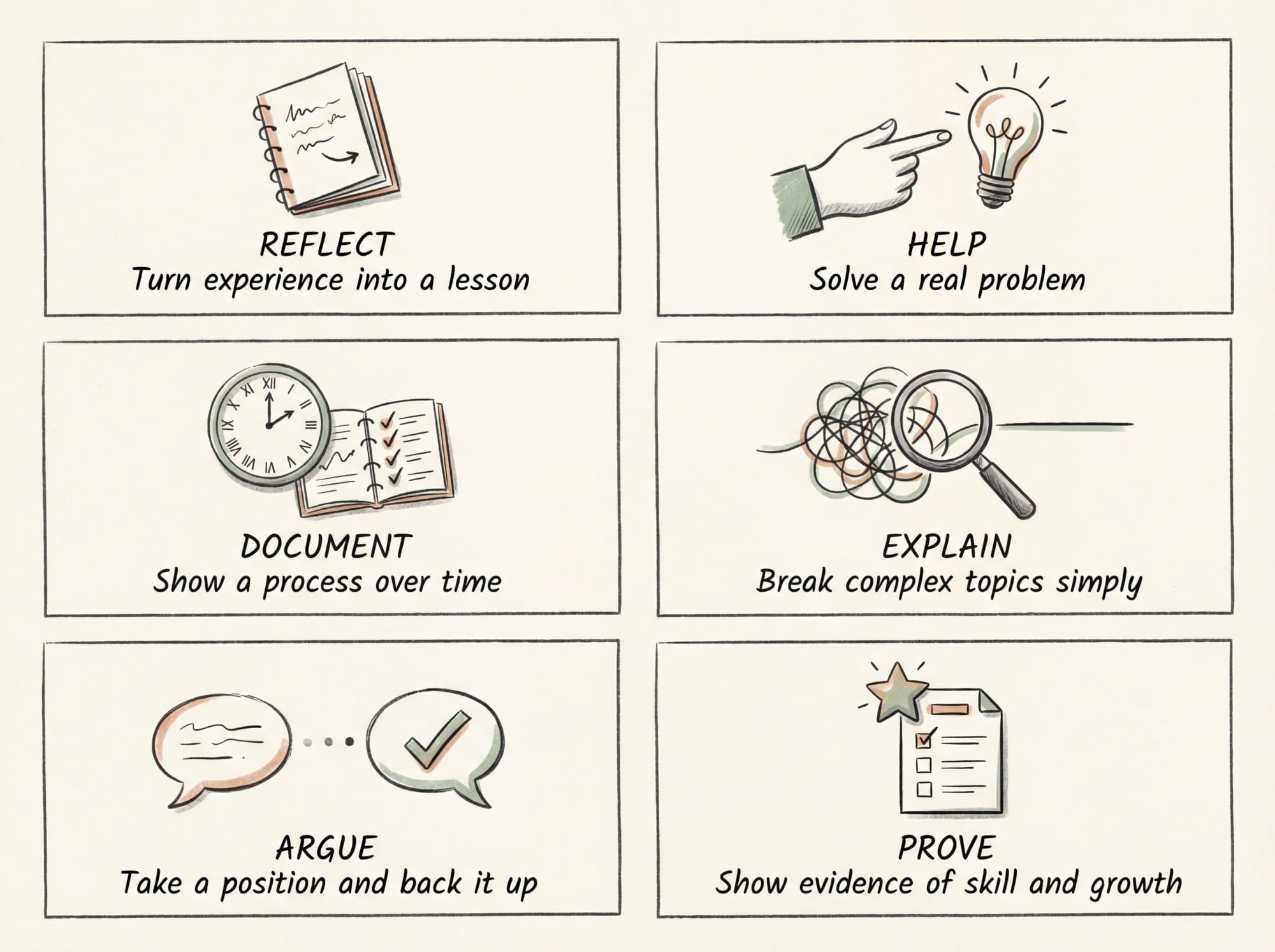
| Job | What it does | Good for | Real example |
|---|---|---|---|
| Reflect | Turns an experience into a lesson | First semester, failure, burnout, growth | MIT's "i miss home" |
| Help | Solves one problem for another student | Study tips, budgeting, routines | Anderson's "My Top Study Tips!" |
| Document | Records a process over time | Day in the life, study abroad, project logs | Bournemouth's "A day in my life on Talbot Campus" |
| Explain | Makes a complex topic plain | Class concepts, research, your major | Princeton's Pokémon thesis post |
| Argue | Takes a position and defends it | Campus debates, your field, education | Princeton's case for philosophy |
| Prove | Shows skill and growth | Portfolio pieces, internships, projects | Northwestern's SURA reflections |
Help posts are the ones most likely to get found on Google, because other students search for the exact problem they solve. "How I study for exams without pulling all-nighters" beats "study tips" every time. The rest of this guide gives you a template for each job.
6 copy-and-paste blog templates for students
Each template matches one job. Fill the brackets, keep the order, and you'll have a first draft in one sitting.
Template 1: Personal story (Reflect)
Title formula: What [Experience] Taught Me About [Bigger Lesson]
Structure: one concrete moment → what you expected → what happened → what changed in your thinking → the lesson for the reader.
Starter line: "The moment I realized [X] was [specific time and place]. I had expected [Y]. Instead, [Z]."
Template 2: How-to guide (Help)
Title formula: How to [Specific Goal] as a [Type of Student]
Structure: the problem → who this is for → the steps in order → common mistakes → a short checklist.
Starter line: "If you're a [year/major] trying to [goal], this is the method that finally worked for me, step by step."
Template 3: Day in the life (Document)
Title formula: A Day in the Life of a [Major / Role / Year] Student
Structure: set expectations → morning → classes, work or lab → the hard part of the day → evening → what surprised you → three takeaways for someone considering the same path.
Starter line: "My alarm goes off at [time]. Here is what a [weekday] actually looks like as a [major] at [school]."
Template 4: Research explainer (Explain)
Title formula: What [Concept / Study / Debate] Actually Means, in Plain English
Structure: the confusing term → a simple definition → one concrete example → why it matters → one common misunderstanding → the takeaway.
Starter line: "[Concept] sounds complicated, but it comes down to one idea: [one-sentence definition]."
Template 5: Opinion (Argue)
Title formula: Why [Policy / Trend / Habit] Needs to Change
Structure: your claim → context → reason one → reason two → the strongest counterargument, answered → a better way forward.
Starter line: "I used to think [common view]. After [experience or evidence], I think [your claim]."
Template 6: Portfolio case study (Prove)
Title formula: How I Built [Project], and What I'd Do Differently
Structure: the project and goal → constraints → your process → the result → what worked → what you'd improve → skills used.
Starter line: "In [month], I had [time] to build [project] for [class/client]. Here's how it went."
111 student blog post ideas and title examples
Use these as written or swap in your major, city, campus or year. For more angles beyond student life, browse our list of blog post ideas.
Personal stories and self-discovery
- What I Wish I Knew Before My First Week of College
- 7 Things Nobody Told Me About Changing Majors
- How I Went From Feeling Lost to Finding My Rhythm This Semester
- The First Time I Failed an Exam, and What It Taught Me
- Why I Stopped Trying to Be Productive All the Time
- What Being a First-Generation Student Really Feels Like
- How I Learned to Ask for Help Without Feeling Weak
- The Semester I Took on Too Much, and What I Learned
- What My Part-Time Job Taught Me About School
- The Best Decision I Made This Year as a Student
- How My Definition of Success Changed in College
- A Letter to My Past Self Before Finals Season
Study skills and academics
- How I Study for Exams Without Pulling All-Nighters
- The Note-Taking Method That Finally Worked for Me
- How to Read Academic Papers Without Getting Lost
- My 5-Step System for Writing Essays Faster
- The Best Way to Break a Huge Assignment Into Smaller Tasks
- How I Use the Pomodoro Method During Exam Week
- How to Catch Up When You're Already Behind in Class
- 10 Study Mistakes Most Students Make
- How to Build a Weekly Study Plan You'll Actually Follow
- The AI Tools I Use to Organize Coursework, and Where I Draw the Line
- How to Prepare for Oral Presentations Without Panicking
- What to Do the Night Before an Important Exam
Campus life and belonging
- A Day in the Life of a First-Year Student
- 48 Hours on Campus: My Favorite Cheap and Fun Things to Do
- How I Made Friends Without Forcing It
- What Orientation Week Was Actually Like
- The Clubs That Surprisingly Helped Me Grow
- How I Built a Routine in a New City
- What Living With Roommates Taught Me About Boundaries
- The Hardest Part of Moving Away From Home
- My Honest Experience With Campus Events, Clubs and FOMO
- How I Created a Sense of Belonging in My First Semester
- The Quiet Places on Campus Where I Actually Get Work Done
- What I Learned From Saying Yes to More Campus Opportunities
High school, applications and transition
- How I Chose Between Two Colleges
- What I Wish I Knew in High School Before Applying to College
- How to Build a Student Resume With No Fancy Experience
- The Extracurricular Activities That Helped Me Grow the Most
- How I Wrote My Personal Statement Without Sounding Fake
- What Senior Year Taught Me About Pressure
- How to Pick a Major When You Like Too Many Things
- My College Decision Process: What Actually Mattered
- Things I Regret Worrying About During Admissions Season
- A Realistic Guide to Your Last Month Before Starting College
Major-specific and academic explainers
- What a Psychology Major Actually Studies
- A Beginner's Guide to Writing a Lab Report
- What I Learned in My First Coding Class
- The Most Useful Concept I Learned in Economics This Year
- How to Survive Your First University Math Course
- A Plain-English Guide to [Complex Concept From Your Major]
- The Difference Between High School Writing and College Writing
- What a Literature Seminar Is Really Like
- 5 Skills I Didn't Expect to Learn in [Your Major]
- The Best Classes I've Taken in [Your Department] and Why
- What Research Methods Actually Look Like in [Your Field]
- How to Explain Your Major to Someone Outside Your Field
Research and ideas
- What My Research Project Is Really About, in Plain English
- The Most Interesting Paper I Read This Semester
- A Student's Guide to Understanding [Current Issue] Through [Your Subject]
- What This Semester's Big Debate in [Your Field] Is Really About
- 3 Research Findings That Changed How I Think About [Topic]
- Why More Students Should Learn About [Topic]
- What Popular Media and AI Summaries Get Wrong About [Academic Topic]
- My Biggest Surprise From Working in a Lab or Research Group
- How to Turn a Class Project Into a Public-Facing Blog Post
- What I Learned From Explaining My Research to Non-Experts
Career, internships and portfolio
- How I Landed My First Internship
- What I Put in My Portfolio as a Student
- How I Wrote a Better LinkedIn Profile Without Sounding Cringe
- 5 Networking Lessons I Learned the Hard Way
- How I Used Class Projects to Build Professional Proof
- What Recruiters Probably Care About More Than Students Think
- How to Ask for an Informational Interview
- My First Interview Mistakes, and What I'd Do Differently
- The Projects That Helped Me Stand Out for Internships
- How to Turn a Class Assignment Into Portfolio Content
- What I Learned From Freelancing as a Student
- The Personal Website Sections Every Student Needs
Money, productivity and life admin
- How I Budget on a Student Income
- The Cheapest Meals I Actually Enjoy Making
- How I Stopped Wasting Money on Small Weekly Expenses
- The Productivity Advice That Worked, and What Totally Failed
- How I Organize My Week When Everything Feels Urgent
- The AI Tools I Use for Student Life, and the Ones I Skip
- How to Balance Classes, Work and Rest Without Burning Out
- How I Cleaned Up My Digital Footprint Before Internship Season
- How I Plan a Busy Week Without Overbooking Myself
- The Small Habits That Save Me Time Every Day
Wellness, mental health and balance
- How I Protect My Energy During Stressful Weeks
- What Burnout Felt Like Before I Admitted It
- 5 Tiny Habits That Improved My Mood This Semester
- How I Built a Sleep Routine in College
- My Honest Experience With Homesickness
- What Helped Me Cope With Academic Anxiety
- How I Reset After a Bad Week
- Why Rest Made Me a Better Student, Not a Lazy One
- The Wellness Advice Students Hear All the Time, and What Actually Helps
- How I Stay Active During the Busiest Parts of the Semester
Creative, hobby and culture
- The Books That Changed How I Think This Year
- What My Favorite Film Taught Me About [Topic]
- My Beginner's Guide to Starting [Photography / Drawing / Music / Coding] as a Student
- The Creative Project I Started Just for Fun
- How I Keep a Hobby Alive During Busy Semesters
- My Favorite Student-Friendly Cafes, Study Spots or Hidden Corners
- What Traveling or Studying Abroad Changed About Me
- A Playlist for [Mood], and the Story Behind It
- The Campus Trend Everyone Talks About, Explained
- My Favorite Student Discounts, Resources or Local Finds
- The Internet Rabbit Hole That Led Me to a New Academic Interest
How to format a student blog post
Cambridge's guide to writing a blog post recommends a title that signals the subject, a short introduction, concise paragraphs for each point, and an ending that invites readers to respond, all in a friendly, conversational tone. In practice that becomes six parts:
| Part | What it does | Example |
|---|---|---|
| 1. Title | Makes the topic and promise obvious | "How I Study for Exams Without Pulling All-Nighters" |
| 2. Hook | Opens with a moment, a problem or a surprise | Blanking on a question you practiced twice |
| 3. Context | Says who it's for and why it matters | "If you cram the night before, this is for you" |
| 4. Main sections | 3 to 5 subheadings, one idea each | One step or lesson per section |
| 5. Specific proof | Examples, photos, routines, mini stories | What happened when you tried it |
| 6. Ending | One takeaway or next step | "Pick your next exam and make the list tonight" |
Keep paragraphs to two or three sentences and use subheadings a skimmer can follow. UNC's handout makes the same point: readers skim, and big blocks of text put them off.
How long should a student blog post be?
Long enough to keep the title's promise, and no longer. Wix's guide to writing a blog post gives three working ranges, and the real student posts above land right inside them:
| Post type | Typical length | Real example |
|---|---|---|
| Short and punchy (update, quick reflection, one tip) | 300 to 600 words | Princeton's Pokémon thesis post, ~550 words |
| The sweet spot (how-to, advice, opinion) | 800 to 1,200 words | Duke MQM's international student tips ( |
| In-depth (research explainer, portfolio case study, big guide) | 2,000+ words | James Clear's "Habit Stacking", ~2,100 words |
For context, the average blog post across the industry is 1,312 words, according to Orbit Media's 2026 survey of 1,042 bloggers. For a first post, aim for 600 to 1,000 words you can actually finish. If you later write for search traffic, our explainer on what long-form content is covers when extra length helps.
Where to start a student blog for free
The platform matters less than publishing. These options cost nothing to start (checked October 2026):
| Platform | Free plan | Your address | Best for |
|---|---|---|---|
| WordPress.com | Yes, with WordPress.com ads and 1 GB storage | yourname.wordpress.com | Students who may grow into a full site later (paid plans from $4/month billed yearly) |
| Blogger | Yes | yourname.blogspot.com | The simplest setup with a Google account |
| Medium | Yes | medium.com/@yourname | Writing without design work, with a built-in reader base |
| Substack | Yes (keeps 10% if you charge for subscriptions) | yourname.substack.com | Blogs that double as an email newsletter |
| Outrank Blogs | Yes, up to 10,000 visits a month, no credit card | yourname.outrankblog.com or your own domain | A clean, SEO-ready blog with five designs |
| Google Sites | Yes | sites.google.com/view/yourname | Simple portfolio pages for class projects |
Not sure between two of these? Our guides on how to start a blog for free and Substack vs WordPress walk through the trade-offs. Want more choice? Our list of 13 free blog sites shows which ones keep ads off your posts.
Before you publish: quality and privacy checklist
A student blog is public writing with your name, or at least your school, attached. Tick through this list before each post goes live. Your progress is saved in your browser.
Interactive checklist
Student blog post checklist
0/14
The post itself
0/8Privacy and safety
0/6Your progress is saved in this browser, so you can come back to it later.
Common mistakes that make student blogs forgettable
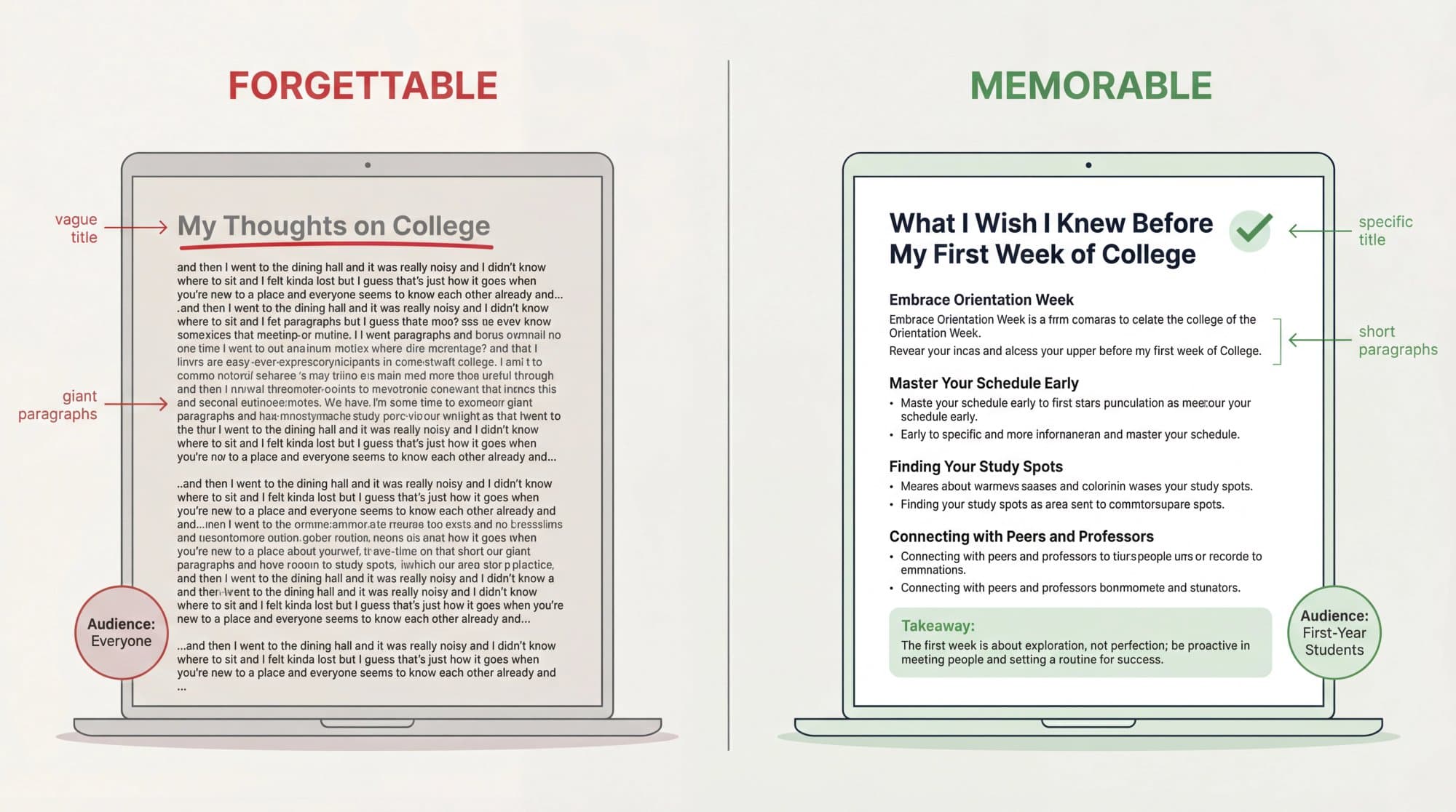
- Writing for everyone. A post for "all students" helps nobody. Write for a first-year commuter, an international master's student, a pre-med sophomore.
- A vague title. "My Thoughts on College" gives no reason to click. "What I Wish I Knew Before My First Week of College" does. The same rules apply to writing meta titles.
- Sounding like an essay for a teacher. Contractions, first person and short sentences are allowed. You're writing to be read, not graded.
- Starting too wide. Three paragraphs of background lose readers. Open with one scene.
- Advice you haven't tested. "I read that Pomodoro works" is weak. "I used 25-minute Pomodoro sessions all finals week" is a post.
- Publishing unedited AI text. AI is fine for brainstorming and outlines, but readers come for your specific experience, which a model doesn't have.
- No ending. Close with a takeaway, a question or a next step.
How to get your student blog found on Google
Most student blogs get read by friends and family. To reach strangers, title posts with the exact problem people type into Google, and favor specific long phrases over broad ones. "Study tips" is hopeless for a new blog; "how to study for organic chemistry exams" is winnable. Our guide to long-tail keyword research explains why.
Free tools that help:
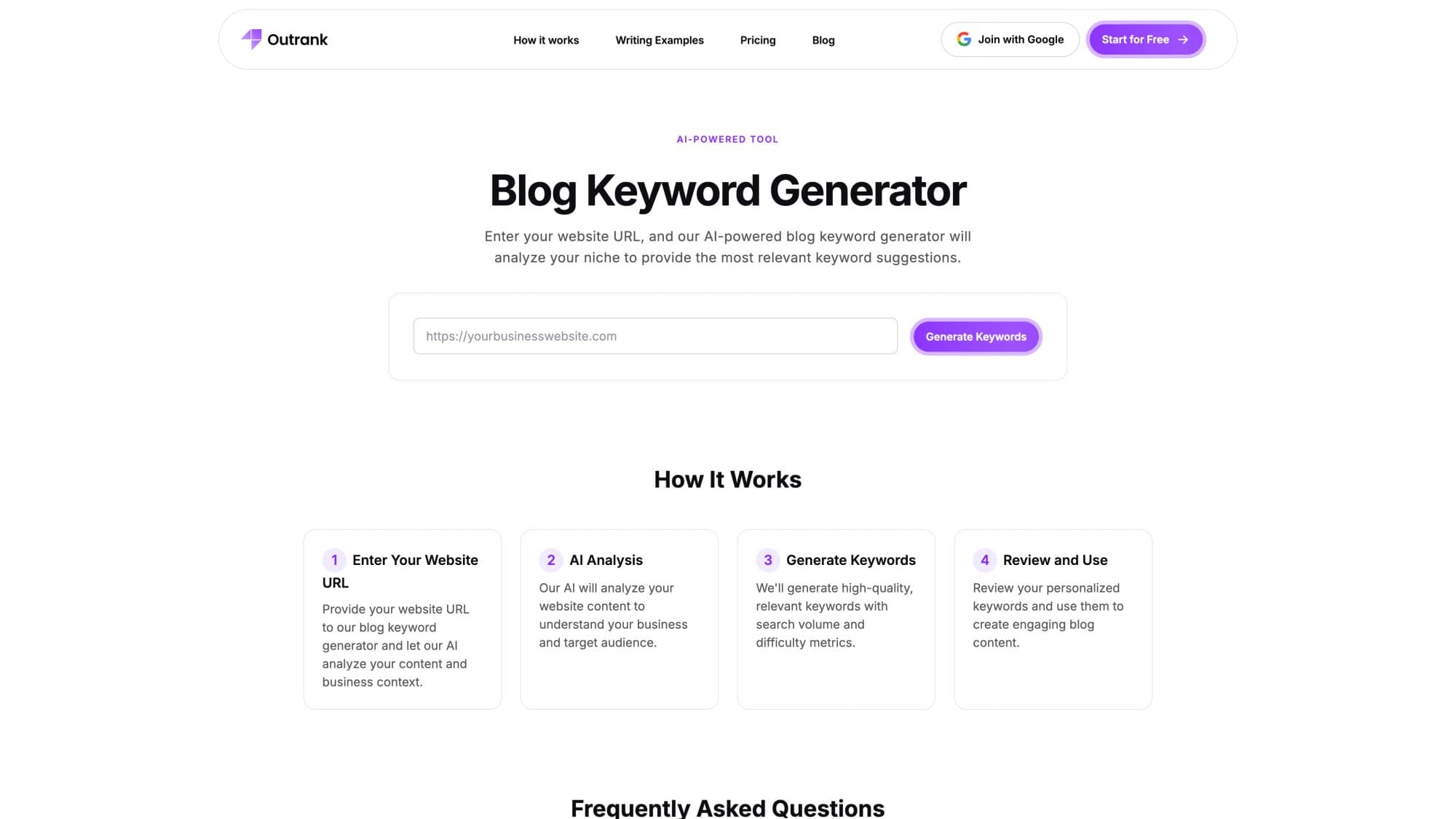
- Outrank's Blog Keyword Generator: enter your blog's URL and it suggests keywords with search volume and difficulty. It's free.
- Google Trends: shows whether interest in a topic is rising or falling.
- Google's autocomplete and "People also ask" box: the free way to see how people phrase a question.
Once you have a few posts, optimizing each blog post for SEO (title, headings, internal links, image alt text) is the next step.
FAQ
What is an example of a blog?
MIT Admissions Blogs, Seth's Blog and Smitten Kitchen are all examples of blogs: websites that publish dated, conversational posts with the newest first. MIT's is written by current students, Seth Godin's is a daily marketing blog, and Smitten Kitchen is a food blog built on personal stories and tested recipes.
What are good blog examples for students?
Start with blogs written by current students: MIT Admissions Blogs, Princeton's Undergraduate Student Blog, Tufts' Jumbo Talk and the Duke MQM Student Blog. Then study blogs that began as student projects, such as Cal Newport's Study Hacks and College Info Geek. All of them were live on October 19, 2026.
What does a good blog post look like?
A good blog post has a specific title, opens with a concrete moment or problem, uses three to five subheaded sections with short paragraphs, includes proof from real experience, and ends with one takeaway. Princeton's "48 Hours in Princeton, NJ" and MIT's "i miss home" are strong student examples, and the sample post earlier on this page shows the same structure in about 200 words.
What should a student blog be about?
Write about something you know, something you care about, and something another person would want to read, which is UNC Writing Center's test for blog topics. In practice that means your course, your campus, a skill you're building or a problem you just solved. Pick the post's job (reflect, help, document, explain, argue or prove) before the topic.
How long should a student blog post be?
Most student posts work best at 500 to 1,200 words. Wix's writing guide puts short posts at 300 to 600 words and the sweet spot at 800 to 1,200, with in-depth posts at 2,000 words or more. The real student posts in this guide, from Princeton, MIT, Duke and Anderson, run from about 550 to 1,000 words.
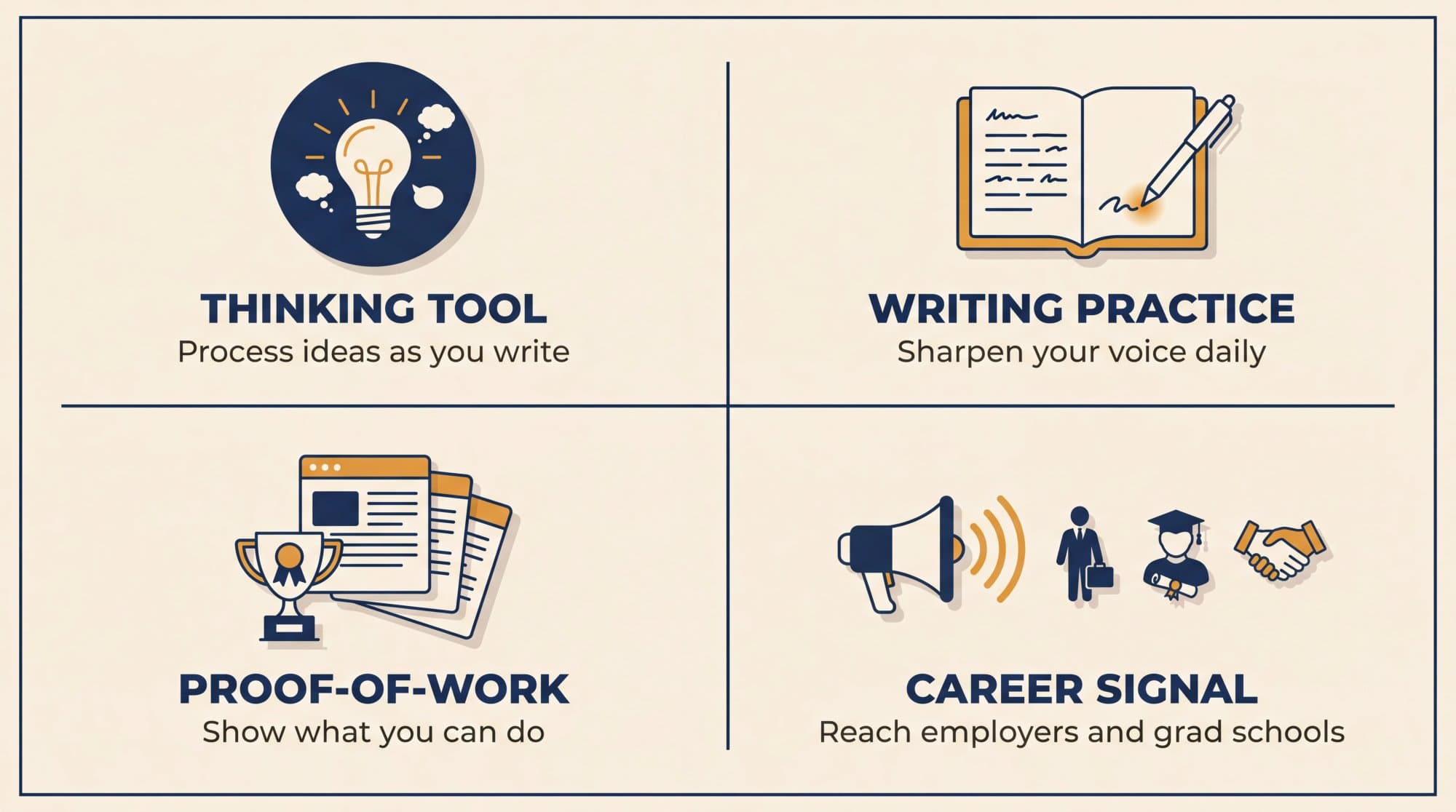
Can a blog help with college applications or internships?
Yes, when it shows work. A blog full of project write-ups, research explainers and clear writing gives an admissions reader or recruiter evidence instead of claims. The University of Arkansas, for example, recognizes student ePortfolios that demonstrate career readiness.
Should I use my real name on a student blog?
Use your real name for a career-facing blog so employers and schools can find it. Use a pen name for personal or experimental writing. The University of Mary Washington's blogging guidance notes that a pseudonym may suit students who don't want their name publicly associated with their writing.
What is the best free platform for a student blog?
WordPress.com and Blogger are the classic free options, Medium is the fastest way to publish with no setup, and Substack suits a blog that is also a newsletter. Outrank Blogs is free up to 10,000 visits a month and works on your own domain. Pick one and publish; you can move later.