

The blogs that consistently get traffic aren't the ones with the best writing: they're the ones publishing the right content, targeting the right keywords, and doing both consistently enough that Google trusts them. Social and email help at launch, but organic search is the only channel that compounds without additional spend every month.
Here's the system.
Why Most Blogs Get Almost No Traffic
Most blogs fail to get meaningful traffic because they're publishing without a plan.
They write about what interests them, not what their audience is searching for. They publish irregularly. They don't link between posts. And when traffic doesn't appear after a few months, they stop.
Google rewards consistent topical coverage from sites that demonstrate expertise across a subject area. A blog with 5 posts won't rank for competitive keywords. A blog with 50 well-structured posts on a focused topic has a real chance. The gap isn't quality; it's volume, consistency, and structure.
The Channels That Actually Drive Blog Traffic
| Channel | Scalability | Compounds? | Cost |
|---|---|---|---|
| Organic search (SEO) | High | Yes | Time + content |
| Email newsletter | Medium | Partially | List-building investment |
| Social media | Medium | No | Time + ongoing spend |
| Paid traffic | High | No | Ongoing ad budget |
| Communities / forums | Low | No | Relationship time |
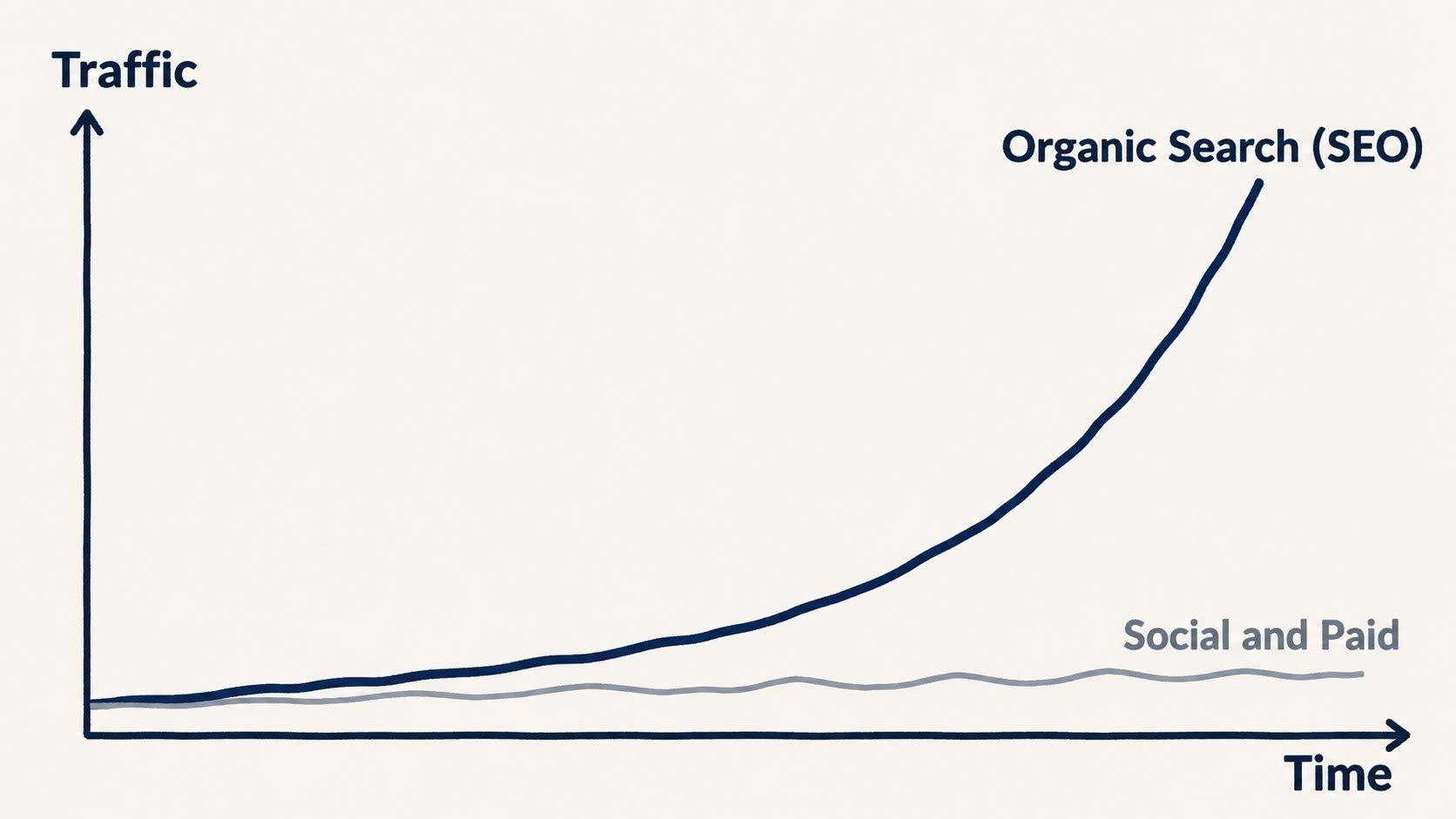
Organic search is the only channel that compounds. A post ranking for a keyword keeps generating traffic 12, 24, 36 months later without additional spend. The most cost-efficient content programs are built SEO-first, with other channels amplifying what's already working.
The SEO-First System for Sustainable Blog Traffic
1. Start With Keyword Research, Not Topics
Every post you publish should target a specific keyword with real search volume. Not a vague topic: an exact phrase your audience is typing into Google.
Basic viability criteria:
Search volume: 100+ monthly searches minimum (lower is fine for high-intent, niche terms)
Keyword difficulty: within reach of your domain authority; new sites should target KD below 20 to start
Intent match: does the content you can write match what Google is surfacing for this query?
Pull real data using Ahrefs, DataForSEO, or Search Console before committing to any topic. Even experienced writers guess wrong about what their audience searches for.
2. Build Topical Clusters, Not Random Posts
Google evaluates your whole site's coverage of a subject area, not just individual pages. A site with 20 posts on SaaS onboarding will outrank a site with 1 post on the same topic, even if that single post is better.
The structure that earns topical authority:
Pillar page: a comprehensive overview of a broad topic (e.g., "SaaS Onboarding Guide")
Cluster posts: deeper dives on specific subtopics (e.g., "how to reduce time-to-value in SaaS," "in-app onboarding checklist templates")
Internal links: cluster posts link back to the pillar; the pillar links out to clusters
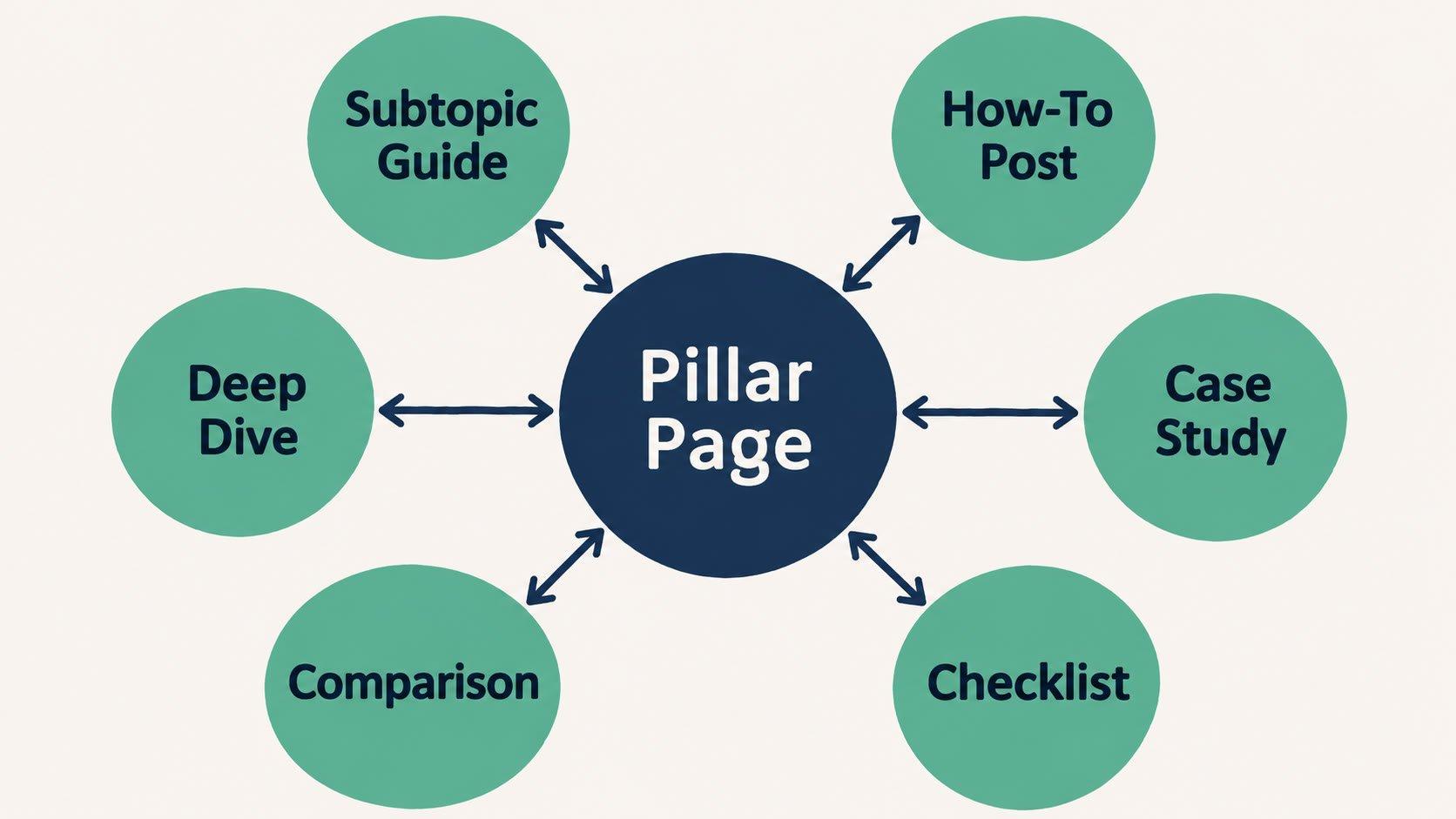
This creates a web of content that signals depth of expertise to Google and distributes page authority across your posts simultaneously.
3. Volume and Consistency Matter More Than Most Teams Expect
A blog publishing 4 posts per month will almost always outperform one publishing 1 high-quality post per month, quality held roughly equal.
More posts cover more keywords. Frequently updated sites get crawled more often, so new content indexes faster. And more posts on your core topics signals greater expertise to Google's ranking systems.
Rough benchmarks by stage:
Building momentum: 8–16 posts per month in a competitive niche
Maintenance pace: 4–8 posts per month once you're ranking well
Starting out: 2–4 posts per month if resource-constrained; expect growth to be slow
The constraint is almost always production capacity. That's where content automation becomes directly relevant.
4. On-Page SEO: Get the Basics Right on Every Post
Each post needs:
Target keyword in the H1, URL slug, and first 100 words
Meta description that includes the keyword and a compelling reason to click
H2/H3 structure covering related subtopics (drives long-tail rankings from the same post)
Internal links to and from related posts on your site
Schema markup (Article schema; FAQ schema for posts with question sections)
None of this is complicated. It has to be consistent: every post, not most of them. Gaps here leave compounding ranking potential on the table.
5. Internal Linking: The Consistently Underused Lever
Internal links pass authority between pages, help Google understand your site's structure, and keep readers on your site longer. Longer sessions improve engagement signals that reinforce ranking.
A workable rule: every new post links to at least 2–3 existing posts, and you update existing posts with links to the new one when it publishes.
Over time, well-linked content clusters compound together. Posts that rank pull up related posts in the cluster. For a deeper look at platform and CMS choices that support systematic internal linking, see our guide to the best CMS for SEO.
6. Indexing Speed Matters More Than Most Blogs Realize
A post that sits unindexed for three weeks after publication is three weeks of traffic you're not capturing.
IndexNow is an open protocol that pings search engines the moment a URL goes live, triggering near-instant crawling. Bing, Yandex, and several other search engines support it natively. Google has not officially adopted IndexNow. For high-velocity publishing schedules, faster indexing across supporting engines meaningfully compresses the lag between publish and ranking.
Your publishing platform should support IndexNow natively. If it doesn't, you're accepting slower indexing by default.
7. Track What's Working and Optimize Accordingly
You can't improve what you're not measuring. At minimum:
Google Search Console: impressions, clicks, and ranking positions by query
Google Analytics 4: traffic, engagement rate, and goal completions by page
Ahrefs or DataForSEO: keyword ranking progress over time
Check Search Console weekly and look for:
Posts with high impressions but low CTR (the title or meta description isn't earning the click; fix it)
Posts ranking in positions 5–15 (easy wins to push to page 1 with a targeted update)
New keyword clusters surfacing in queries you're already appearing for
The Volume Problem: Where Most Content Teams Stall
The system above works. The constraint is execution.
Publishing 8–16 posts per month on researched keywords, with proper on-page SEO, internal linking, and tracking, is a significant production load. For a founder doing it solo, it's a part-time job. For a one-person content team, it's the entire job.
Most teams plateau at 2–4 posts per month and wonder why traffic growth is slow. The answer is that the volume threshold for meaningful SEO momentum is higher than most people expect. A site adding 2 posts per month will take 2–3 years to build real organic authority in most niches. A site adding 15–20 posts per month can get there in 6–12 months.
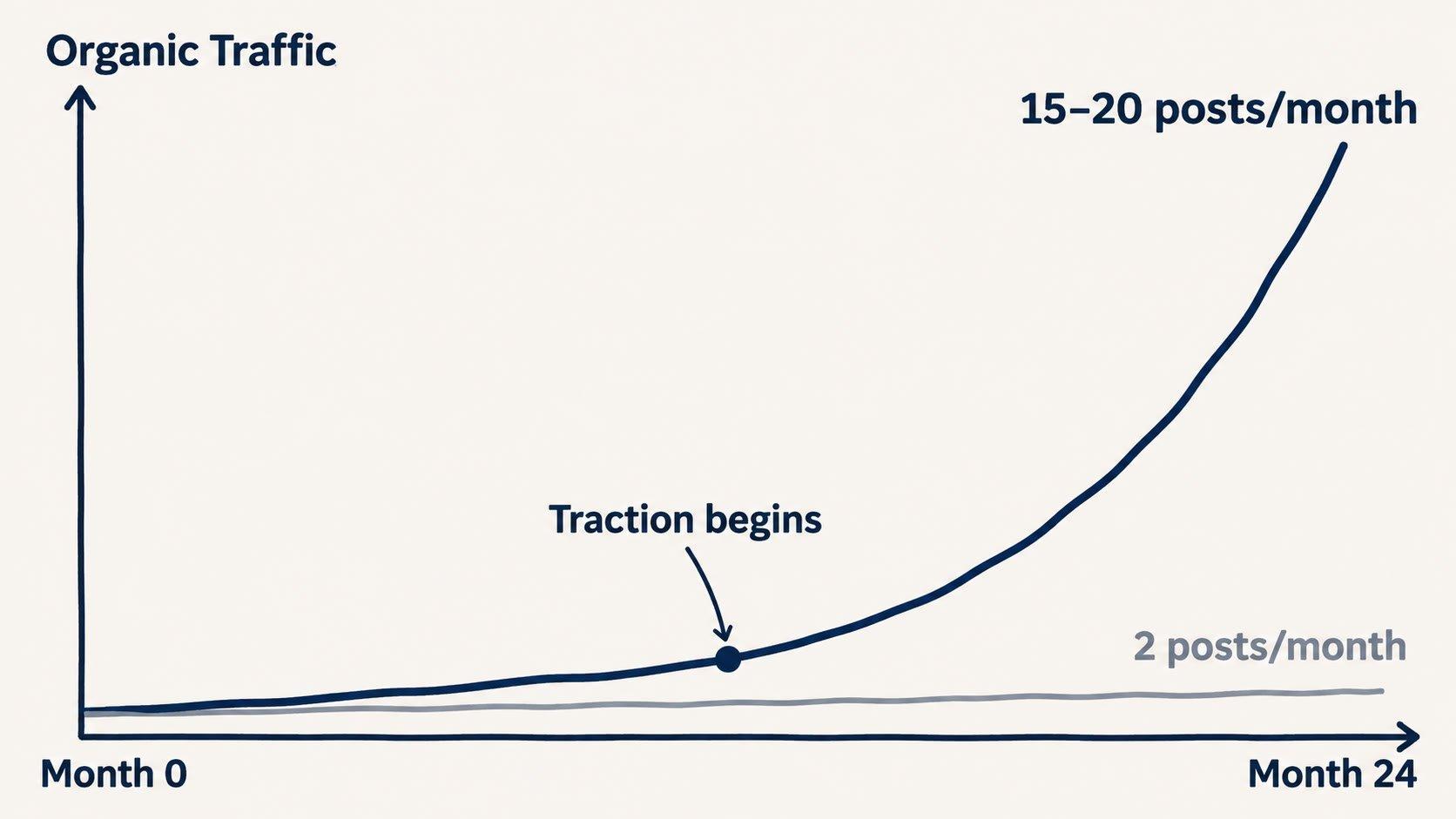
This is the problem Outrank's Organic Growth plan is built to solve: 30 AI-written, SEO-researched articles per month with keyword research, drafting, auto internal links, and publishing handled automatically. For teams that want organic traffic without hiring a full content team, it closes the volume gap without the overhead.
How We Put This Together
This post comes from the Outrank team, based on our experience building and running SEO content programs for SaaS and B2B companies. We evaluated what actually drives compounding blog traffic versus what generates short-term spikes, and structured this around the repeatable system we see work consistently across different niches. The numbers cited (volume thresholds, publishing cadence, ranking timelines) are directional benchmarks; your actual results will vary by niche, domain authority, and content quality.
Start Building Blog Traffic That Compounds
If your blog is stuck below the volume threshold where organic traffic compounds, the fastest path forward is a systematic increase in publishing cadence: keyword-targeted posts, properly structured, published consistently.
The problem most teams hit isn't a strategy problem. They understand the system. The bottleneck is production: finding the time to research keywords, write 8–16 posts per month, handle on-page SEO for each one, update internal links, and track what's ranking. Done properly, that's a full-time job. For most founders and lean teams, it doesn't get done at the cadence that actually moves the needle.
That's exactly what Outrank's Organic Growth plan is built for.
For $99 per month, Outrank handles the full content production workflow:
Keyword research: 30 SEO-targeted topics per month, selected based on your niche and competitive gap
Article writing: AI-drafted posts built around search intent, not filler
Auto internal links: every new post is linked into your existing content automatically
Publishing: posts go live on your blog without manual intervention
The result is a blog publishing at the cadence SEO actually requires, without the overhead of a content team. You stay in control of strategy, approval, and direction; Outrank handles the volume that makes the strategy work.
If you're writing 1–2 posts per month and wondering why traffic isn't growing, the answer is almost always cadence. Start with the Organic Growth plan and see what your blog looks like at 30 posts per month.
Frequently Asked Questions
How long does it take to get traffic from a blog?
Most blogs start seeing meaningful organic traffic between 6 and 12 months after launch, assuming consistent publishing and proper keyword targeting. With high-volume publishing (8+ posts per month), that timeline compresses. With 1–2 posts per month, expect 18–24 months before you see significant results.
How many blog posts do you need to start getting traffic?
There's no fixed number, but most SEO practitioners see a noticeable inflection around 50–100 published posts on a focused topic area. Before that threshold, individual posts can rank, but site-wide topical authority is still building. Volume and topic focus matter as much as post count.
Is SEO the best way to get blog traffic?
For sustained, compounding traffic without ongoing ad spend, yes. Social media and email are valuable for initial distribution, but neither compounds the way organic search does. A post that ranks well keeps generating traffic without further investment; a social post stops delivering within days.
Do you need backlinks to rank blog posts?
Backlinks help, especially for competitive keywords, but they're not required for all traffic. Long-tail keywords with low difficulty can rank without external links. As you move toward broader, more competitive terms, link equity becomes more important. Focus on building content volume first; links often follow organic rankings.
How often should you publish to increase blog traffic?
Consistency matters more than any specific cadence. Publishing twice a week regularly outperforms publishing four posts in one week and nothing for the next month. That said, higher cadences generally produce faster traffic growth: 8+ posts per month is roughly the threshold where most sites start seeing compounding momentum.
What's the difference between ranking and getting traffic from a blog post?
Ranking means your page appears in search results for a keyword. Traffic means searchers click through to your page. A post can rank on page 1 and still generate poor traffic if the title and meta description don't earn the click. Both matter: you need rankings and a SERP listing compelling enough to drive clicks at your position.