

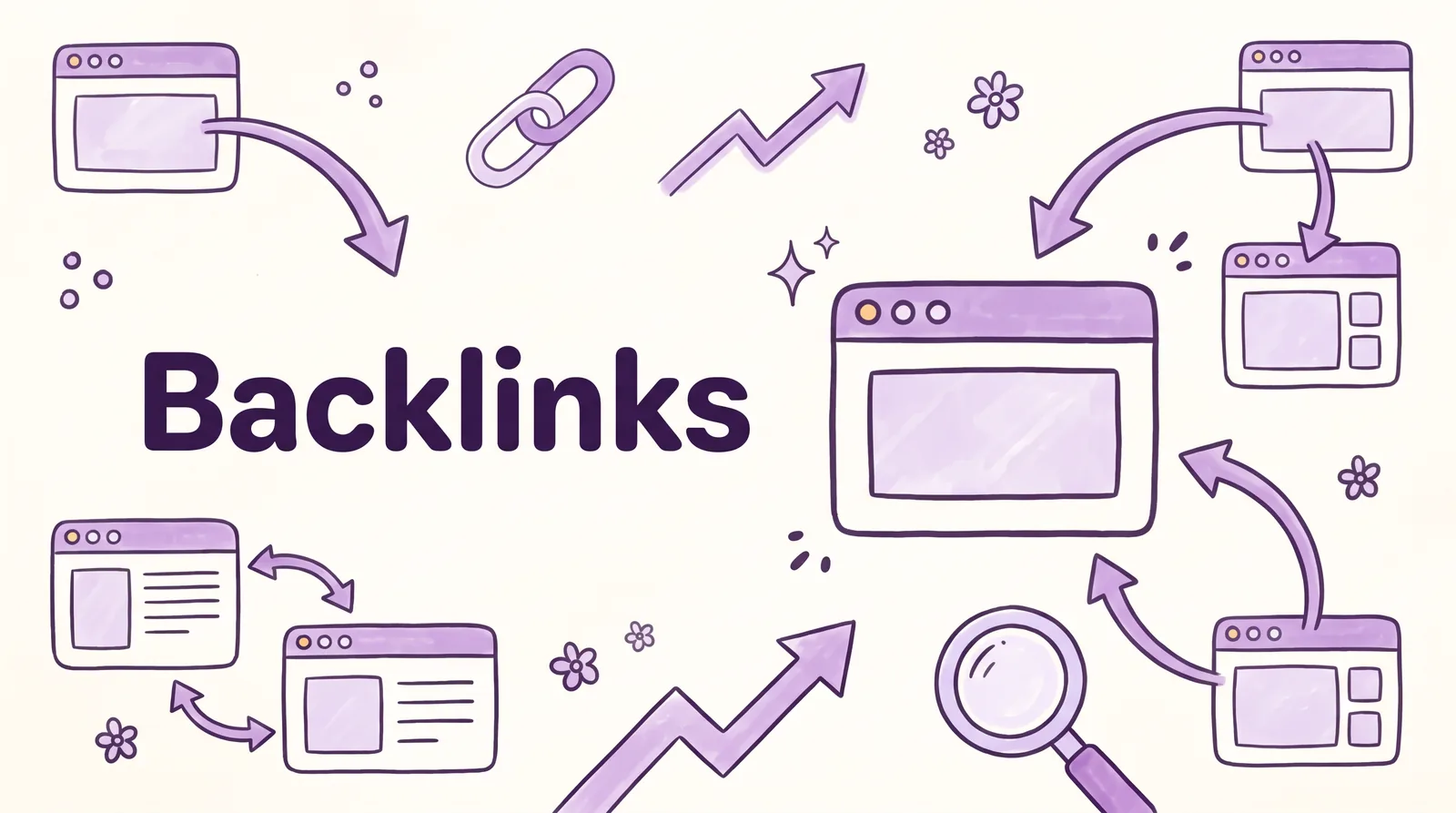
A backlink is a link on another website that points to yours. When a blog, a news site or a directory links to one of your pages, that link is a backlink for you and an outbound link for them.
Search engines treat backlinks as votes. Every relevant site that links to you tells Google your page is worth sending people to, which is why backlinks are still one of the clearest differences between the pages that rank and the ones that don't. They now shape AI answers too: ChatGPT, Perplexity and Google's AI Overviews lean on pages the rest of the web already vouches for.
This guide explains what a backlink is, what makes one valuable, how to get them without wasting money, and what the Search Console data of Outrank customer sites shows about backlinks and Google traffic.
The short version
- A backlink is a link from another site to yours. Google uses backlinks to find pages and to judge which ones deserve to rank.
- One link from a relevant site with real traffic is worth more than dozens of links from sites nobody reads.
- In our Search Console data, sites receiving 30+ backlinks a month grew their Google clicks a median 2.18×, against 1.59× for sites receiving under 5.
- Backlinks carry into AI answers: sites with 150+ verified backlinks got 16× the AI citations of sites with fewer than 10.
- Results compound: the median Outrank site reached 2.04× its starting Google clicks seven months after joining.
What is a backlink?
A backlink, also called an inbound link or an incoming link, is a hyperlink on one website that points to a page on another. If a blog writes about invoicing apps and links to your pricing page, your pricing page has earned a backlink from that blog.
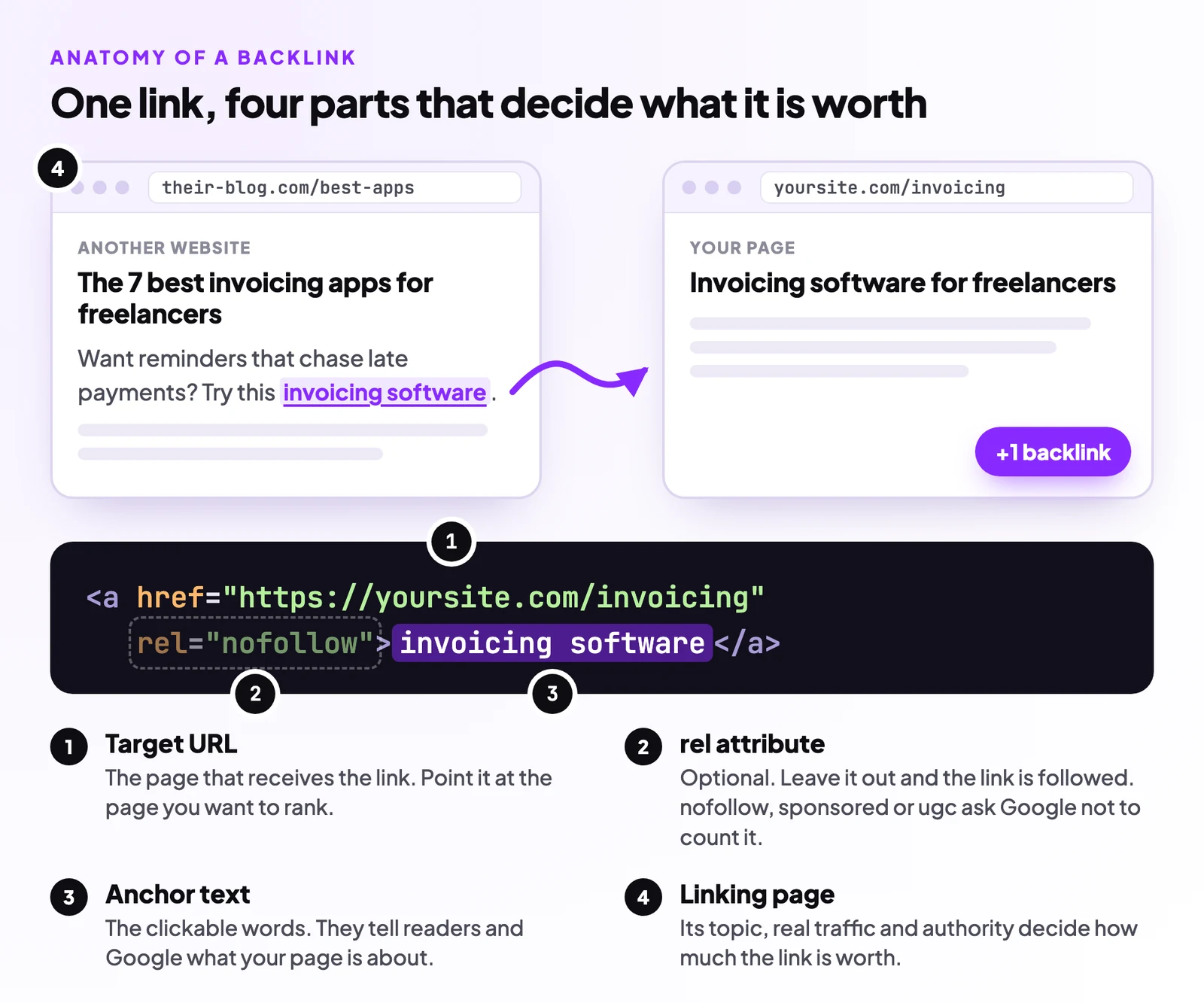
In the linking page's HTML, a backlink is an ordinary <a> tag:
<a href="https://yoursite.com/invoicing">invoicing software</a>Four things decide what that link is worth:
- The target URL. The page on your site that receives the link. A link to a specific guide or product page helps that page rank; a link to your homepage lifts the site as a whole.
- The rel attribute. An optional label on the link. Without one, the link is followed, so Google can count it.
nofollow,sponsoredandugcask Google not to. - The anchor text. The clickable words. Google describes good anchor text as descriptive and relevant to both pages, so "invoicing software" tells it far more than "click here".
- The linking page. Its topic, its traffic and its own authority. A link from a page that ranks and gets read carries more weight than one from a page nobody visits.
Backlinks, internal links and external links
Three terms that often get mixed up:
- An internal link connects two pages on the same website.
- An external link, or outbound link, points from your site to another site.
- A backlink is an external link seen from the site that receives it.
Every backlink is a hyperlink. "Backlink" only tells you which side of the link you are on.
Backlinks vs. referring domains
A referring domain is a website that links to you at least once. If one blog links to you from ten different articles, you have ten backlinks but one referring domain. SEO tools report both, and the number of referring domains is usually the better measure of authority, because ten links from the same site still come from a single source vouching for you.
Why backlinks matter for SEO
Google states it plainly in its own documentation: it "uses links as a signal when determining the relevancy of pages and to find new pages to crawl." Links have been part of Google since PageRank, the algorithm its founders built on the idea that a link works like a citation in a research paper. A page that many relevant sites cite is probably worth reading.
Independent studies keep finding the same pattern on today's results pages:
3.8×
More backlinks for the #1 Google result than for positions 2 to 10
Backlinko, 11.8 million search results
~95%
Of pages in the same study had no backlinks at all
Backlinko, 11.8 million search results
55.1%
Of new domains that never reached Google's top 10 had zero backlinks
Semrush, new domains tracked for 13 months
1 in 6,671
Pages with no referring domains that get 1,000+ monthly search visits
Ahrefs, ~14 billion pages
Sources: Backlinko, Semrush and Ahrefs. Every figure is checked against its original study on our link building statistics page.
Most pages never earn a single link, and the pages that win hold more of them than their neighbors. Links are not the only thing that matters. A page still needs to answer the search better than the alternatives, on a site Google trusts. But two pages that are equally good will usually be separated by the links pointing at them.
What our own data shows
Outrank builds backlinks for its customers and many of them connect Google Search Console, so we can compare the links each site received with what happened to its Google traffic. Growth was strongest for the sites that received the most backlinks:
Median growth in Google clicks, by backlinks received per month
Under 5 a month
65% of these sites grew
1.59×
5 to 14 a month
78% of these sites grew
1.66×
15 to 29 a month
69% of these sites grew
1.54×
30+ a month
80% of these sites grew
2.18×
Two things stand out. The median site grew in every group, so even sites receiving the fewest links gained traffic. And the jump comes at the top: sites receiving 30 or more backlinks a month grew the most, and four out of five of them ended up with more clicks than before.
Do backlinks still matter for AI search?
Yes. AI assistants build their answers from pages that search engines already trust and show, and backlinks are one of the main ways a site earns that trust.
When we matched AI citations measured by Ahrefs with the backlinks of Outrank customer sites, the sites with the most verified backlinks were cited far more often:
Median AI citations per site, by verified backlinks
6
15
68.5
98
Under 10
backlinks
10 to 49
backlinks
50 to 149
backlinks
150+
backlinks
Sites with 150 or more verified backlinks got 16× the AI citations of sites with fewer than 10. The study found a chain rather than a shortcut: backlinks raise a site's authority, authority earns Google visibility, and assistants mostly cite what search engines already show.
Outside studies point the same way:
- Authority predicts AI mentions. Semrush found a 0.65 correlation between a backlink-based authority score and how often a domain is mentioned in AI answers.
- Nofollow links count too. In the same study, nofollow backlinks correlated with AI mentions at 0.340, almost exactly the 0.334 of followed links.
- Mentions matter more than link counts. Ahrefs found brand mentions across the web correlate with AI Overview visibility at 0.664, far more than the raw number of backlinks at 0.218.
- Lists get cited. Evertune found that 50% of ChatGPT's citations are listicles, and 58% of those are ranked lists.
So the goal for AI visibility is the same as for Google: be mentioned, and linked, on relevant pages that people already read. "Best of" articles on other sites are the clearest example, since assistants answer "what is the best..." questions by reading exactly those lists.
Dofollow, nofollow, sponsored and UGC links
The rel attribute on a link tells search engines how to treat it. There are four cases:
| Link type | rel value | What it tells Google | Where you usually see it |
|---|---|---|---|
| Followed ("dofollow") | None | Count this link normally | Links inside articles, resource pages, editorial mentions |
| Nofollow | nofollow | Don't associate my site with this page | Links a site owner doesn't want to vouch for |
| Sponsored | sponsored | This link is an ad or a sponsorship | Ads, sponsorships, affiliate links |
| UGC | ugc | A user added this link | Forum posts, comments, community pages |
"Dofollow" isn't a real attribute. It is shorthand for a link with none of the other three values, which is the default for any link. Since 2019, Google treats all three values as hints about which links to count, not strict commands.
On the open web, nofollow is common and the newer values are rare. The HTTP Archive found nofollow on 32.3% of pages, against 0.5% for sponsored and 0.5% for ugc.
Types of backlinks by where they come from
Backlinks come from many places, and they are worth very different amounts:
| Type | What it looks like | Typical value | Effort or cost |
|---|---|---|---|
| Editorial mention | A writer cites your page because it helps their article | Highest | Earned with something worth citing |
| "Best of" list | Your product named in a roundup like "best invoicing apps" | Very high, for buyers and for AI answers | Outreach, PR or a placement service |
| Digital PR | A journalist quotes your data or your expert | High | Data or stories to pitch |
| Guest post | An article you write for another site, with a link back | Medium, depends on the site | $295 bought direct, $461 through a vendor, on average |
| Resource page | A "useful tools" or "further reading" list | Medium | Outreach |
| Link insertion | A link added to an article that already exists | Varies a lot | $225 on average |
| Content network | Sites placing links in each other's relevant articles | Depends on relevance and placement | Low once it runs |
| Directory or profile | Business listings, review sites, app marketplaces | Low on its own, a useful foundation | Quick, some are paid |
| Forum or comment | A link in a post, a reply or a signature | Low for rankings, can send visitors | Quick, easy to overdo |
Prices: BuzzStream for guest posts and Adsy for link insertions, both 2026.
Online stores have their own mix, with product roundups, gift guides and supplier pages at the top. We cover them in our guide to ecommerce link building.
What makes a good backlink?
Two links can look identical in a backlink report and be worth completely different amounts. These are the qualities that separate them, roughly in order of importance:
- 1
Relevance
The linking page is about your subject. In a uSERP survey of SEO leaders, 58.6% named topical relevance as the single factor that matters most. - 2
Real traffic
The linking site gets visitors from Google. A page that ranks and gets read passes more trust and sends you people. It's the bar we set for Outrank's marketplace: blogs with a Domain Rating of 30+ and at least 100 Google clicks a month, checked in their Search Console. - 3
A place inside the content
A link in the body of an article, surrounded by text about the same topic, beats a link in a footer, a sidebar or an author bio. - 4
A natural anchor
Your brand name or a descriptive phrase. Editorial.Link found 41.7% of SEO pros prefer partial-match anchors. The same exact keyword on every link looks manufactured. - 5
Authority, in context
Domain Rating helps you compare sites, but 62.9% of senior SEOs in the same uSERP survey say it is not a primary factor in a link's return. A relevant DR 30 blog can beat a DR 80 site that has nothing to do with you. - 6
A new referring domain
The first link from a site usually adds more than the tenth link from that same site. - 7
It stays live
Ahrefs found that 66.5% of the links pointing to a sample of over 2 million websites rotted within nine years. A link only helps while it exists.
How many backlinks do you need?
There is no universal number. It depends on what the pages already ranking for your keyword have. Look at the top 10 results for your target keyword, note how many referring domains point to each page, and aim for the middle of that range with links at least as relevant as theirs.
The target also moves. Ahrefs found that most pages ranking #1 keep gaining followed backlinks from new referring domains at 5% to 14.5% a month. A page that stops earning links slowly loses ground to one that keeps going.
We walk through the full method, with worked examples for easy and competitive keywords, in how many backlinks you need to rank.
How to get backlinks
There are only a few ways to get a backlink: earn it, ask for it, pay for a placement or join a network that places links for you. These methods cover all of them, starting with the ones that last longest:
- 1
Publish something worth linking to
Original data, free tools, templates and definitive guides earn links on their own, because writers need sources to cite. That is why we publish our results and our link building statistics. - 2
Get into the "best of" lists your buyers read
Search for the roundups in your category, like "best [your category] for [your audience]", and ask to be included. These lists win twice, with readers and with AI assistants. - 3
Pitch journalists and newsletters
Offer data, an expert comment or a story they can use. Editorial.Link found 48.6% of SEO pros consider digital PR the most effective link building tactic. - 4
Write for other sites
Guest posts still work on sites with a real audience in your niche. Write for their readers first and the link will look natural. - 5
Reclaim mentions and broken links
Find pages that mention your brand without linking, or that link to a dead page you could replace, and ask for the fix. It's the easiest yes you will get. - 6
Claim the basics
Business directories, review sites, partner and supplier pages, app marketplaces and your social profiles. Outrank's directory submission service handles the listings in one go. - 7
Automate the repetitive part
Outrank's backlink exchange places links to your site inside relevant articles that other Outrank customers publish, and its marketplace writes new articles on blogs with real Google traffic with your link inside.
For step-by-step playbooks for each method, read how to build backlinks.
Free ways to get backlinks
Most of the methods above cost time, not money. The free ones that work best are publishing data or tools others cite, listing your business on directories and profiles relevant to your niche, answering questions in communities where you are an expert, reclaiming unlinked brand mentions, and trading guest articles or features with complementary businesses.
Skip anything that promises hundreds of free backlinks at once. Those links come from sites built only to host links, and they add nothing at best.
Backlinks to avoid
Not every link helps. Google's spam systems are built to ignore links that exist only to manipulate rankings, and to act against sites that rely on them. Its SpamBrain system found 50 times more link spam sites in one link spam update than in the previous one.
Be wary of:
- Sites with no topic and no audience. Pages stuffed with unrelated outbound links, often on networks of sites built to sell them.
- Sitewide links. The same link repeated in the footer, sidebar or widgets of sites that have nothing to do with you.
- Comment and forum spam. Keyword-stuffed links dropped into conversations.
- Bulk directory and bookmark links. Hundreds of listings at once, on sites nobody visits.
- Exact-match anchors everywhere. The same money keyword as the anchor on most of your links.
- Sudden bursts from irrelevant sites. Spikes of links from foreign-language or off-topic sites you never contacted.
Google lists every pattern it treats as link spam in its spam policies. Read it before you trade, pay for or automate links, and favor links you would be happy to show a human reviewer.
If you spot bad links pointing at your site, you usually don't need to do anything. Google says that in most cases it can assess which links to trust on its own, and that most sites will not need the disavow tool. Keep it for the cases Google describes: many spammy links that have caused, or are likely to cause, a manual action.
How Outrank keeps its backlinks relevant
Google's spam policies target links created primarily to manipulate rankings: links with no topic, no readers and no reason to be on the page. Outrank is built around the opposite rule. Every link has to make sense to the person reading the article it sits in.
- Relevant by design. A link is only placed when the article and the page it points to cover the same subject. When nothing fits, Outrank skips the placement instead of forcing one.
- Inside content written for readers. Links sit in the body of a full article published for the host site's own audience, next to text about the same topic. Never in footers, sidebars, widgets or link lists.
- On blogs people actually read. Marketplace placements only go to blogs with a Domain Rating of 30+ and at least 100 Google clicks a month, verified in their Search Console.
- Natural anchors. Anchor text reads like the rest of the sentence, usually your brand or a descriptive phrase, instead of the same keyword on every link.
- No pile-ups. Each article carries only a few links, the same site can't link to you again for 30 days, and in the marketplace you never hold two live links on the same blog.
- A clean network. Sites with adult or gambling content are removed automatically.
- Checked, and reversible. Every link is verified on the live page and checked again later. If one disappears, your credits come back, and you can switch the exchange off for your site at any time.
The results point the same way. If these links were hurting sites, the sites receiving the most of them would do worst. In our Search Console data they grew the most: sites receiving 30+ backlinks a month reached a median 2.18× their Google clicks from before joining.
No one outside Google can promise how it will treat a given link, and we won't either. What we can show is how every link is placed, and what happened to the sites that received them.
How to check your backlinks
You can see who links to you for free, and paid tools fill in the gaps:
- Google Search Console (free). Open Links in the left menu. "Top linking sites" lists the domains that link to you and "Top linked pages" shows which of your pages earn links. Export both each month to spot new and lost links.
- Google Analytics (free). Referral traffic shows which backlinks actually send visitors. Our guide on how to find backlinks in Google Analytics shows where to look.
- Ahrefs, Semrush and similar tools. Bigger link indexes, your competitors' backlinks and alerts for lost links. Ahrefs Webmaster Tools is free for sites you verify.
- Your Outrank dashboard. Every link Outrank places is checked on the live page and listed with the site and the article it sits on.
About the data in this guide
How we measured this
Outrank figures come from the Google Search Console data that customers connect to their account. Growth by backlinks received compares each site's Google clicks in the latest 28 days with the 28 days before it joined Outrank, for sites with at least two months on Outrank and 30+ clicks before joining, and is published on our results page (snapshot of October 1, 2026). AI citations come from Ahrefs, September 2026, as published in our study How to get cited by ChatGPT. We report medians, not averages. These are observational numbers: sites that receive more links also tend to publish more, and customers may do other SEO work, so they show what active Outrank sites achieve, not a controlled experiment. Third-party figures link to their original studies.
Cite this article
Outrank (2026). Backlinks: What They Are, Why They Matter and How to Get Them. https://www.outrank.so/blog/backlinks
FAQ
What is a backlink in simple terms?
A backlink is a link on someone else's website that points to yours. Search engines read it as a vote of confidence: another site thinks your page is worth sending its readers to.
Are backlinks still important in 2026?
Yes. The #1 result on Google has 3.8× more backlinks on average than the pages ranking 2 to 10, according to Backlinko. In our own data, sites with 150+ verified backlinks got 16× the AI citations of sites with fewer than 10, so backlinks now matter for AI answers as well as for rankings.
What is a dofollow backlink?
A dofollow backlink is a normal link with no nofollow, sponsored or ugc value, so search engines can count it. "Dofollow" isn't an HTML attribute. It only means none of the other values were added.
What is the difference between a hyperlink and a backlink?
A hyperlink is any clickable link. A backlink is a hyperlink seen from the page it points to: when another site links to you, that hyperlink is your backlink.
How long do backlinks take to work?
Usually weeks to months. Google first has to recrawl the page that links to you, and rankings then build gradually. In our Search Console data, the median Outrank site reached 1.43× its starting Google clicks four months after joining and 2.04× after seven months, with articles and backlinks working together.
What is a good backlink strategy?
Build one or two assets other sites want to cite, get listed in the "best of" lists your buyers read, earn a steady flow of relevant links to the pages you want to rank, keep anchors natural, and track referring domains and rankings every month. Steady beats bursts.
Can backlinks hurt your site?
Links from spammy sites are usually ignored rather than counted. Links that look built to manipulate rankings, such as bulk links from sites with no audience, can lead to lost rankings or a manual action. Google's spam policies list the patterns to avoid.
How much does a backlink cost?
Nothing if you earn it. When people pay, a guest post costs $295 on average bought directly from a site and $461 through a vendor (BuzzStream), a link insertion costs $225 on average (Adsy), and SEO professionals consider $508.95 an acceptable price for one high-quality backlink (Editorial.Link). Our guide to the best place to buy backlinks compares the options.
What are some free ways to get backlinks?
Publish data or tools others want to cite, list your business on relevant directories and profiles, reclaim brand mentions that don't link to you, get quoted as an expert, and swap features with complementary businesses.
How do I check how many backlinks I have?
Open the Links report in Google Search Console. It is free and lists your top linking sites and your most linked pages. Tools like Ahrefs and Semrush show more links, your competitors' backlinks and the links you lost.