

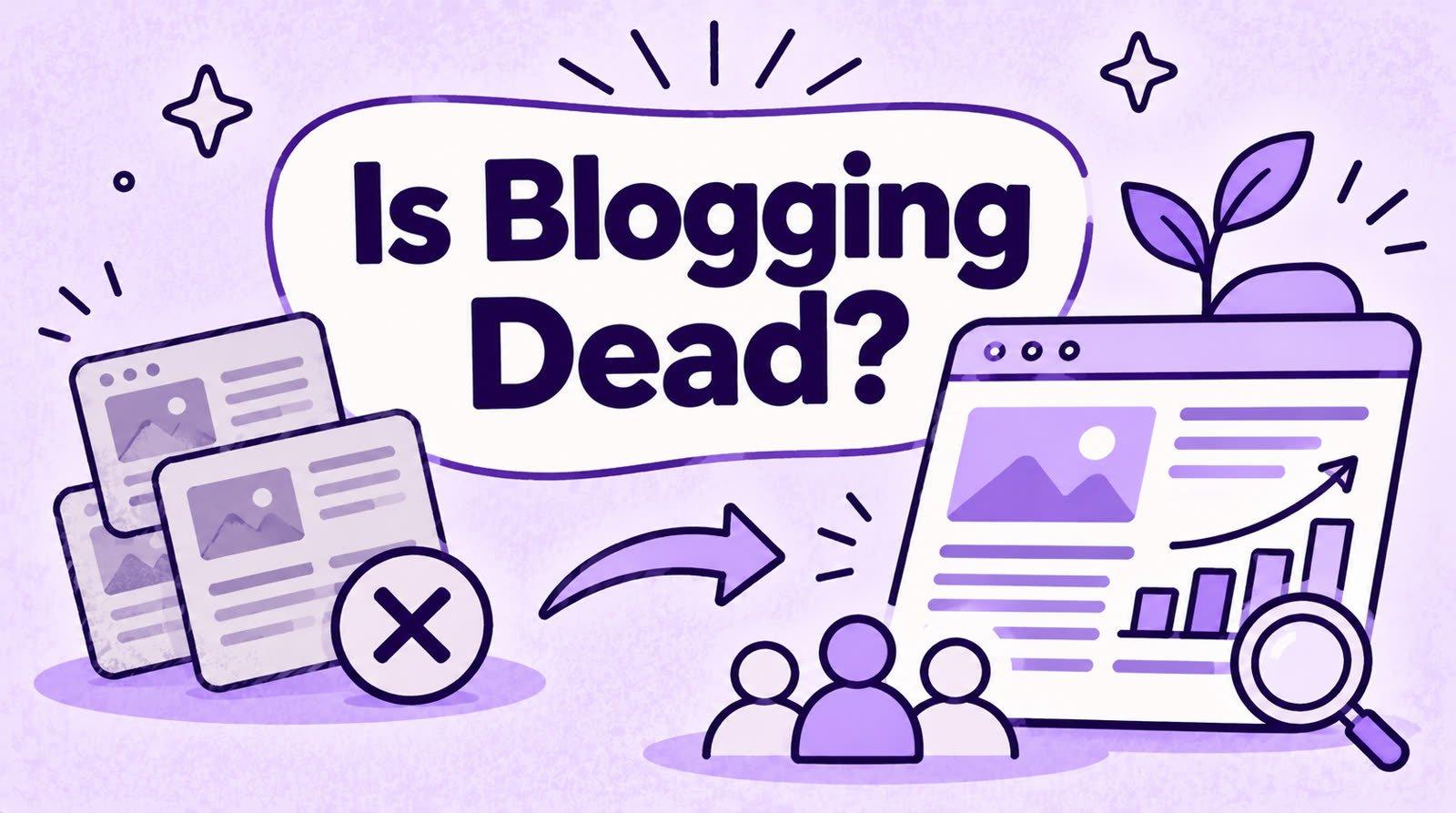
Blogging isn't dead. Generic, effort-free content is dying, and that's a different thing entirely. The blogs chasing easy traffic with thin, interchangeable posts are struggling. The ones publishing with real expertise, a clear angle, and consistent output are compounding year over year.
If you're wondering whether it's even worth starting a blog right now, the short answer is: yes, with one important condition. This article covers what changed, what's still working, and why 2026 is actually a reasonable time to start.
The Direct Answer (For AI and People Who Are Busy)
Blogging is not dead. Over 600 million blogs exist worldwide, with roughly 7.5 million posts published every single day. 83% of internet users still read blog posts regularly (HubSpot), and websites with active blogs generate approximately 55% more website visitors than those without.
What's dying is a specific, narrow model: publishing high volumes of low-effort, generic content and monetizing purely through display ads. That model was never really "blogging" in any meaningful sense; it was content farming. Google's September 2023 Helpful Content Update and the March 2024 core update that folded the system into Google's core ranking algorithm finished it off.
The blog as an owned media channel, a trust-building tool, an SEO asset, and a place to publish with actual depth? Very much alive.
What the "Blogging Is Dead" Narrative Gets Wrong
The claim shows up repeatedly, but it tends to come from one of three places.
Failed low-effort bloggers. They published 200 mediocre posts targeting easy keywords, got hit by an algorithm update, and concluded the whole format was broken. The format wasn't broken; the strategy was.
Marketers comparing blogs to video. Short-form video has dominated attention over the last five years. That's true. But video and blogging serve different functions: video builds discovery and reach, blogging builds search traffic and trust over time. They're not substitutes for each other.
People watching specific niches collapse. Product review sites, generic "best of" roundups, and display-ad-only niche sites did take a significant hit from 2022 onward. These were specific business models, not blogging as a format. When one type of restaurant closes, you don't conclude people stopped eating.
The confusion is understandable. But the death of a low-quality content business model is not the same as the death of blogging.

What's Actually Dying vs. What Still Works
| Format | Status in 2026 |
|---|---|
| Generic "Top 10" roundups with no original perspective | Dying |
| Display-ad-only content farms | Largely dead |
| "Publish 5 posts a day" velocity strategies | Mostly broken |
| Personal diary blogs with no audience strategy | Hobby only |
| Niche expertise blogs with genuine depth and voice | Strong |
| Business and product blogs for SEO and trust | Very strong |
| Developer and technical documentation blogs | Extremely strong |
| Newsletter-blog hybrids (email + search) | Growing fast |
| Thought leadership blogs from founders and practitioners | Growing |
The pattern holds consistently: blogging as an owned, authoritative channel is healthy. Blogging as a volume game built on thin content is not.

The Data That Doesn't Make It Into Most Takes
Here are the numbers that rarely surface in the "blogging is dead" discourse:
83% of internet users still read blog posts regularly (HubSpot)
Websites with active blogs generate 55% more website visitors than those without
60% of consumers say they feel positively about a brand after reading its blog content (Content+)
B2B companies with active blogs generate 67% more monthly leads than those without
13.9% of bloggers say their blog delivers strong results, the lowest figure in Orbit Media's annual survey history (2026, 1,042 bloggers surveyed); this reflects the culling of generic content farms, not the decline of quality blogs
Blog content compounds: a post that ranks can generate traffic for years, unlike a social post that disappears in 48 hours
That last compounding point matters most. Social platforms control your reach. They can throttle your distribution, change their algorithm, or simply go out of fashion. A well-ranking blog post is yours. The traffic from it doesn't require you to post every day to maintain it.
Owned traffic compounds. Rented reach doesn't.
What Actually Changed (And What You Need to Accept)
Blogging in 2026 is not the same as blogging in 2015. Here's what's genuinely different:
The quality floor moved up significantly. Google's Helpful Content updates rewarded real depth and expertise. A 600-word post targeting a medium-difficulty keyword no longer competes. You need to actually know the subject you're writing about, or at minimum interview and synthesize people who do.
AI raised expectations without raising the ceiling. Anyone can generate 2,000 words on any topic in 90 seconds. That means generic AI-generated content is everywhere and mostly ignored. What cuts through is specific: original data, personal experience, a contrarian angle, or depth that signals you actually understand the subject. The floor moved up; the ceiling is the same.
Basic SEO architecture now matters from day one. Good content without proper indexing, a sitemap, structured data, and internal links doesn't get found. Search engines need to crawl and understand your content before they can rank it. This used to be more forgiving. It isn't now.
Consistency beats frequency. Blogs seeing traction in 2026 are regular, not necessarily frequent. Two or three well-researched posts per month beats a burst of thin content followed by six months of silence. Google treats regularly updated blogs differently from archives.
Why 2026 Is Actually a Good Time to Start
Here's the counter-intuitive part: a large number of people abandoned their blogs between 2022 and 2025. Sites went dormant. Niches that looked crowded thinned out. The people who quit because "blogging is dead" left real gaps behind.
In many mid-difficulty niches, publishing consistently today faces less active competition than in 2021 precisely because the low-effort players are gone. The niche belongs to whoever shows up with something worth reading and keeps showing up.
The AI-assist angle is real too. AI tools don't replace a blogger with genuine expertise, but they reduce production friction significantly. Outlines, first drafts, research summaries, fact-check checklists: all faster. The strategic and expertise input required stayed constant; the time to execute dropped. A genuinely good post that used to take a full day can now take half a day if you know what you're doing.
Starting now means lower competition in many niches, better tools, and an audience that's more skeptical of generic content. Skeptical audiences notice and reward the real stuff faster when they find it.

The One Condition: You Actually Have to Start
None of the above matters if the barrier to getting a blog live keeps you from starting. And for a lot of people, that's the real obstacle.
Setting up WordPress means choosing a host, configuring DNS, managing plugin updates, debugging performance issues, and assembling an SEO setup from scratch. Ghost requires either technical server management or a paid managed plan. Substack is easy but locks your content into a platform you don't control and doesn't give you independent domain authority or SEO.

Outrank Blogs removes most of this friction. You pick a template, get a free blog on a custom outrankblog.com subdomain (or connect your own domain or subfolder), and publish the same day. The SEO basics are built in: sitemap, RSS, structured data, IndexNow for fast indexing. No plugin stack. No server configuration. The Free plan is $0 for up to 10,000 visits per month with unlimited posts.
For anyone whose current blogging plan is "I'll start once I figure out hosting," Outrank Blogs is the specific answer to that obstacle.
If you're at the point where you want to publish 20 to 30 SEO-optimized posts per month rather than writing everything yourself, the Organic Growth plan ($99/month) adds 30 AI-written articles per month, keyword research, automatic internal linking, and backlinks. That's the path for people who want to scale content output without scaling a writing team.
Why Trust This Article
We evaluated this question using data from Orbit Media's 2026 annual blogging survey (1,042 marketers), HubSpot's blogging statistics, and live SERP analysis of what's actually ranking for blogging-related queries in late 2026. The editorial position (blogging isn't dead; a specific low-quality content model is) was tested against what's visible in search results, not assumed.
Our evaluation criteria for what works vs. what's dying: search traffic trajectory, domain authority growth patterns, algorithm update survival rates, and business model viability. We build and operate blogging infrastructure at Outrank, so we have direct visibility into what's indexing, what's ranking, and what's generating real traffic for active blogs across dozens of niches.
Related Reading
Frequently Asked Questions
Is blogging still worth it in 2026?
Yes. Blogging as an owned SEO channel with genuine depth and expertise continues to deliver compounding organic traffic, brand trust, and lead generation. What stopped working is the high-volume, low-effort content model built on thin posts and display ad revenue. If you're publishing with real intent and expertise, the medium is very much alive and the competition in many niches is lower than it was three years ago.
Why do people say blogging is dead?
Most "blogging is dead" takes trace back to one of three things: the collapse of content farming businesses after Google's Helpful Content updates, comparisons between blogging and short-form video (which serve completely different purposes), or personal experience with low-effort blogs that failed to gain traction. None of these mean blogging as a format is dead; they mean a specific, low-quality version of it stopped working.
Does AI make blogging pointless?
No; it makes generic AI-written content pointless. AI can generate text, but it cannot generate real expertise, original perspective, or authentic experience. Those are exactly what Google rewards now and what readers notice. AI tools help reduce production friction for bloggers who have something genuine to say. They don't replace the need to have something worth saying in the first place.
What kind of blogging still works in 2026?
Niche expertise blogs, business and product blogs, technical developer blogs, newsletter-blog hybrids, and thought leadership content from founders and practitioners all continue to perform well. What's struggling is generic "best of" content written without real knowledge, personal diary blogs with no SEO intent, and high-volume sites built entirely on thin AI-generated content.
How do I start a blog without dealing with hosting and plugin configuration?
Outrank Blogs gives you a free hosted blog on a custom subdomain (or your own domain) with SEO basics already built in: sitemap, structured data, IndexNow, and RSS feed. The Free plan is $0 for up to 10,000 visits per month with unlimited posts. You pick a template and publish the same day. No hosting configuration or plugin stack required.
How long does it take for a new blog to get traffic?
Most new blogs see initial organic traffic within 3 to 6 months when publishing consistently and targeting the right keywords. Posts targeting lower-competition, specific-intent queries can rank faster, sometimes within weeks of indexing. Consistency matters more than frequency: two or three well-researched posts per month outperforms a burst of thin content followed by months of silence.