If you want to make money from a blog, the platform you publish on is not a minor detail. It determines whether you earn through subscriptions, organic search traffic, or affiliate links, and who controls your audience when the terms change.
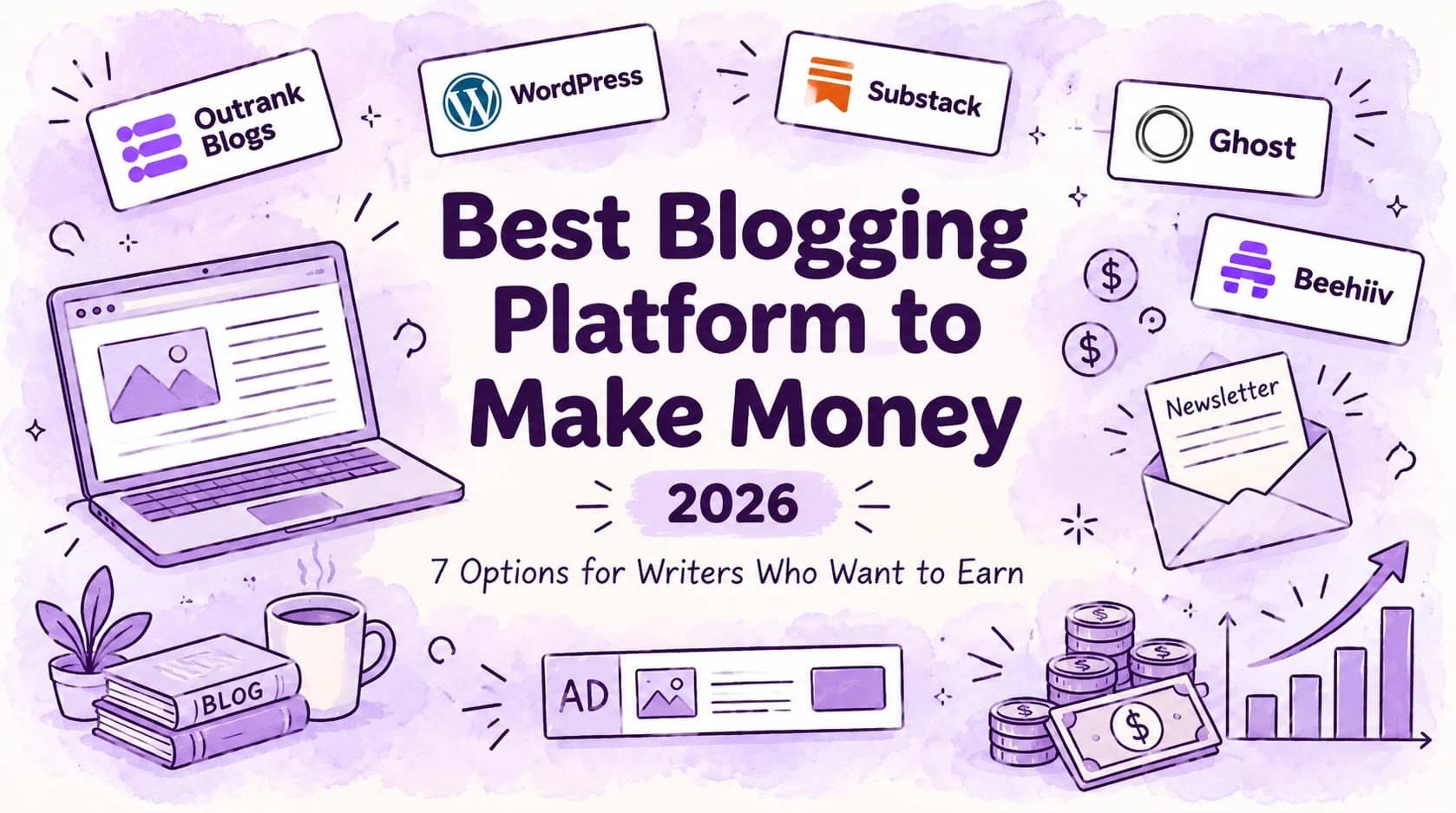
The short answer: WordPress.org gives you the most monetization options. Substack and Ghost are the best paths if your readers pay directly. Outrank Blogs is the strongest free option if organic search traffic is how you want to earn.
Every platform below has been compared on five factors that actually matter for income: how revenue reaches you, what the free plan allows, whether you own your audience, how the platform handles SEO, and what you pay when you scale.
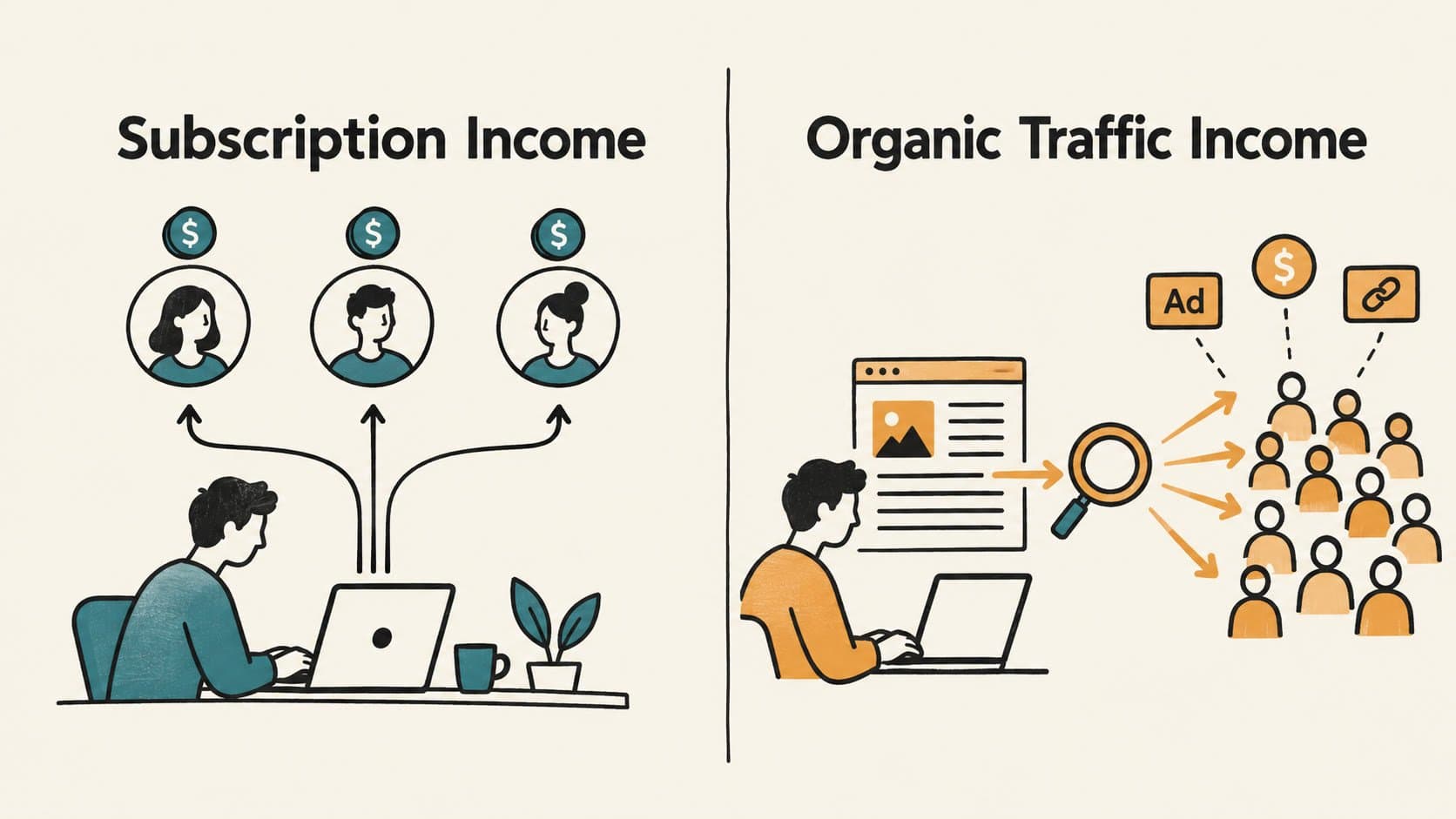
Two Income Models. Two Very Different Platform Needs.
Before comparing platforms, it helps to know which model you are actually building toward. Most writers pick a platform before deciding how they will earn, and end up fighting the platform's defaults later.
Subscription income: Readers pay a monthly or yearly fee to access your writing. Platforms like Substack, Ghost, and Beehiiv handle payment, delivery, and some discovery for you. Revenue is predictable, but it is capped by your subscriber count.
Organic traffic income: You write posts that rank on Google and capture search demand. Revenue arrives through display ads (once you reach a traffic threshold most ad networks require), affiliate commissions, sponsored placements, or your own digital products. This model takes longer to generate income but scales without asking readers for a credit card.
The catch most newsletter writers discover too late: most newsletter platforms are designed for Model 1 and actively work against Model 2. Substack has no sitemap exposed to search engines by default and very limited SEO tooling. If you want search traffic, that is a real structural problem, not a plugin you can install.
At a Glance: Platforms Compared for Monetization
| Platform | Best income model | Free plan | Own domain free | Platform revenue cut | SEO tools |
|---|---|---|---|---|---|
| Outrank Blogs | SEO/organic traffic | Yes (10k visits/mo) | Yes | None | Built-in (sitemap, IndexNow, structured data) |
| Substack | Subscriptions | Yes (unlimited subscribers) | $50 one-time fee | 10% of paid revenue | Minimal |
| Ghost | Subscriptions + SEO | No (from $18/mo billed annually) | Yes | None | Good |
| WordPress.org | All models | No (hosting ~$3-10/mo) | Yes | None | Excellent (via plugins) |
| WordPress.com | Limited | Yes (1GB, platform ads shown) | No (from $4/mo billed annually) | None | Basic |
| Medium | Partner Program read time | Yes | No | Variable | None owned |
| Beehiiv | Subscriptions + ad network | Yes (up to 2,500 subscribers) | No (from $49/mo billed annually) | None | Limited |
7 Best Blogging Platforms to Make Money
1. Outrank Blogs
Best free platform for SEO-based income
Outrank Blogs is a hosted blog builder with SEO built in from day one: automatic sitemap, IndexNow submission, structured data, and RSS are included on every blog, including the free plan. You pick a template, get a free outrankblog.com subdomain or connect your own domain at no extra charge, and publish with a block-based editor.
Free plan: Up to 10,000 visits per month, unlimited posts, no platform ads shown on your blog. There is a small footer badge.
How you make money: Organic search traffic is the primary model. You earn through affiliate links in your posts, display ads via networks like Mediavine or Raptive once you hit their traffic thresholds, or by sending search visitors into your email list and product stack. The platform takes no cut of anything you sell.
The honest catch: The free plan pauses new posts if you stay over 10,000 visits two months in a row. Outrank Blogs also collects email subscribers through a built-in form but does not send newsletters: pair it with your email tool. If you want your blog to write itself, the Organic Growth plan ($99/month) adds 30 AI-written SEO articles per month, keyword research, automatic internal links, and backlinks.
Best for: Creators who want a free, no-setup blog that gets indexed properly from day one and want to earn from organic traffic rather than asking readers to pay directly.
Compare Outrank Blogs with Substack side by side
2. Substack
Best starting point for subscription income from a loyal audience
Substack is the platform that defined the paid-subscription model for independent writers. The mechanics are simple: you write, readers subscribe for free or pay a monthly or annual fee, and Substack processes the payment and handles delivery.
Free plan: Unlimited free subscribers at no cost. The 10% cut only applies to paid subscription revenue.
How you make money: Subscriptions are the primary path. Most successful Substack writers use a free tier to build audience and a paid tier (commonly $5-15/month) for their best work. The Recommendations feature helps you grow through other writers' audiences, which is a real structural advantage Substack has over most platforms.
The honest catch: Substack keeps 10% of everything your paid subscribers pay you. On $500/month in subscriptions, that is $50 leaving your pocket every month, compounding as you grow. Connecting your own domain also requires a one-time $50 USD fee.
More critically for writers thinking about long-term monetization: Substack's SEO story is weak. Posts rank occasionally but the platform has limited structured data, no exposed sitemap by default, and your content builds authority on Substack's domain, not yours. If you ever want to move, your subscriber list is portable (Substack lets you export it), but your URL history is not.
Best for: Newsletter-first writers who want a built-in community and are comfortable with subscriptions as their primary income model. If your monetization plan is "readers pay me directly," Substack handles this well. If your plan involves growing through search, you need a separate blog in parallel.
Compare Substack with Outrank Blogs in detail
3. Ghost
Best all-in-one for serious publishers who want both subscriptions and SEO
Ghost is an open-source publishing platform built for professional writers and media companies. It handles subscriptions, email newsletters, and a blog in one place, with notably better SEO defaults than Substack. It is what Substack writers usually graduate to when they want more control.
Free plan: None for Ghost(Pro), the managed hosting version. Plans start at $18/month (Starter, billed annually) and $29/month (Publisher, billed annually). One important distinction: the Starter plan does not include paid subscriptions, tips, or premium tiers. If reader subscriptions are your income model, you need the Publisher plan at $29/month. You can self-host the open-source software for free if you have technical comfort.
How you make money: Subscriptions via the Publisher plan (Ghost has Stripe built in with no revenue cut), display ads, affiliate links, and sponsored newsletters. Ghost takes no percentage of your revenue. It gives you SEO tooling, custom themes, and an email newsletter tool in one package.
The honest catch: There is no free tier. For a writer starting out, even $18/month before you have a single dollar of revenue is a real barrier, and $29/month is where paid subscriptions actually unlock. Ghost also has a smaller discovery ecosystem than Substack: growing an audience from zero is harder because there is no Recommendations-style growth engine.
Best for: Writers who have outgrown Substack's limitations and want full ownership without managing WordPress. Ghost is particularly strong if you want both a clean subscription model and reasonable SEO capability in the same platform.
For a direct comparison of these two newsletter platforms, see Ghost vs Substack.
4. WordPress.org
Best for maximum monetization control, no ceiling
Self-hosted WordPress is how most of the internet's money-making blogs are built. The software is free; you pay hosting (usually $3-10/month from providers like SiteGround or Hostinger) and a domain ($10-15/year).
Free plan: Not applicable. You pay for hosting from day one.
How you make money: Every model applies. Subscriptions via MemberPress or WooCommerce, display ads, affiliates, digital products, courses, physical products, sponsorships. Nothing is blocked. SEO plugins like RankMath or Yoast give you fine-grained control over metadata, structured data, and sitemaps.
The honest catch: Setup and maintenance require more effort than hosted platforms. You manage updates, security, and backups, and occasionally debug plugin conflicts. If that sounds like a part-time job, it is. Managed WordPress hosting abstracts this away but raises the monthly cost significantly.
Best for: Bloggers who want no ceiling on monetization and are willing to invest time in setup and maintenance. If you are building toward display ad income from a major network (which requires speed, Core Web Vitals, and a fully controllable ad stack), WordPress.org is the industry standard.
5. Beehiiv
Best newsletter platform with monetization tools built in
Beehiiv was built as a more monetization-focused alternative to Substack. It includes a built-in ad marketplace where brands can place ads directly in your newsletter, a referral program that pays per referred subscriber, and native paid subscription handling, all with no revenue cut from Beehiiv.
Free plan: Up to 2,500 subscribers with basic newsletter and website features. Paid subscriptions, ad monetization, and automations require the Lite plan at $49/month billed annually.
How you make money: Paid subscription revenue on the Lite plan and above (you keep 100% minus Stripe's standard processing fee, unlike Substack's 10% cut), ad placements through Beehiiv's ad network, referral commissions, and your own products or affiliate links. The ad network is particularly useful for newsletters with 5,000 or more subscribers who want brand revenue without doing their own sponsorship outreach.
The honest catch: Like Substack, Beehiiv is newsletter-first. SEO is limited. Your site lives on beehiiv.com on the free plan. To actually start earning through paid subscriptions, you need the Lite plan ($49/month), so the free tier is really a trial rather than a long-term monetization home.
Best for: Newsletter writers who have already built a list and want better monetization tools than Substack's default setup, especially the ad marketplace and the referral growth system.
6. Medium
Most limited for long-term monetization
Medium is the easiest platform to start writing on: no setup, millions of existing readers, and a clean editor. The Partner Program pays writers based on how much time paying Medium members spend reading their work.
Free plan: Free to publish. Partner Program access requires a verified payment account.
How you make money: Partner Program payouts, which are inconsistent by design. A post that reaches Medium's recommendation engine can earn a few hundred dollars; a post that does not reach paying members earns almost nothing regardless of quality. You cannot run your own ad code or affiliate links in a meaningful way within Medium's terms.
The honest catch: Medium's algorithm decides your distribution. You do not own the audience, cannot email them directly without a separate tool, and your posts build Medium's domain authority, not yours. Writers who have succeeded on Medium consistently describe it as a discovery channel that should feed an owned platform, not a primary income source.
Best for: Writers who want to test whether their writing finds an audience before investing in a separate platform. Not recommended as a primary monetization strategy.
Compare Medium with Outrank Blogs
7. WordPress.com
Good for starting, real limits for earning
WordPress.com is the managed version of WordPress: you get the familiar editor without managing hosting. The free plan exists but is restrictive for anyone trying to earn money from day one.
Free plan: 1GB storage, WordPress.com ads shown on your site, and no custom domain. Ads, custom domains, and plugin access (including third-party ad networks and affiliate tracking tools) all unlock on paid plans starting from the Personal plan at $4/month billed annually.
How you make money: On any paid plan, all the usual WordPress monetization options apply via plugins. On the free plan, your options are effectively zero: WordPress.com shows its own ads on your blog and takes a 10% cut of any paid subscription revenue on the free tier.
The honest catch: The free plan is genuinely not useful for monetization. And once you pay for a meaningful WordPress.com plan, the monthly cost approaches self-hosted WordPress with hosting included, so the convenience advantage narrows. Most people who start on WordPress.com either migrate to WordPress.org or switch to a simpler hosted platform.
Best for: Beginners who want to explore WordPress's editor before committing to self-hosted WordPress. Not a long-term monetization home in its own right.
How to Choose the Right Platform for Your Situation
The decision comes down to one question: where are your readers, and how do they prefer to pay you? If you are still deciding on a platform at all, the full best blog platform comparison covers Wix, Squarespace, Blogger, and the developer setup options this article skips.
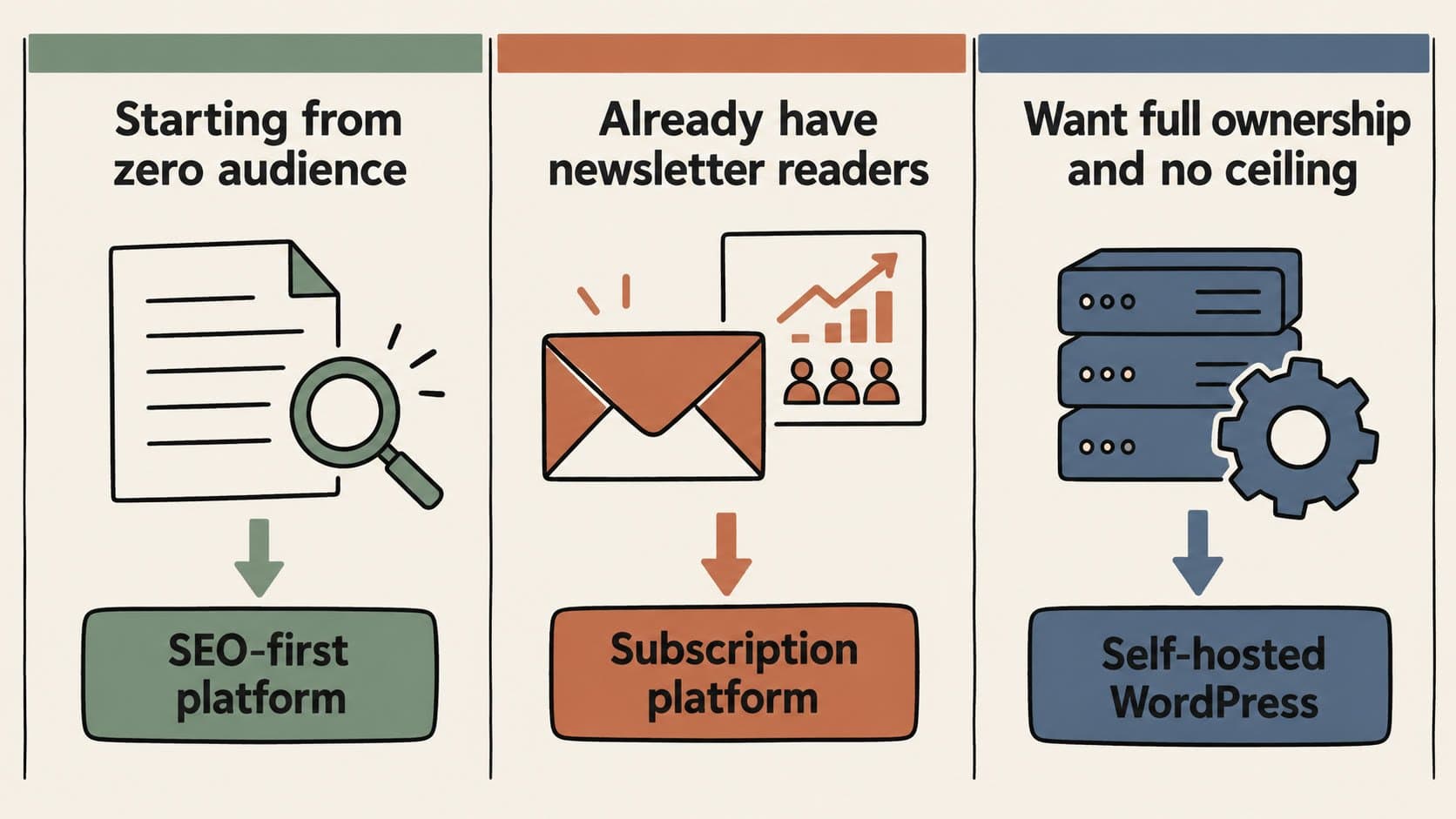
Choose a subscription-first platform (Substack, Ghost, Beehiiv) if:
You already have an audience that follows you personally
Your content is high-signal and people in your niche are used to paying for writing
You are a newsletter writer whose primary goal is consistent, predictable subscription revenue
Choose an SEO or traffic-first platform (WordPress.org, Outrank Blogs) if:
You are starting from scratch with no existing audience
You write about topics people search for (personal finance, software, health, travel, niche hobbies)
You want to earn from display ads or affiliates without asking readers to subscribe upfront
Start with Outrank Blogs if:
You want to publish for free without technical setup
SEO basics (sitemap, structured data, fast loading) matter to you from day one
You are a Substack or newsletter writer adding a parallel blog to capture search traffic you are currently missing
Why Trust This Article
We evaluated these seven platforms on five criteria: monetization model, free plan limits, platform revenue cut, SEO defaults, and audience ownership. Pricing and plan details were verified against each platform's public pricing page in October 2026. Free plan specifics change without notice, so check each platform's current terms before committing. Outrank Blogs is our own product; we have stated that clearly in the section above rather than presenting it as neutral. For setup steps across any of these platforms, see our guide to how to start a blog for free. For a broader view of free options, see the full best free blogging platforms roundup.
Start a Free SEO Blog With Outrank Blogs
If you are a newsletter writer on Substack or Beehiiv and want to add an SEO-ready blog without building a separate WordPress site, Outrank Blogs is worth a try. You get a free blog with your own domain or subfolder, built-in SEO tools (sitemap, structured data, IndexNow, RSS), unlimited posts, and no ads shown to your readers, up to 10,000 visits per month, all at no cost.
When you are ready for consistent organic traffic growth, the Organic Growth plan adds 30 SEO articles per month, keyword research, and automatic internal links to your blog for $99/month.
Create your free blog at Outrank Blogs
Frequently Asked Questions
What is the best blogging platform to make money in 2026?
It depends on how you want to earn. For subscription income, Substack is the simplest starting point and Ghost is better once you are serious about ownership (the Publisher plan at $29/month is where paid subscriptions unlock). For organic traffic income through ads and affiliates, WordPress.org gives the most control, and Outrank Blogs is the best free option with SEO built in from the start. Most long-term monetization stories involve owning your own domain as early as possible.
Can Substack writers make money from search traffic?
Not easily on Substack itself. The platform has limited SEO support: there is no sitemap exposed by default, structured data is minimal, and you are building authority on Substack's domain rather than your own. Writers who want both a Substack audience and search-based income usually run a separate SEO-focused blog in parallel, pointing organic search readers back to their newsletter.
Is it still possible to make money blogging in 2026?
Yes, though the model has shifted. Display ads require more traffic than they did a few years ago before the payoff becomes meaningful. Affiliate income depends on trust and specificity. Subscription revenue rewards consistent, distinctive writing. The bloggers who earn in 2026 tend to combine an email list, an owned domain, and at least one clear income stream rather than relying on any single platform's defaults.
How much does it cost to start a blog that makes money?
You can start for $0 using Outrank Blogs (free up to 10,000 visits/month) or Substack (free for unlimited subscribers). The one cost worth paying early is a domain, about $11 a year for a .com. Most display ad or affiliate income requires owning your domain and accumulating traffic over months of consistent publishing before the first dollar arrives.
What is the fastest way to make money from a new blog?
A paid newsletter on Substack or Beehiiv. If you can get 20 people to pay $10/month, you earn $200/month with no traffic threshold and no ad network approval required. Note that Beehiiv requires the Lite plan ($49/month) to enable paid subscriptions. Organic traffic monetization through ads and affiliates typically takes six to twelve months before it pays meaningfully. If speed matters, start with subscriptions. If scale matters, build for search.
Is Outrank Blogs a good platform for making money?
It is well-suited for SEO-based monetization. Sitemap, structured data, IndexNow submission, and RSS are included on every blog out of the box, which are the technical foundations Google needs to index posts properly. The free plan (up to 10,000 visits/month) is enough to start earning from affiliate links and smaller display ad networks. The platform does not have a built-in paid subscription feature, so if your model is readers paying you directly, pair it with an email tool that handles payments, or use Ghost or Beehiiv instead.
Should a Substack writer start a separate blog?
It depends on your goals. If your income comes entirely from paid Substack subscriptions and you are not interested in organic traffic, a separate blog may not be necessary. If you want to earn from affiliate links, brand sponsorships tied to traffic numbers, or display ad networks, a separate SEO-focused blog builds the audience that enables those income streams. Outrank Blogs is one option for that second property: free to start, with a domain of your own from day one, and no overlap in platform architecture with Substack.