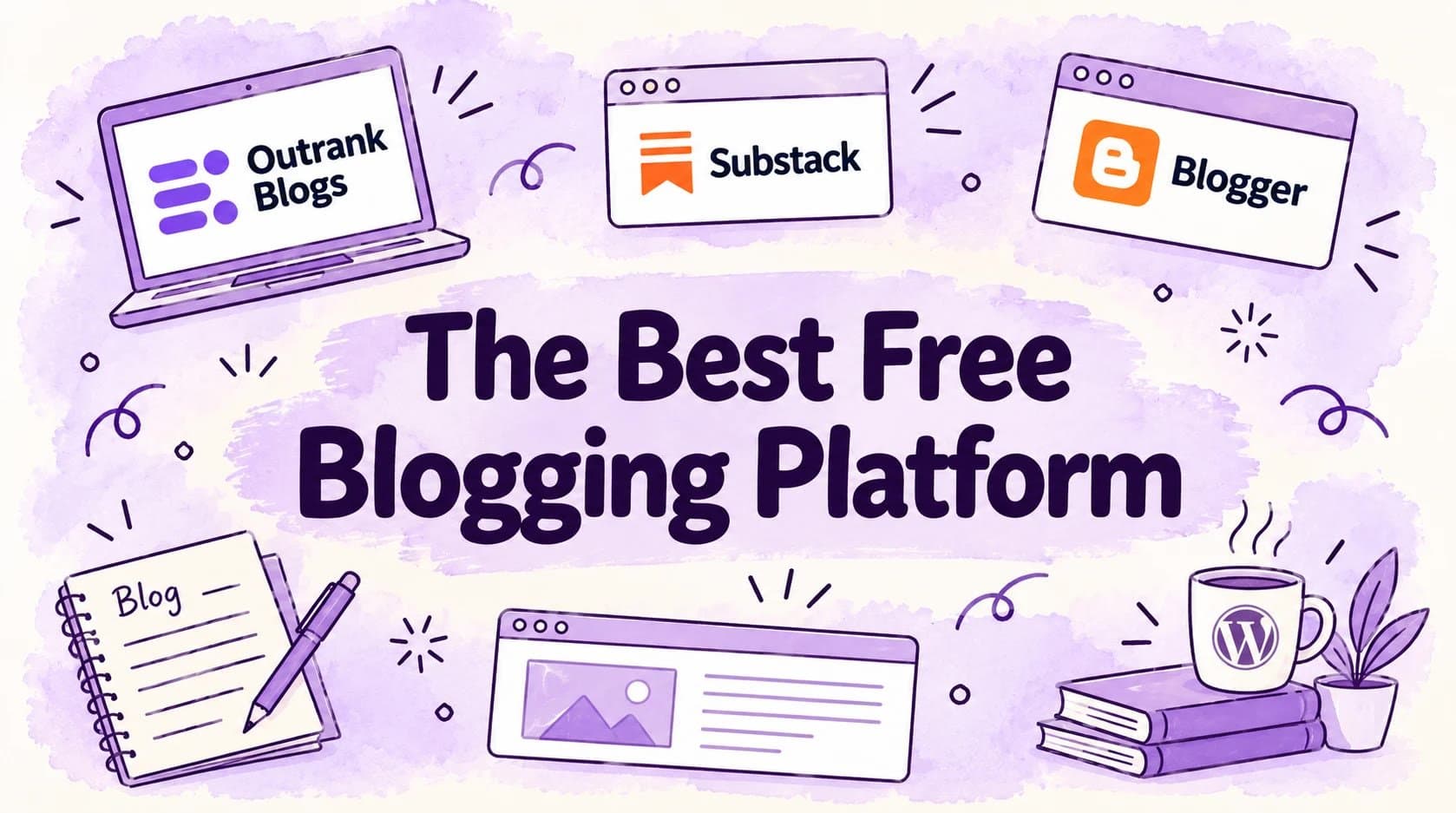
The best free blogging platform depends on what you're actually building. For a business or personal site that needs search traffic on your own domain: Outrank Blogs, free up to 10,000 visits a month with your own domain and no ads. For building a paid newsletter from scratch: Substack. For a personal blog with no usage limits and zero cost forever: Blogger.
That's the short version. Here's the honest longer one, including what most platform comparisons quietly skip: what "free" actually costs you.
What "Free" Actually Costs You on Most Platforms
Every free blogging platform makes a trade. Not all of them make it obvious.
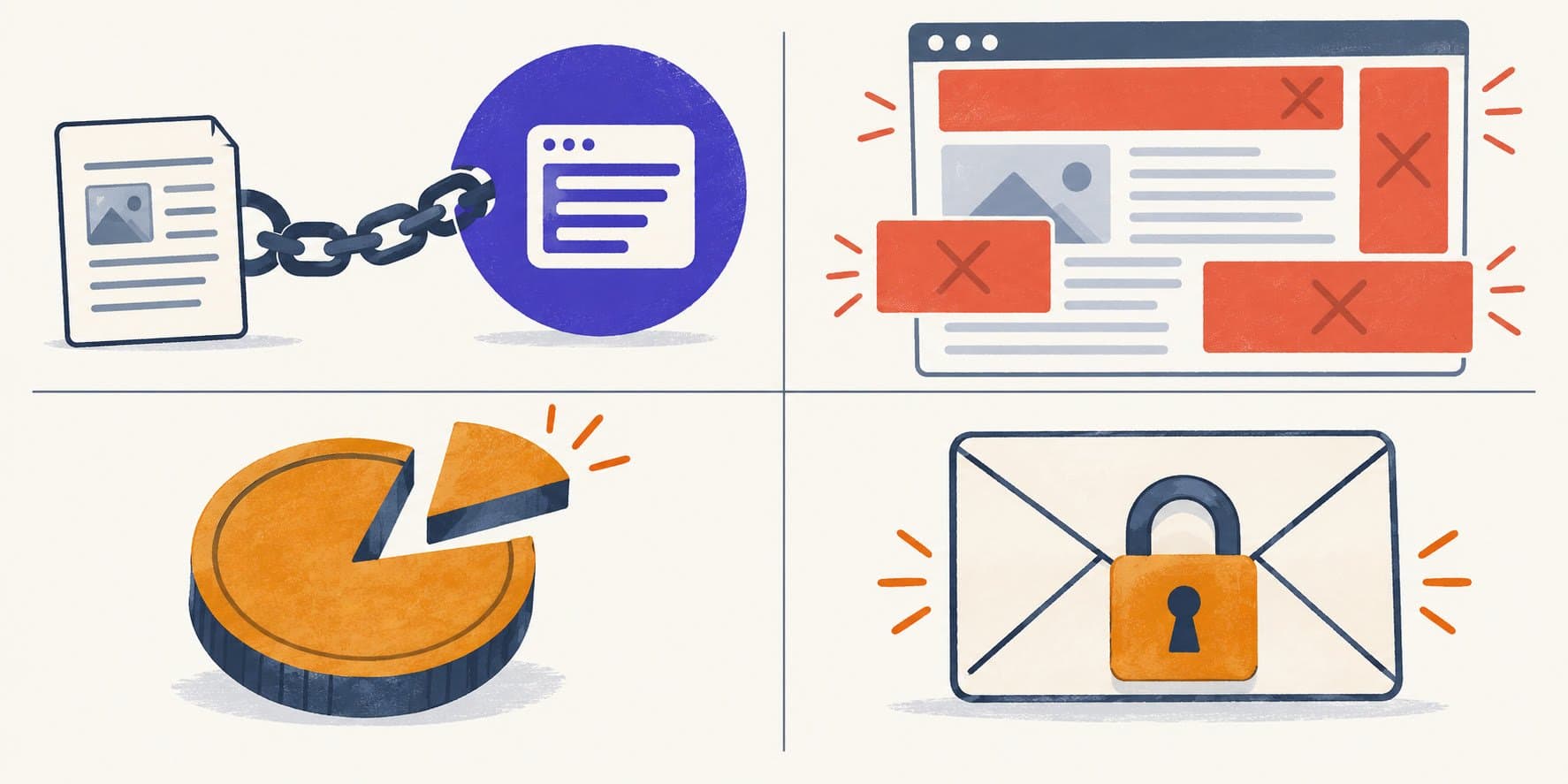
The four most common catches on free plans:
No custom domain. Your posts go live on wordpress.com, medium.com or substack.com. Every article you publish builds that platform's SEO authority, not yours.
Ads shown to your readers. WordPress.com and Wix display their own ads on your free site. You don't earn from them; your readers just see them.
A cut of your revenue. Substack keeps 10% of paid subscription income. That sounds fine at the start. At $5,000 a month in subscriptions, it's $500 going to Substack every month.
No way to take your audience with you. Medium and Tumblr don't give you your followers' email addresses. If you decide to leave, your audience doesn't come with you.
None of these are reasons to avoid free platforms outright. They're reasons to go in knowing the trade you're making.
The One Question That Settles It
Before you compare features, answer this:
Are you trying to get search traffic to your own website, or are you trying to reach an existing audience that's already on a platform?
These are genuinely different goals, and they point to different tools.

| Goal | Best free pick | Why it wins here |
|---|---|---|
| SEO traffic on your own domain | Outrank Blogs | Free custom domain, subfolder support, no ads, SEO set up automatically |
| Paid newsletter from scratch | Substack | Email + web archive in one, free until you earn, reader discovery network |
| Newsletter with 0% revenue cut | beehiiv | Free up to 2,500 subscribers, no platform cut on paid subscriptions |
| Reach readers immediately | Medium | Built-in audience; no setup, zero friction |
| Personal blog, no limit, free forever | Blogger | No visit cap, free custom domain, run by Google since 1999 |
| Developer with an existing site | GitHub Pages | Free hosting, any domain, full code control |
| Whole website plus a blog | Wix | Everything in one drag-and-drop editor (paid plan for a custom domain) |
Outrank Blogs: For SEO and Business Traffic
The detail that makes Outrank Blogs different in a free-plan comparison isn't the editor or the templates: it's subfolder support. You can run your blog at yourbrand.com/blog on the free plan. No other major free hosted blog offers this. Every article you publish builds your own website's SEO authority, not a subdomain's.
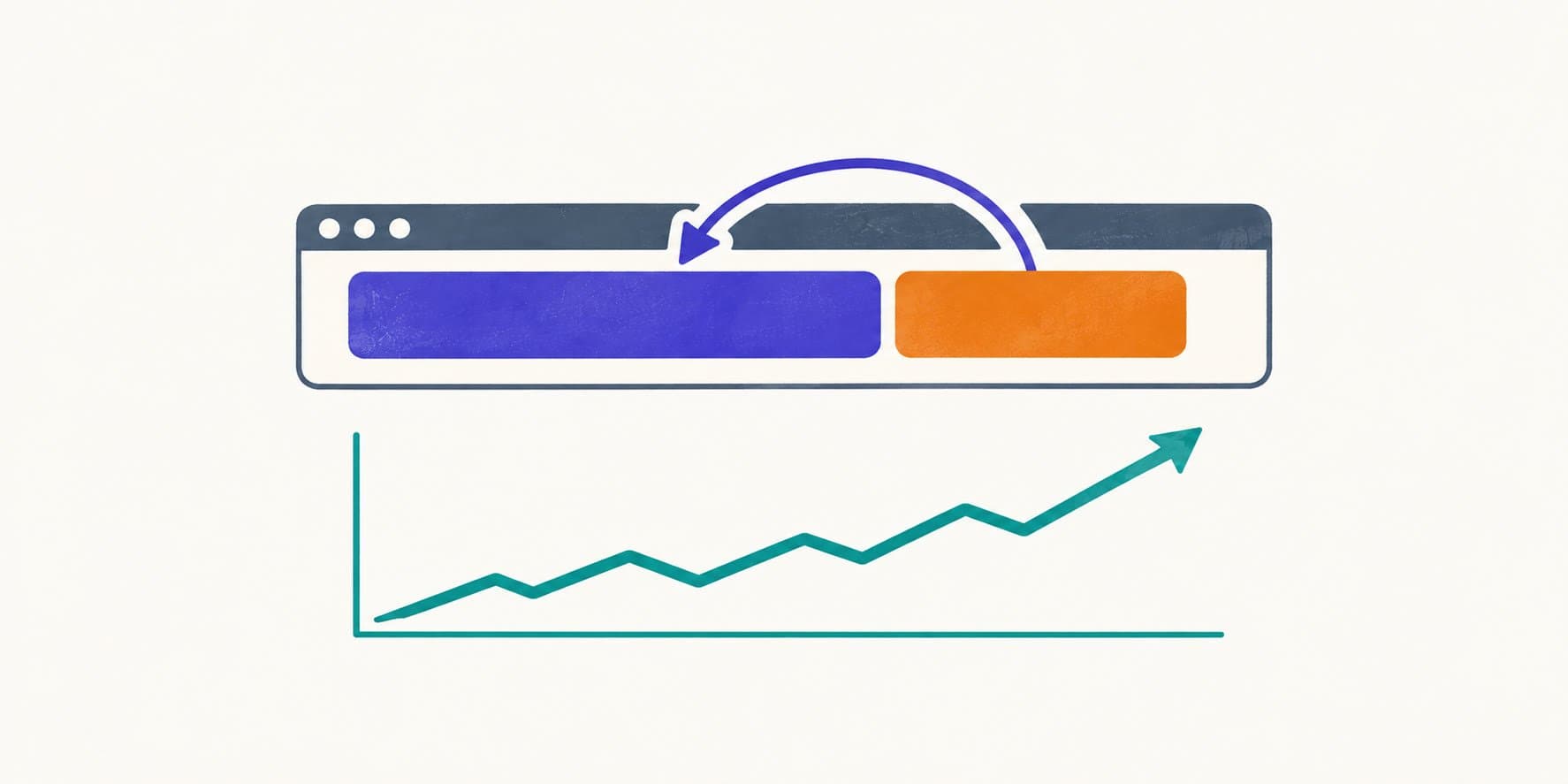
The free plan is $0, covers up to 10,000 visits a month, includes unlimited posts, your own domain or subfolder, no platform ads, and SEO basics (sitemap, structured data, IndexNow) configured automatically. A small "Published with Outrank" badge in the footer is the only branding.
The honest constraint is the 10,000-visit cap. Two months over it pauses new posts; the blog stays live either way. For most small businesses and early-stage sites, that's comfortable room before the upgrade question becomes real.
When you're ready to scale beyond what you can write yourself, the Organic Growth plan ($99/month) adds 30 AI-written SEO articles a month, keyword research, automatic internal linking and backlinks.
For a full comparison of Outrank Blogs against paid options like WordPress.org, Ghost and Squarespace: Best blog platform: the honest comparison →
Substack: For Paid Newsletters
On Substack's free plan, there's no monthly fee and no subscriber cap. The cost is 10% of paid subscription revenue. That's how Substack gets paid, and it compounds: at $5,000 a month in subscriptions, you're sending Substack $500 every month.
The other free-tier constraints: no custom domain without a one-time $50 fee, a substack.com address by default, no subfolder support, and minimal SEO customization (no structured data control, no IndexNow). If organic search traffic is part of your strategy, Substack's free plan doesn't support it.
For the broader picture on Substack as a platform choice, including how it compares to Ghost for professional publishers: best blog platform comparison → and Ghost vs. Substack →.
Medium: For Reach, Not Ownership
The free-tier cost on Medium is straightforward: posts live on medium.com, building Medium's domain authority instead of yours. Writers don't receive their subscribers' email addresses, so if you leave, your audience doesn't follow.
Medium's built-in reader network is real, and for writers testing ideas or supplementing a primary blog elsewhere, it's a legitimate distribution channel. As a primary publishing home, it's a channel you don't own.
Medium alternatives → | Outrank Blogs vs Medium →
Blogger: The Most Honest Free Blog
This is the one that surprises people. Blogger is Google's free blogging service, running since 1999, with no paid tiers and no visit limits. It's also the only platform here that is both free forever and lets you connect a domain you own at no charge.

The trade-offs are real. The interface feels dated. Editing the theme means writing HTML. Google deprecated the follow-by-email widget in 2021, so there's no built-in newsletter. You can't run the blog at yourbrand.com/blog.
But for a personal blog that will stay personal (no monetization plans, no SEO goals, just writing), Blogger is the most honest option on the market. There's no upgrade trap, no visit limit, no ads placed by the platform unless you add Google AdSense yourself.
If you want a free blog that costs nothing and will still exist in ten years, Blogger is a more reliable bet than most.
beehiiv: For Newsletter Creators Who Want Full Revenue
beehiiv is the newsletter platform that charges 0% of paid subscription revenue. The free plan covers up to 2,500 subscribers with unlimited sends, and the subscriber experience is cleaner than most alternatives.
The ceiling arrives quickly on the free plan. A custom domain, paid subscriptions and removing beehiiv branding all require the paid Lite plan ($49/month billed yearly). The free tier is for getting started; the real beehiiv value shows once you're on a paid plan, where the 0% revenue cut starts to mean something.
If you're building a newsletter you plan to monetize and Substack's 10% cut concerns you, beehiiv is worth running the numbers on.
A Note on WordPress.com and Wix
Both have free plans. Both show their own ads on your free site. That's the headline.

WordPress.com free gives you 1 GB of storage, a wordpress.com address and WordPress ads served to your visitors. Custom domains start at $4/month billed yearly. The WordPress editor is excellent, the ecosystem is vast, and the upgrade path is clear. The free tier isn't designed to serve you: it's designed to show you what paid would feel like.
Wix free gives you a wixsite.com address and a Wix banner across the top of every page. Custom domains start at $17/month billed yearly. As a full website builder with a blog included, Wix is worth evaluating on a paid plan. On the free tier, the banner ad is a real concession to hand your visitors.
Both platforms are solid paid products. Neither's free tier is something we'd point a business toward.
Other Platforms Worth Knowing
A few more come up often enough to mention:
HubSpot (free CMS): A free blog of up to 100 posts with a custom domain, tied into HubSpot's CRM and forms. Strong choice for B2B businesses already using HubSpot. HubSpot branding on free pages.
Hashnode: A free blog for developers on a hashnode.dev address, with a built-in tech-writer community. Custom domains are now behind a $5/month Hashnode Pro plan.
Bear Blog: A deliberately minimal blog with no ads or trackers. Fast, privacy-friendly, text-first. No image uploads or custom domain on the free plan.
GitHub Pages: Free static hosting with any domain, for developers who know Git. Pair it with Jekyll or Hugo for a blog. Not intended for business or SaaS sites.
For a full side-by-side of all 13 free platforms including Ghost, Squarespace, Webflow and Framer, with every plan limit checked at time of writing:
Full comparison: 13 best free blogging platforms →
How We Evaluated Each Free Plan
We built Outrank Blogs, and that conflict of interest is real. Our standard for this comparison was specific: we only credited a free plan for what it actually delivers without upgrading. Four criteria drove every evaluation: whether the custom domain is genuinely free, whether the platform puts ads on your site, whether the blog can run at yourbrand.com/blog, and whether the SEO basics (sitemap, structured data, IndexNow) work without installing anything.
That standard pushed us toward some conclusions that don't flatter our own product: Blogger is the more honest free option for personal blogs with no visit limit, and beehiiv is the better pick for newsletter creators who want no revenue cut. We've said both clearly rather than burying them.
Every figure comes from the platform's own pricing pages, checked at time of writing. Free plan limits change; verify before you commit.
Start a Free Blog With Outrank Blogs
If getting search traffic on your own website is the goal, Outrank Blogs was built for that job. Your domain or subfolder, no ads, and SEO handled automatically on the free plan.
The free plan covers 10,000 visits a month. When you're ready to scale, the Organic Growth plan ($99/month) writes 30 SEO articles a month and handles keyword research, internal linking and backlinks.
Once you've picked your platform, this guide covers the full setup: How to start a blog for free.
Frequently Asked Questions
Is there really a free blogging platform with no catch?
Almost every free platform has one. WordPress.com and Wix show ads on your site. Substack takes 10% of paid subscription revenue. Most platforms keep you on their subdomain instead of your own domain. Outrank Blogs has a 10,000-visit-per-month cap. The combination with the fewest catches for a business blog is Outrank Blogs: no ads, your own domain or subfolder, no revenue cut, with the visit cap as the trade-off. For a personal blog with genuinely no ceiling, Blogger is free forever with a custom domain and no platform restrictions.
What free plan limits should I check before committing to a platform?
The ones that catch people off guard most often: visit caps (Outrank Blogs is free up to 10,000/month; Blogger and most others have none), post counts (HubSpot's free plan caps at 100 posts), storage (WordPress.com's free plan gives you 1 GB), and whether a custom domain is genuinely free or locked behind a paid upgrade. Revenue cuts aren't a limit exactly, but they're a free-plan cost worth checking early: Substack's 10% of paid subscriptions is the most significant one. Finding these limits after you've built an audience on a platform makes migration much harder.
Is there a free blogging platform with no ads?
Yes. Outrank Blogs, Blogger (unless you add AdSense yourself), Substack, Medium, Bear Blog and GitHub Pages show no platform ads on your site. WordPress.com and Wix show their own ads on free plans.
Can a free blog run at yourbrand.com/blog?
With Outrank Blogs, yes. Subfolder support is included on the free plan, with setup guides for Next.js, Vercel, Netlify, Cloudflare and nginx. Self-hosted WordPress can also run in a subfolder, but you pay for hosting. No other major free-hosted platform supports a subfolder on a free plan.
What happens when I hit the 10,000 visit limit on Outrank Blogs' free plan?
Two consecutive months over 10,000 visits pauses new posts until you upgrade. The blog stays live and all existing posts remain accessible to readers. Upgrading to the Organic Growth plan ($99/month) removes the cap entirely and adds 30 AI-written SEO articles a month, keyword research, automatic internal linking and backlinks. If you're already hitting 10,000 visits a month on a free blog, that upgrade typically pays for itself quickly.
Is Substack actually free?
Substack has no monthly fee and no subscriber cap. The cost is 10% of paid subscription revenue, plus a one-time $50 fee if you want a custom domain. If you plan to monetize, the 10% share is the number to track: at $5,000/month in subscriptions, that's $500 per month to Substack.
What is the easiest free blogging platform to start with?
Medium is the fastest: create an account, write, publish. No settings, no domain, no setup. The trade-off is that you're building on medium.com's authority, not your own. If you want a little more setup but full domain ownership, Outrank Blogs is the next easiest: pick a template, connect your domain, and you're live.