Here's the thing nobody tells you when you're picking a newsletter platform: most of them are quietly bad at getting your content found on Google.
They're built to deliver emails. The web archive (the publicly accessible version of every issue you've written) is almost always an afterthought. You end up with a newsletter that reaches your existing subscribers and can't reach anyone else, because search engines can't find it.
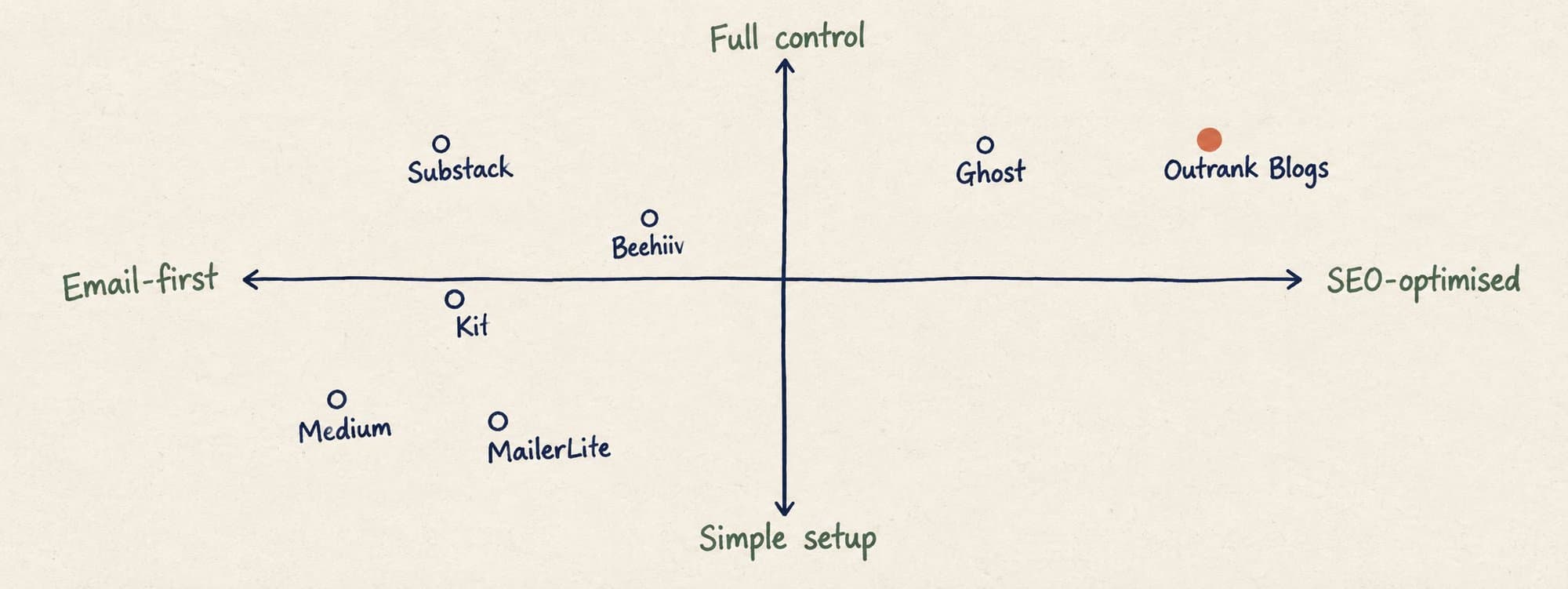
That's the lens we used for this comparison. We looked at the usual criteria: subscriber limits, pricing, monetization, ease of setup. And we added the one that most comparisons skip: how well each platform handles your public content archive, and whether your writing can actually grow an audience beyond the people already subscribed.
The Short Answer
For most new creators, Beehiiv is the best starting point: a 2,500-subscriber free tier, unlimited sends, and growth tools built into the product from day one. If you just want to write with zero friction and let a built-in network surface your work to readers, Substack still earns its reputation. If organic search is part of your strategy, Ghost or Outrank Blogs deserve serious consideration.
How We Evaluated Each Platform
| Platform | Free tier | Paid entry point | Custom domain | Web archive SEO | Best for |
|---|---|---|---|---|---|
| Beehiiv | 2,500 subs, unlimited sends | $49/month (annual) | Requires Lite plan | Moderate | Growth-focused creators |
| Substack | Unlimited subs | 10% cut on paid subs | $50 one-time fee | Basic | Independent writers |
| Ghost | Self-hosted free | $18/month (Starter, annual) | Yes, all paid plans | Strong | Technical publishers |
| Kit (ConvertKit) | 10,000 subs | $33/month (Creator, annual) | Yes, free | Basic | Creators selling products |
| Medium | Unlimited posts | N/A (Partner Program) | $5/month or $50/year membership | Poor | Writers wanting built-in audience |
| MailerLite | 250 subs, 2,500 emails/month | $12/month (Comfort, annual) | Yes, paid plans | Minimal | Email-first beginners |
| Outrank Blogs | 10,000 visits/month, unlimited posts | $99/month (Organic Growth) | Yes, free | Strong (sitemap, structured data, IndexNow) | SEO-first blogs with RSS newsletter |
The Platforms, One by One
Beehiiv
Beehiiv was built by people who used to run Morning Brew, one of the fastest-growing newsletters of the last decade. That context matters: this platform was designed to grow newsletters, not just send them.
The free "Launch" plan gives you 2,500 subscribers with unlimited sends, a recommendation network that can surface your publication to readers of similar newsletters, and an analytics dashboard that shows where each subscriber came from. For newsletter growth specifically, nothing in this list comes close at zero cost.
What it does less well: the web archive is functional but not built for search. Custom domain support requires the Lite plan at $49/month (annual billing). Beehiiv branding is only removed on the Pro plan ($95/month). If you want your past issues to rank for keywords or your publication to look unbranded, those features cost money.
Best for: Creators who want to grow a subscriber list fast and are happy with email as their primary distribution channel.
Don't use this if: Custom domain matters from day one, or you want your content to generate organic search traffic alongside email subscribers.
Substack
Substack made newsletters mainstream again, and two things still set it apart: the discovery network and the simplicity.
Setting up a Substack publication takes less than 20 minutes. Within days of publishing, if a larger Substack recommends your work, you can gain dozens of real subscribers overnight. According to Substack's own figures, more than half of new subscribers come through its internal network. For writers who want to focus on writing rather than growth strategy, that's a genuinely compelling combination.
The honest trade-offs: Substack takes 10% of every paid subscription payment, plus Stripe's 2.9% + $0.30 per transaction on top. A custom domain costs a one-time $50 fee and is limited to a subdomain format (like www.yourdomain.com), meaning your posts still build substack.com's domain authority unless you pay. Design flexibility is minimal by design. And Substack's SEO features, including sitemaps and Search Console verification, are only unlocked as your publication grows rather than being available to everyone from the start.
Best for: Independent writers, journalists, and experts who want to build a reader-supported publication through Substack's built-in network.
Don't use this if: You need a custom domain from day one at no extra cost, or if the 10% platform fee will meaningfully eat into your revenue as you scale.
See also: 7 Best Substack Alternatives: Without the 10% Cut.
Ghost
Ghost is where serious publishers eventually end up. It's open-source, which means you can self-host it for free on any server, or pay for Ghost Pro managed hosting starting at $18/month (Starter, billed yearly). Custom domain is included on every Ghost Pro plan.
One important detail: paid subscriptions require the Publisher plan ($29/month billed yearly), not Starter. Ghost takes 0% of subscription revenue on Publisher and above, compared to Substack's 10%. At modest subscription revenue, the math still favors Substack; the break-even where Ghost becomes cheaper is roughly $3,500 a year in paid subscription income. Above that, Ghost saves money at every scale.
The SEO story is the strongest among the email-first platforms here: clean URL structures, XML sitemap generation, schema markup support, full custom domain control, and solid handling of canonical URLs. Ghost was built by people who thought about how web content gets discovered, not just delivered to inboxes.
The honest trade-offs: self-hosting requires a server and at least basic technical confidence. Ghost Pro Starter ($18/month) can't accept paid subscriptions, so you'd need Publisher ($29/month) to monetize. There's no built-in discovery network, meaning audience growth is entirely on you.
Best for: Technical creators and publishers who want full ownership, 0% platform fees on paid subscriptions from the Publisher plan, and a strong SEO foundation.
Don't use this if: You don't want to manage hosting or pay for Ghost Pro before your newsletter earns anything.
See also: Ghost vs Substack: Fees, SEO and Which to Pick.
Kit (formerly ConvertKit)
Kit occupies an interesting position: it's the tool of choice for creators who are building businesses, not just audiences.
The free tier has a subscriber cap that no one else matches at zero cost: 10,000 subscribers, free, with a custom domain included. You also get unlimited landing pages and the ability to sell digital products from day one. Kit takes 3.5% + $0.30 per transaction on digital product sales, with no additional platform fee at the free tier level. For a creator who wants to run a free newsletter, sell an ebook or course, and not pay a monthly platform fee until they have a significant audience, that combination is hard to beat.
Where Kit falls short is automation depth and the web-archive side. Visual automations and email sequences are locked to the Creator plan ($33/month billed yearly for 1,000 subscribers; price scales with list size). The free plan also carries Kit branding in your emails and on landing pages, removable only on paid plans. The public newsletter pages are functional but not SEO-optimized in any meaningful way.
Best for: Creators, coaches, and entrepreneurs who need a large free subscriber cap and want to sell digital products without monthly platform costs from day one.
Don't use this if: Your primary goal is building a content archive that grows through organic search, or you need advanced automation on the free plan.
Medium
Medium is not a newsletter platform in the conventional sense. You write there, Medium owns the URL, and you never fully control the reader relationship. There's no subscriber list you can export, no standalone custom domain on the free tier (it requires an active Medium membership at $5/month or $50/year), and no meaningful way to take your audience with you if you leave.
That said, Medium's built-in distribution is real. Articles can pick up significant traffic through Medium's recommendation algorithm and its presence in search results. The Partner Program pays you based on reading time from paying Medium members, which can add up for high-performing posts.
The long-term problem is ownership. Every post you publish builds medium.com's domain authority, not yours. Your audience belongs to Medium's platform, and the reader email addresses are not shared with writers.
Best for: Writers who want immediate distribution and don't need to own the audience relationship.
Don't use this if: Building an owned audience or content archive matters to you long-term.
MailerLite
MailerLite is an email marketing tool built for simplicity. The free plan gives you 250 subscribers and 2,500 email sends per month. It includes one website, one landing page, three active automations (with up to five steps each), and a drag-and-drop editor. Getting automation access on a free plan at all is genuinely rare; most competitors make you pay for it.
That said, 250 subscribers is a tight ceiling. You'll need to upgrade to the Comfort plan ($12/month billed yearly, base price) to get more sending volume and remove the subscriber cap. MailerLite's public email archive exists but won't drive search traffic. This is an email tool that's good at being an email tool.
Best for: New creators and small businesses who want to start building an email list with automation included, at zero cost, before upgrading.
Don't use this if: You expect to grow past 250 subscribers quickly, or you want a public blog-style archive that grows through SEO alongside your email list.
Outrank Blogs
Outrank Blogs approaches this from a different angle: it's a hosted blog builder with the SEO infrastructure most newsletter platforms are missing.
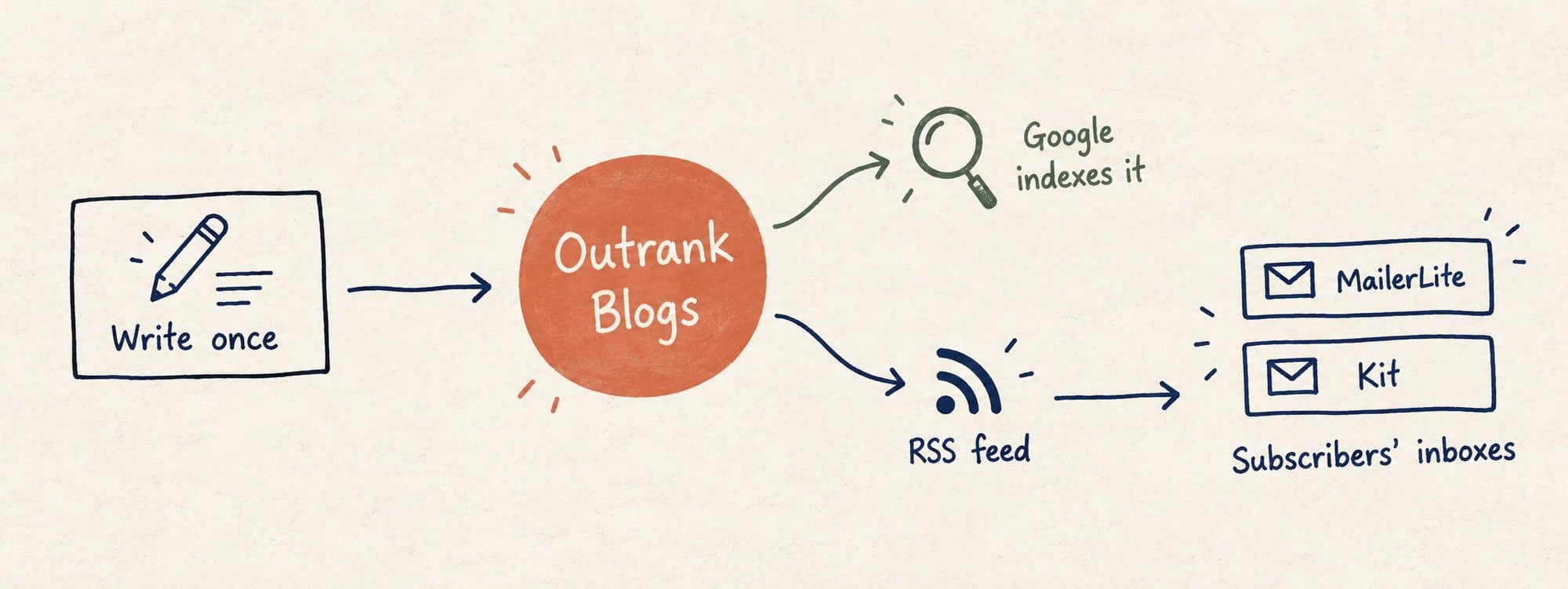
The free plan is $0 for up to 10,000 visits per month, with unlimited posts. You get a block-based editor, a free outrankblog.com subdomain (or connect your own domain, also free), an auto-generated sitemap, RSS feed, structured data, and IndexNow, which means new posts are submitted to search engines automatically rather than sitting in a queue waiting to be crawled. Free blogs show a small "Published with Outrank" badge in the footer. There are no ads, ever.
The RSS feed is the key bridge for newsletter-first creators: connect your Outrank Blogs content to any free email tool (MailerLite, Kit, or even Mailchimp) and your subscribers get each post automatically in their inbox. Your content lives at a URL you own, gets indexed properly by Google, and generates search traffic, while your email subscribers still get it delivered.
If Substack is where you write to be discovered within Substack, Outrank Blogs is where you write to be discovered through Google.
The Organic Growth plan ($99/month) adds 30 AI-written SEO articles per month, keyword research, automatic internal linking, and backlinks, for creators and small businesses who want to scale content production beyond what they can write themselves.
Best for: Creators and small businesses who want their content to grow through search, with a zero-cost entry point and no technical setup required.
Don't use this if: You need a native email send feature in the same tool. Pair it with a free email platform for full newsletter delivery.
Why Trust This Article
We run Outrank Blogs and work with hundreds of creators and small businesses building content programs. We evaluated these platforms against concrete criteria: exact free-tier limits, what paid plans actually unlock, how the public web archive handles SEO, and what happens when you want to leave. Pricing and free-tier terms across all these platforms change; figures in this article reflect what was live on each platform's pricing page at time of writing. Verify directly before signing up.
Where Outrank Blogs Fits In
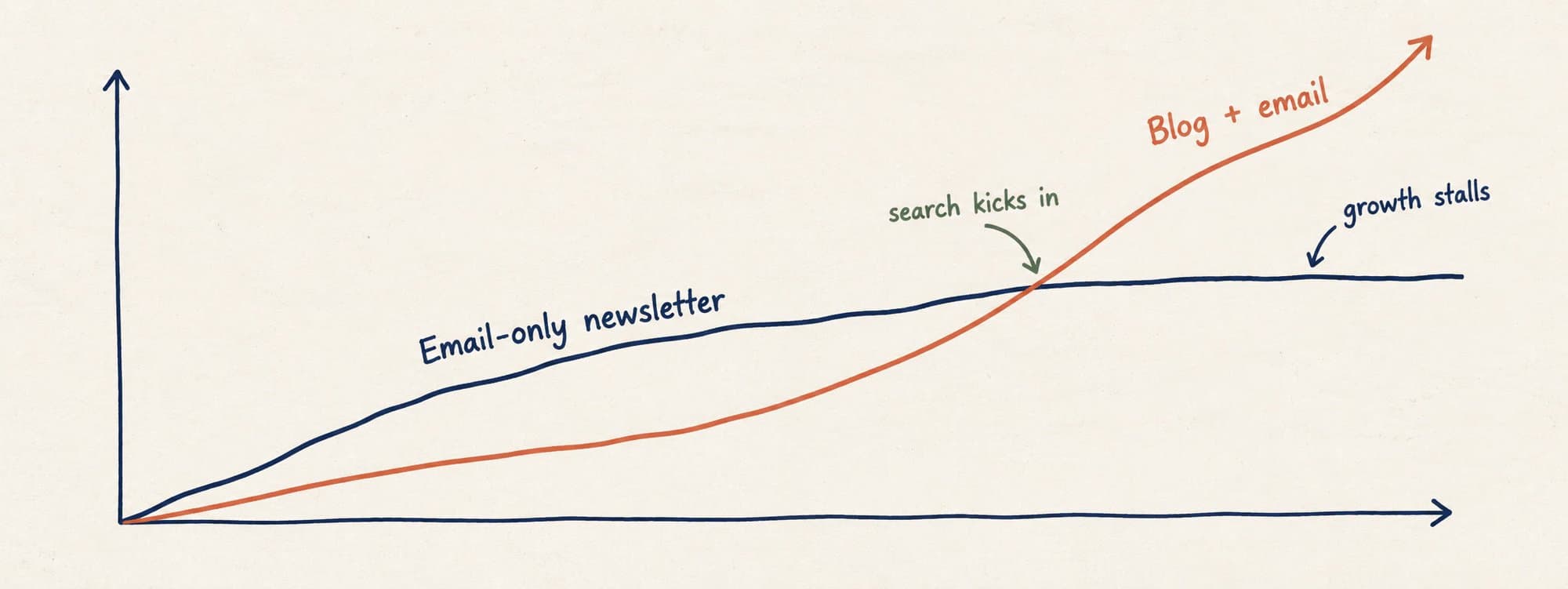
Most creators pick a newsletter platform, grow an email list, and eventually realize their content isn't discoverable to anyone who hasn't already subscribed.
Outrank Blogs is the simplest answer to that problem: start with a free hosted blog that handles sitemap generation, structured data, and IndexNow out of the box, then add email delivery via RSS using any free newsletter tool. You get both channels without paying for either to start.
As your content grows and search traffic builds, the Organic Growth plan ($99/month) gives you AI-written SEO articles, keyword research, and automatic internal links, turning your blog into a compounding traffic source rather than just an email list.
Get started free with Outrank Blogs. See how Outrank Blogs compares head-to-head at Best Free Blogging Platforms.
Frequently Asked Questions
What is the best newsletter platform for beginners?
Beehiiv is the strongest starting point for most beginners: a 2,500-subscriber free tier, unlimited sends, and growth tools included at no cost. Kit is the better pick if you need a higher free subscriber cap (10,000) and want to sell digital products from day one. Substack works well if you want zero setup friction and are comfortable with the 10% revenue share once you start charging for access.
Which newsletter platform is best for SEO?
Most newsletter platforms are built for email delivery, not search discoverability. Ghost has the strongest SEO story among the email-first platforms: clean URL structures, sitemap generation, schema markup, and custom domain control on every paid plan. If organic search is your primary growth channel, Outrank Blogs gives you a dedicated blogging platform with SEO features built in (sitemap, structured data, IndexNow), then pair it with any free email tool via RSS.
What is the difference between Substack and Beehiiv?
Both platforms let you publish newsletters for free, but the models differ. Substack earns by taking 10% of paid subscriptions, so its incentive aligns with your growth; the built-in discovery network reflects that. Beehiiv charges a monthly platform fee on paid plans (Lite at $49/month, billed yearly) and keeps 0% of subscription revenue on those tiers, giving you more growth tools and better analytics. For writers who want to monetize through paid subscriptions at scale, the difference in take rate becomes significant over time.
Can I switch newsletter platforms later?
Yes, but the ease varies. Beehiiv, Kit, Ghost, and MailerLite all support subscriber list export as a standard feature. Substack makes exporting your email list straightforward, though content migration is more manual. Medium is the hardest to leave: there's no subscriber list to export, and your content URLs don't transfer with you. Factor in exit flexibility when choosing, especially if you're starting small and expect to grow.
Does my newsletter archive rank on Google?
It depends on the platform. Substack archives do appear in search results but aren't technically optimized for ranking. Ghost archives rank well if configured correctly. Medium articles can rank, but you don't control the URL or the audience. Beehiiv's public pages are functional in search but not purpose-built for it. If consistent search traffic from your archive matters, Outrank Blogs is built specifically for that use case, with sitemap generation, structured data, and IndexNow handled automatically.
Is Outrank Blogs a newsletter platform?
Outrank Blogs is a hosted blog builder with a free plan that includes RSS, structured data, a sitemap, and IndexNow. It doesn't send emails natively. The intended setup for newsletter creators: publish on Outrank Blogs so your content is SEO-indexed and lives at a URL you own, then connect a free email tool like MailerLite or Kit via RSS to deliver each post to your subscribers automatically. You get both channels without paying for either.