


Ezoic is an AI-powered display ad monetization platform that helps website owners earn more than AdSense by running automated tests on ad placement, size, and density. In February 2026, Ezoic raised its standard traffic requirement to 250,000 monthly active users, fundamentally changing who the platform is realistically accessible to.
Whether Ezoic is worth it in 2026 depends almost entirely on where you sit relative to that threshold, what niche you're in, and how much technical setup you're willing to manage.
Quick Verdict: Ezoic by Publisher Size
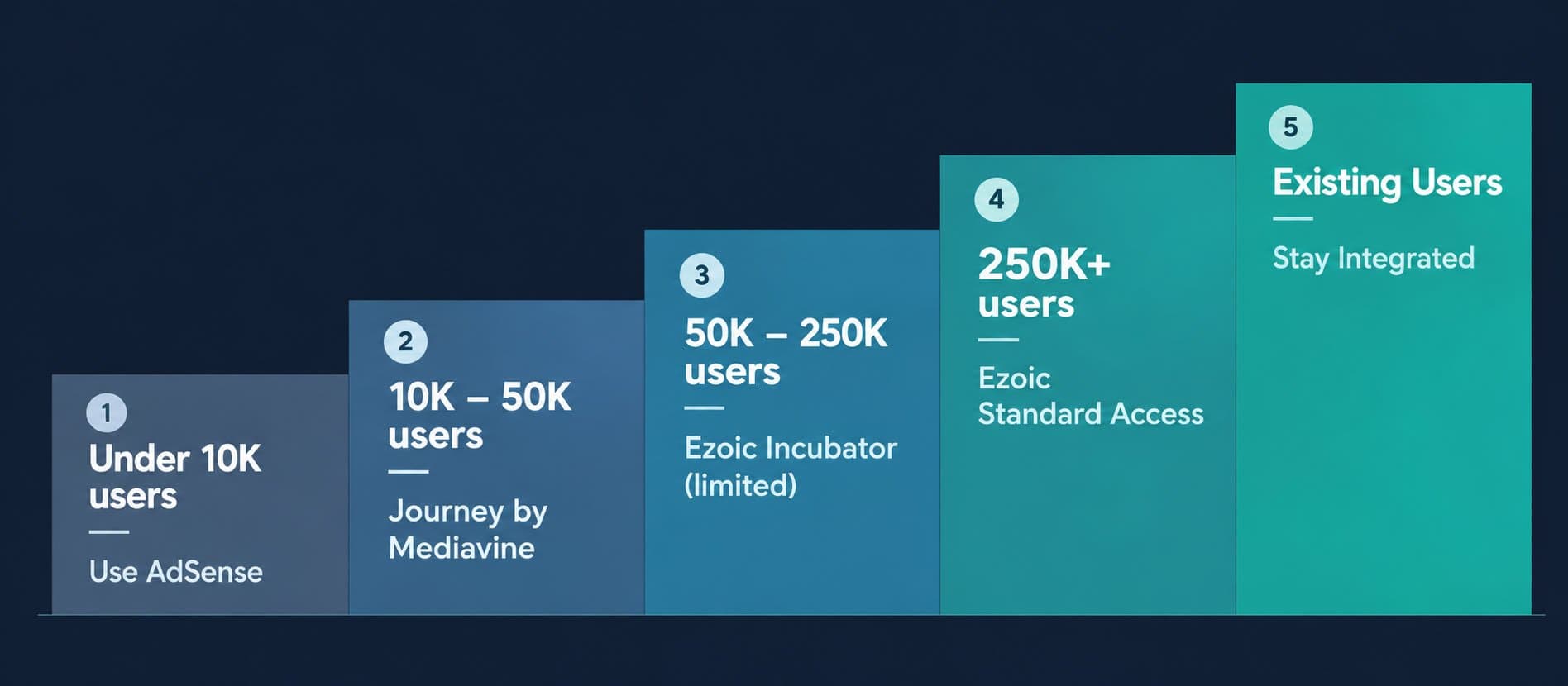
| Publisher stage | Monthly users | Ezoic recommendation |
|---|---|---|
| Early-stage blogger | Under 10K | Not applicable. Use AdSense. |
| Growing site | 10K–50K | Standard path closed. Consider Journey by Mediavine. |
| Mid-tier publisher | 50K–250K | Standard path closed. Apply to Incubator (limited spots). |
| Established publisher | 250K+ | Strong option. Meaningful EPMV gains over AdSense. |
| Existing Ezoic user | Any (grandfathered) | Stay integrated. Leaving for 7+ days loses grandfathered status. |
What Is Ezoic?
Ezoic is a display advertising and site optimization platform founded in 2010. It positions itself as an AI-driven layer between your content and programmatic ad buyers, running thousands of layout and placement experiments to find the configuration that maximizes revenue without destroying user experience.
Beyond ads, Ezoic has expanded into a suite of publisher tools:
Leap: Site speed optimization designed to improve Core Web Vitals
NicheIQ: A keyword research and topic-planning tool built for bloggers
HUMIX: A video ad network that lets publishers earn from video content without producing their own
Big Data Analytics: Revenue and traffic analytics at the URL level, more granular than Google Analytics
The ad platform itself connects publishers to Google Ad Exchange and a broader pool of programmatic demand, which is the core reason Ezoic tends to outperform AdSense on revenue.
How Ezoic's Ad Testing Works
When you integrate Ezoic, it begins running multivariate tests across your pages: different ad sizes in different positions, varying ad density, different consent configurations. Each variation is served to real visitors, and Ezoic's algorithm surfaces the layout that generates the highest EPMV (earnings per thousand visitors) for your specific audience.
This is genuinely more sophisticated than placing a few AdSense units manually. The tradeoff is that during active testing phases, revenue is volatile. A strong week can be followed by a weak one. That's the algorithm gathering signal, not a sign that something broke. Most publishers report stabilization after several months, with EPMV settling into a consistent range.
The testing layer also introduces JavaScript overhead. Ezoic's own Leap tool is designed to offset this, but the net effect on your Core Web Vitals depends on your existing setup, your hosting stack, and how you integrate. Some publishers see scores improve. Others see them worsen. Plan for a testing period before drawing conclusions.
Ezoic's 2026 Traffic Requirements: What Changed and Why It Matters
The most significant development for anyone researching Ezoic right now is the February 2026 traffic floor increase.
What changed: Ezoic now requires 250,000 monthly active users, verified through Google Analytics, for standard platform access. This is a major increase from the previous low-traffic routes the platform offered.
Who is grandfathered: Publishers monetizing on Ezoic before February 19, 2026 retain access as long as they remain continuously integrated. Remove the integration for more than seven consecutive days and grandfathered status is lost. This matters during site migrations or hosting moves.
The Incubator program: Ezoic maintains a selective program for smaller publishers, but acceptance is limited to 20 publishers per month based on content quality, engagement, and growth trajectory. Rejected applicants cannot reapply immediately.
The practical implication: For the 10K–100K monthly user segment that historically used Ezoic as a stepping stone between AdSense and Mediavine, that path no longer exists through Ezoic's standard application. The ladder was pulled up.

At 250K monthly active users, publishers have already cleared Mediavine's 50K session threshold by a significant margin and also qualify for premium-tier networks like Raptive (formerly AdThrive). Ezoic is no longer the obvious intermediate step.
Ezoic EPMV: What You Can Realistically Expect
Ezoic does not publish official EPMV benchmarks. Based on aggregated publisher data:
| Content niche | Typical EPMV range |
|---|---|
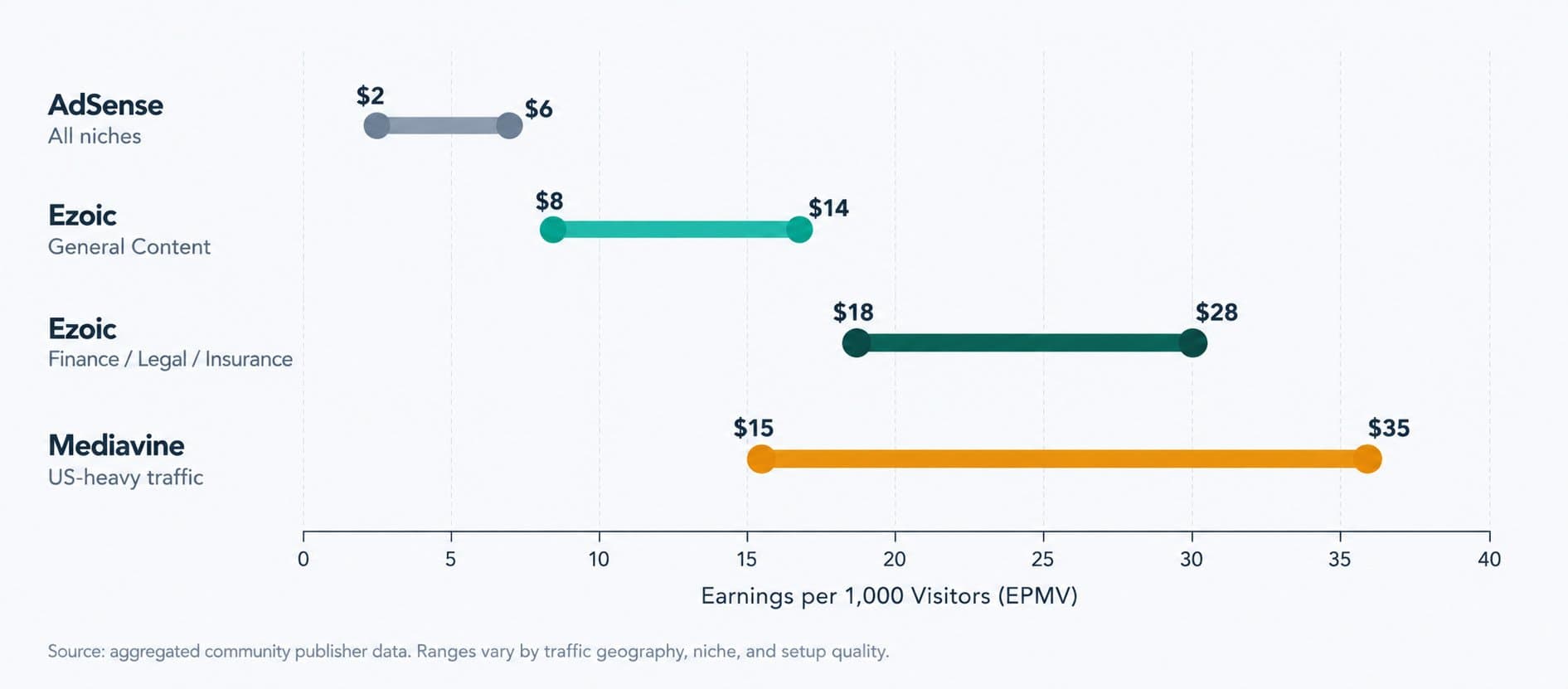
| General content (lifestyle, blogging, how-to) | $8.40 to $14.20 |
| Finance, legal, insurance | $18 to $28 |
| International-heavy traffic | Lower (varies significantly by country) |
These numbers assume the publisher has completed setup correctly and allowed enough time for the AI to finish its testing cycle. Publishers who skip optimization steps or integrate minimally tend to fall into the $6 to $9 EPMV band.
For comparison, Mediavine publishers on US-dominant content in food, lifestyle, and home see RPMs of $15 to $35. The Ezoic ceiling is real but the gap is narrower than commonly assumed, particularly for international traffic where Mediavine's demand advantage shrinks.
Integration: What the Setup Actually Involves
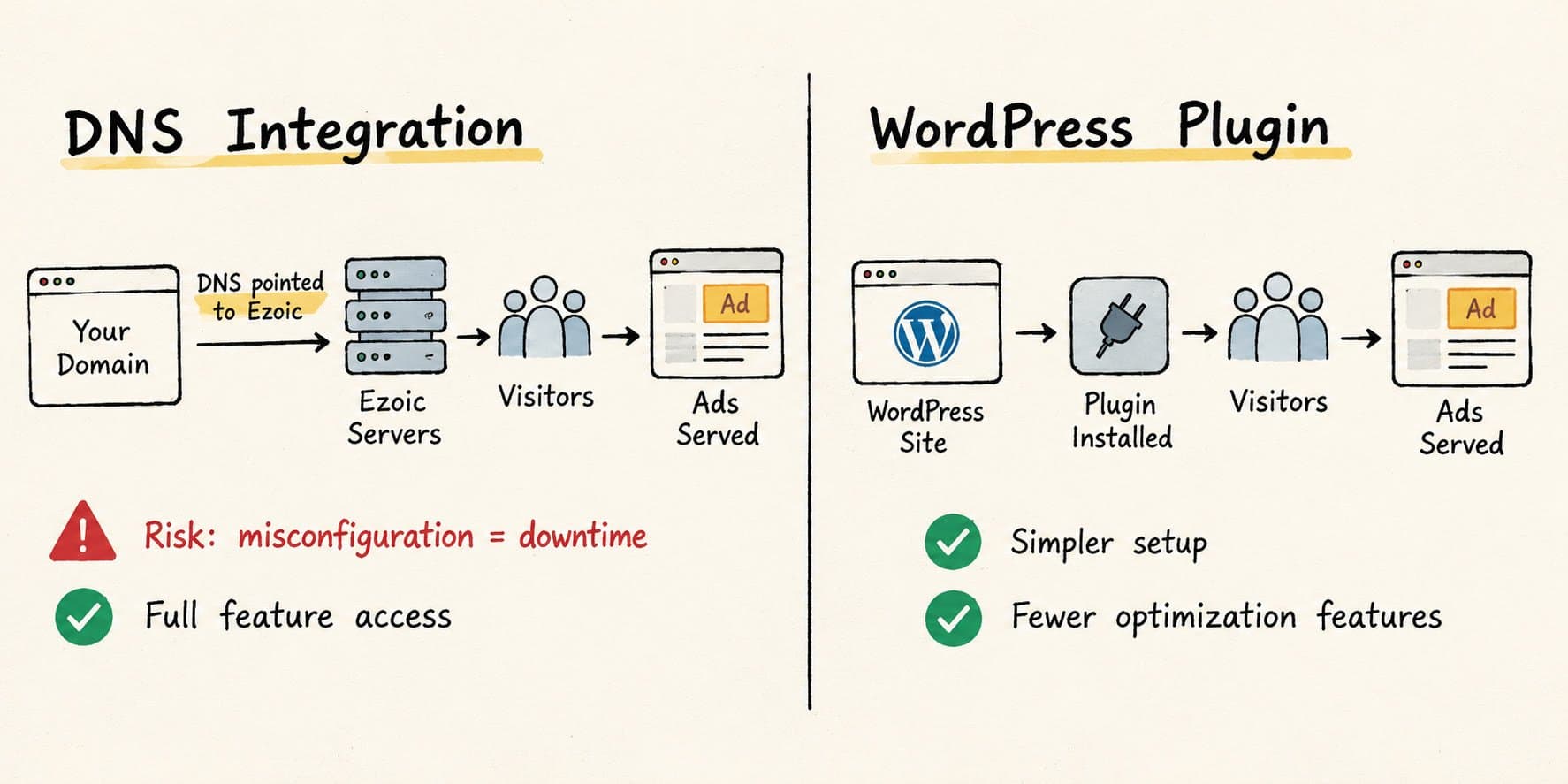
There are two main integration paths, and the choice matters.
DNS integration (recommended by Ezoic): You point your domain's DNS to Ezoic's servers. This gives Ezoic full control over the ad layer and access to all optimization features. Done correctly, it works reliably. Done with a misconfiguration, it can cause 5xx errors, intermittent downtime, and in severe cases, indexing problems while errors persist.
WordPress plugin: A simpler path that does not require DNS changes. Ezoic treats it as a secondary option. Some publishers report fewer optimization features and differences in analytics behavior compared to the DNS path.
A few things to confirm before integrating regardless of which path you choose:
Your hosting provider does not block Ezoic's crawl IPs (some shared hosting environments do, which can cause errors Ezoic cannot fix from their side)
You understand how SSL is handled through Ezoic's layer to avoid mixed content issues
You have a baseline Core Web Vitals score documented before integration, so you can measure Leap's actual impact
Ezoic Support: What Level You Get
Ezoic tiers its support access:
Level 1 publishers: Community forum support only. No direct ticket access.
Level 2 and Level 3 publishers: Direct ticket support.
Level assignments are based on traffic and revenue benchmarks. This means a new publisher working through a technical integration issue is directed to community resources rather than a support rep. For publishers with straightforward setups, this is usually fine. For those hitting edge cases with DNS or hosting conflicts, it can extend resolution time significantly.
Ezoic vs. AdSense vs. Mediavine
For a deeper breakdown of the Ezoic vs. AdSense decision by traffic tier, see our dedicated Ezoic vs. AdSense comparison.
| Factor | AdSense | Ezoic | Mediavine |
|---|---|---|---|
| Traffic requirement | None | 250K monthly active users | 50K monthly sessions |
| Setup complexity | Low | High | Medium |
| EPMV range (US general content) | $2 to $6 | $8 to $14 | $15 to $35 |
| Ad density control | Full control | AI-managed (manual override available) | Percentage-capped by default (28% mobile / 20% desktop) |
| Speed impact | Minimal | Variable (Leap helps but not guaranteed) | Low |
| Support access | Self-serve | Tiered (Level 1: community only) | Full support |
| Revenue exclusivity | No | No | Yes (display exclusivity required) |
| International traffic performance | Moderate | Strong | Lower relative to US |
Ezoic Pros and Cons
What works:
Genuine EPMV improvement over AdSense for publishers who complete setup and allow the AI to run
URL-level revenue attribution through Big Data Analytics, which AdSense and most alternatives don't offer
Strong performance on international traffic
Flexibility: no display exclusivity requirement, so you can run other monetization alongside it
NicheIQ and HUMIX add value for content publishers beyond just ad revenue
What to watch:
Revenue volatility during active testing phases can be disorienting and can last several months
DNS integration carries technical risk; misconfiguration causes real problems
Leap does not guarantee Core Web Vitals improvement and can worsen scores on certain setups
Level 1 support is community-only, which limits options when something genuinely breaks
The 250K floor closes Ezoic off for most publishers in the growth phase
Why Trust This Review
We've analyzed Ezoic's published documentation, official policy updates, and aggregated publisher data from community sources and third-party review platforms. EPMV ranges cited reflect consensus data from multiple independent publisher reports rather than single-site anecdotes. Where data is unavailable or contradicted across sources, we've said so rather than presenting a false precision.
We do not have a commercial relationship with Ezoic. The analysis is based on what the evidence actually shows.
Where Content Automation Fits Into This Picture
The publishers who get the most out of Ezoic are the ones generating enough content to sustain real traffic volume. At 250K monthly active users, you are not running a handful of posts. You're running a content operation.
The sites that reach that threshold consistently are typically publishing on a schedule, covering their niche systematically, and treating content as infrastructure rather than a series of one-off pieces. Scaling content marketing requires a repeatable system, not a burst of articles.
Outrank's platform is built for exactly that: researching keywords, writing and publishing 30 to 90 optimized articles a month on a schedule, and connecting directly to WordPress, Webflow, Shopify, and other CMS platforms where your content lives. If Ezoic is the monetization layer, content automation is what gets you to the traffic threshold that makes Ezoic viable in the first place.
For teams managing multiple sites, the math is even clearer. A portfolio approach to content and monetization, using tools like the best AI writers for SEO to keep publishing velocity up across properties, is how publishers compound Ezoic's per-URL revenue attribution into meaningful aggregate returns.
Frequently Asked Questions
What is Ezoic's traffic requirement in 2026?
Ezoic raised its standard traffic floor to 250,000 monthly active users in February 2026, verified through Google Analytics. Publishers already on the platform before that date are grandfathered in as long as they remain continuously integrated without a gap of more than seven days. An Incubator program exists for smaller publishers but accepts 20 applicants per month.
How much can you earn with Ezoic?
Ezoic does not publish official benchmarks. Community data puts general content sites between $8.40 and $14.20 EPMV for primarily US traffic, with finance, legal, and insurance niches reaching $18 to $28. These figures assume full integration and enough time for the AI testing cycle to complete. Publishers who integrate minimally tend to see lower returns in the $6 to $9 range.
Is Ezoic better than AdSense?
For publishers with sufficient traffic who complete the integration correctly, yes: Ezoic consistently outperforms AdSense on EPMV. AdSense is simpler to set up and carries no DNS complexity. For sites under 10,000 monthly sessions, AdSense is the more practical starting point. At scale, Ezoic's AI-driven testing and access to Google Ad Exchange produce meaningfully higher revenue.
Is Ezoic better than Mediavine?
The comparison depends on traffic source and niche. Mediavine requires 50,000 monthly sessions and pays higher RPMs on US-dominant content in food, home, and lifestyle niches ($15 to $35). Ezoic outperforms Mediavine on international traffic and imposes no display exclusivity requirement. Publishers with primarily US traffic and over 50K sessions should evaluate both. Ezoic's 250K floor now puts it above Mediavine's entry bar for new applicants.
Does Ezoic slow down your website?
It can. Ezoic's ad testing layer injects JavaScript that adds load overhead. The Leap speed tool is designed to offset this, but results vary by site. Some publishers see Core Web Vitals improve after integrating Leap. Others see no improvement or a slight decline. Benchmark your scores before integrating and measure the actual impact rather than assuming Leap will solve existing speed issues.
How does Ezoic's support work?
Ezoic tiers its support by publisher level. Level 1 publishers (smaller or newer accounts) have access to community forums only. Level 2 and Level 3 publishers receive direct ticket support. For complex technical issues during integration, the community-only path can extend resolution time. Publishers hitting hosting-specific problems, such as providers that block Ezoic's crawl IPs, may need to resolve them through their host rather than through Ezoic support.
Can you use Ezoic and Mediavine at the same time?
No. Mediavine requires programmatic advertising exclusivity as a condition of joining. If you join Mediavine, you cannot run Ezoic or other programmatic display networks simultaneously. Ezoic has no exclusivity requirement, which gives publishers more flexibility in testing multiple monetization approaches before committing to an exclusive network.