

AI adoption is no longer a side experiment for small companies. U.S. small businesses using AI regularly rose from 48% in July 2024 to 77% in January 2026, while 85% of B2B marketers said AI was reshaping their SEO strategy, according to this 2026 small business AI adoption summary. The practical question isn't whether AI belongs in your marketing. It's whether you're using it to reduce operational work while also making your website easier for AI search systems to understand and cite.
Why Small Businesses Need AI SEO Right Now
Small businesses have always faced the same SEO problem: the work is continuous, but the team is small. Research, keyword mapping, writing, editing, image production, publishing, internal linking, technical checks, and reporting can quickly consume the time that should go into serving customers.
AI changes the economics of that work. It can handle repetitive research and production tasks, leaving the owner or marketer to supply the judgment that software can't reproduce, such as customer objections, local context, product knowledge, and a credible point of view. The advantage isn't publishing generic articles faster. It's compressing a fragmented workflow into something a small team can maintain.
A useful starting point is this guide to SEO for small businesses, especially if your current process depends on scattered spreadsheets and manual updates.
Adoption has changed the competitive baseline
The rise in usage matters because your competitors don't need to hire a large editorial department to increase their search activity. They can use AI to identify content gaps, group related queries, produce first drafts, and prepare pages for publication. A business that still handles every repetitive step manually can lose opportunities because it can't move with the same consistency.
That doesn't mean every AI-generated page will perform. It means the cost of testing a well-researched topic, improving an existing service page, or answering a recurring customer question has fallen. Small businesses can now direct more effort toward high-value decisions instead of spending their limited hours formatting documents and transferring information between tools.
Practical rule: Use AI to remove low-value repetition, not to remove human accountability.
AI SEO is an operating capability
For a small company, AI SEO has two jobs. Internally, it should help you discover opportunities and execute work without adding headcount. Externally, it should help your public content appear in traditional results and in AI-generated answers.
Those jobs overlap, but they aren't interchangeable. A fast publishing workflow won't fix unclear service pages. A beautifully structured page won't help much if you never publish, update, or connect it to the rest of your site. The businesses that benefit most build both capabilities together.
The right goal is not “more AI content.” It's a repeatable system that turns real customer questions into useful pages, publishes them accurately, and measures whether those pages create meaningful commercial activity.
Understanding How AI Changes Search Visibility
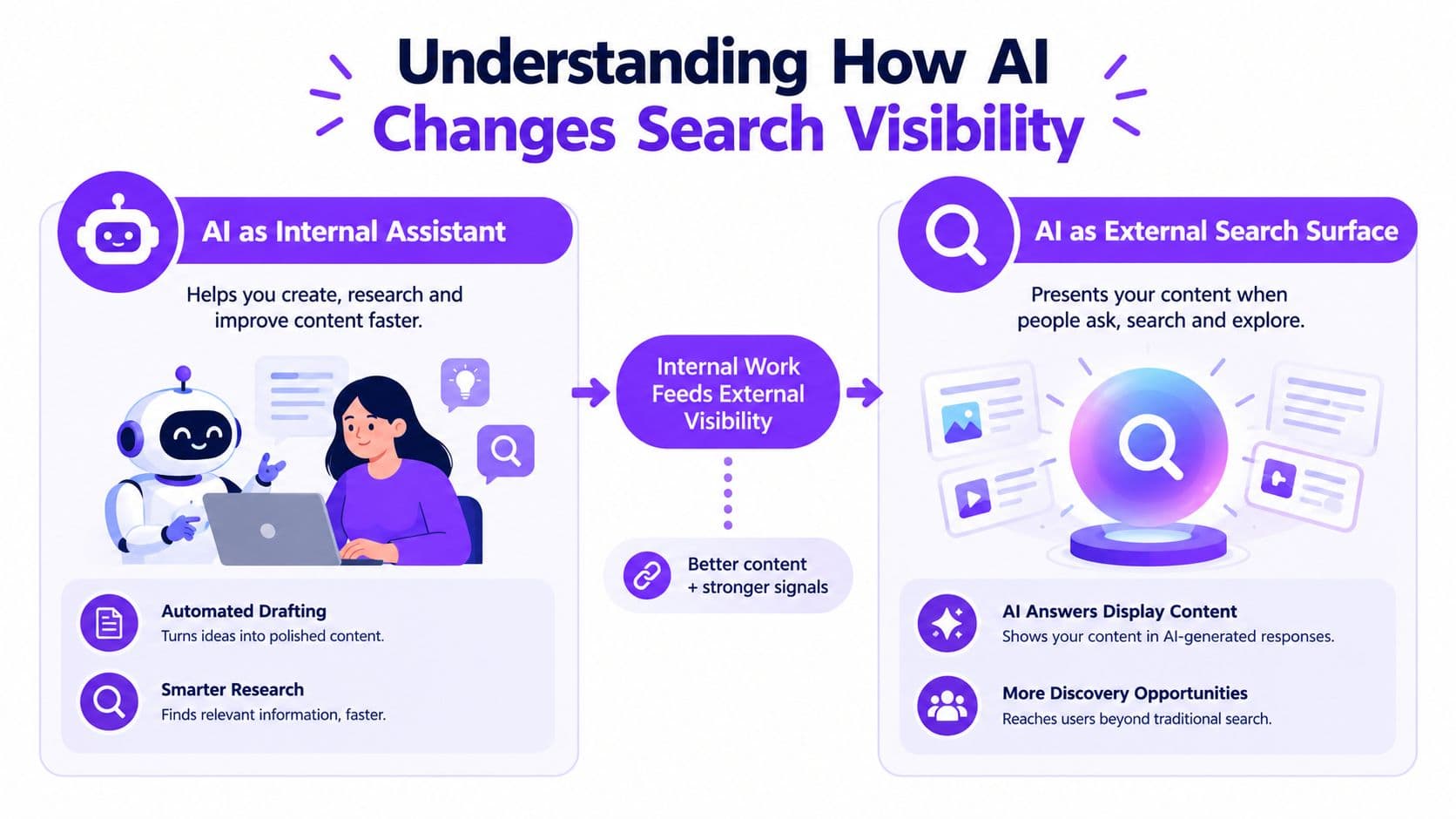
AI SEO is easier to manage when you separate two roles that are often confused.
The first role is AI as an internal assistant. Here, software helps your team research topics, cluster keywords, summarize competing pages, draft outlines, identify missing subtopics, prepare metadata, and organize a publishing queue. It acts like an operations assistant for SEO, but it still needs your business context and editorial review.
The second role is AI as an external search surface. Google AI Overviews and conversational answer systems read public webpages, extract information, summarize it, and sometimes cite the sources behind their answers. Your content must therefore work for a reader scanning a normal search result and for a machine looking for a clear, trustworthy passage to reuse.
The internal assistant improves throughput
Suppose you run a local accounting firm. An internal AI workflow can group questions about quarterly planning, bookkeeping software, tax preparation, and business formation. It can then suggest a cluster, map each topic to a page type, and produce briefs for a writer or owner to refine.
That saves time, but it doesn't create authority automatically. The firm still needs to add its service boundaries, explain who should contact it, correct generic advice, and include examples that reflect the actual clients it serves. AI can organize expertise. It can't legitimately manufacture it.
This distinction prevents a common failure: treating a generated draft as the finished SEO asset. A draft is raw material. The finished page needs accurate claims, useful navigation, a clear next step, and a reason for a customer to trust the business.
The external surface rewards readable evidence
AI search systems need to identify entities, relationships, definitions, and supporting details. They have an easier job when a page states its answer directly, uses descriptive headings, and separates related questions into clear sections.
The small business AI SEO guidance from Morningscore makes a useful practical distinction. Visibility in AI search likely depends more on crawlability, structured data, and content clarity than on adding special AI-specific files or shortcuts. That matters because AI Overviews appear more often for informational searches than for e-commerce queries, so an advice page and a product page may need different visibility tactics.
Your technical foundation still matters. Search engines and answer systems need to access the page, understand what it represents, and connect it to a credible business. No prompt can compensate for a blocked page, vague navigation, missing business details, or content that makes unsupported claims.
Practical AI SEO Strategies for Small Teams
Small teams don't need a complicated AI stack. They need a workflow with clear handoffs, sensible review points, and a firm separation between tasks that software can automate and decisions that require human judgment.
Start with customer language
Feed your research process with actual customer language. Pull questions from sales calls, support tickets, reviews, contact forms, and conversations with staff. Then ask an AI assistant to group those questions by intent, such as learning, comparing, solving a problem, or hiring a provider.
Validate the resulting topics against search data before you commit. AI is good at finding semantic relationships, but it can invent demand or combine terms that look similar but represent different needs. Your job is to decide whether a topic deserves a blog post, a service page, a product page, an FAQ, or no page at all.
Build a cluster around a commercial destination
Don't create a disconnected list of articles. Choose a core offer, then map supporting questions to pages that help a visitor make a decision.
A home renovation company might build supporting content around planning permissions, material choices, project timelines, and contractor selection. Each article should answer its own question and link naturally to the relevant renovation service page. This structure gives readers a route from education to action without forcing a sales pitch into every paragraph.
Let AI outline, then add the knowledge only you have
An AI-generated outline can provide useful coverage, but generic coverage is not a competitive advantage. Add the details that customers need, including eligibility requirements, trade-offs, process stages, common mistakes, maintenance obligations, and signs that a different solution may be better.
Use a brand voice document with approved terminology, claims you can support, words you avoid, and examples of strong and weak copy. Give the system source material from your own business rather than asking it to imitate a vague industry tone.
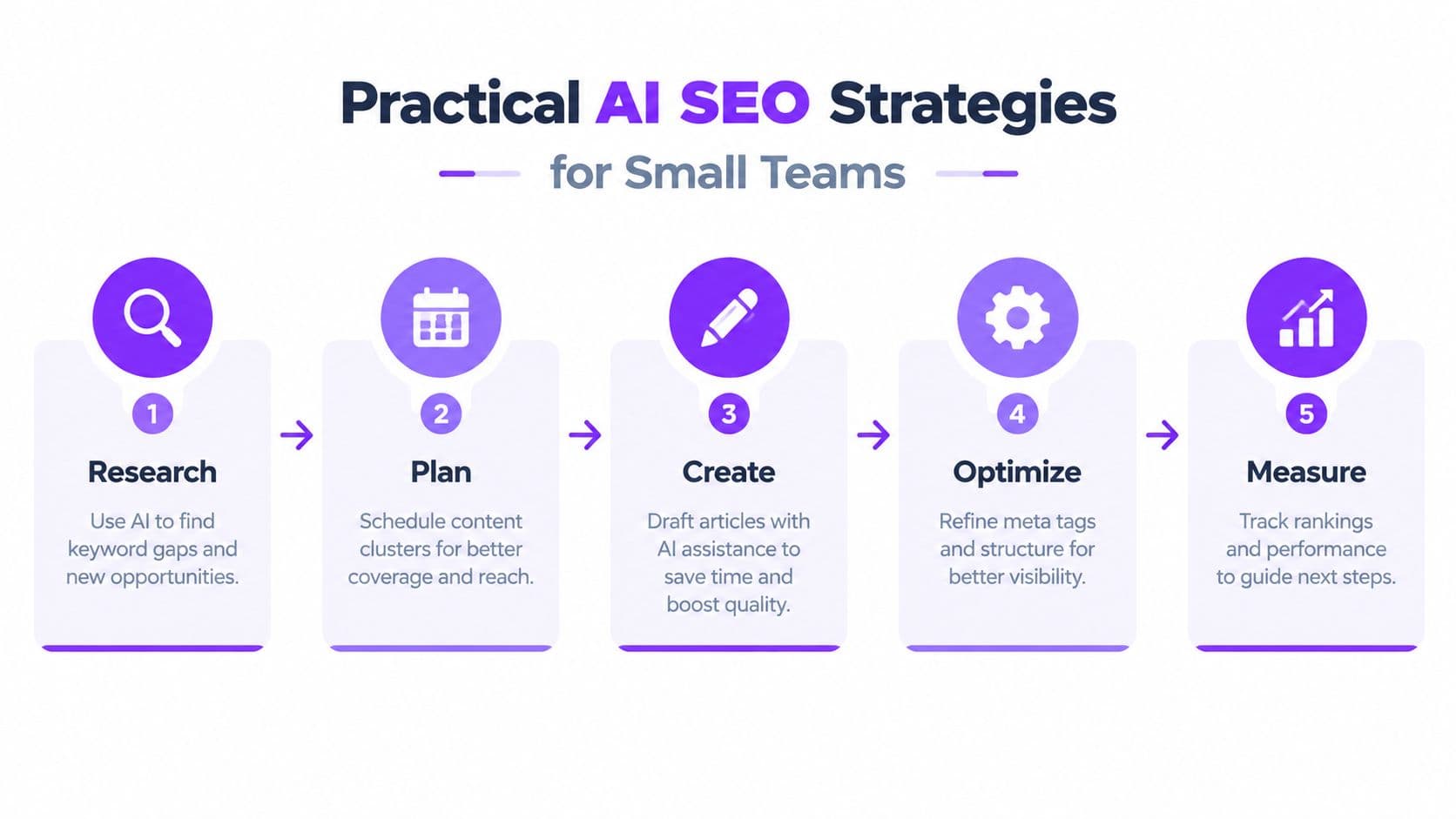
Add a review gate before publication
A lean approval checklist is more useful than a long editorial policy. Check whether the page answers the intended question, reflects the service accurately, uses natural language, links to the right commercial page, and gives the reader a clear next step.
Also inspect every factual statement. AI tools can produce confident but incorrect details, especially around regulations, pricing, compatibility, safety, and health. The business owner remains responsible for what appears on the site.
For a broader comparison of workflows and platforms, this resource on the best AI SEO tools can help you assess whether you need research assistance, content optimization, publishing automation, or a combination.
Measure work completed and business movement
Track operational outputs first. Did the team publish the planned pages, connect them with internal links, update outdated offers, and resolve obvious crawl or indexing issues? Then track business outcomes, including qualified form submissions, calls, bookings, product inquiries, and assisted conversions.
This keeps AI SEO grounded. A workflow that produces many drafts but no useful pages is not efficient. A smaller workflow that consistently produces accurate, commercially relevant content is more valuable.
Building an Automated Content Workflow
A fragmented approach looks affordable at first. One tool finds keywords, another drafts copy, a stock library supplies images, a document editor stores the work, and someone manually transfers everything into the CMS. Each subscription may seem manageable, but the handoffs create the actual cost.
Someone must remove formatting errors, rename image files, write alternative text, add links, check headings, upload assets, set the author, schedule the page, and verify the published version. These tasks are easy to underestimate because none feels difficult. Together, they create enough friction to make publishing irregular.
Fragmented tools versus an integrated workflow
| Fragmented setup | Integrated setup |
|---|---|
| Research sits in one application and drafts sit in another | Research and content planning share one workflow |
| Images require separate sourcing and downloading | Visual assets can be prepared with the article |
| Publishing involves manual copying and formatting | CMS connections reduce repetitive transfer work |
| Internal links are often added as an afterthought | Linking can be planned as part of the content brief |
| Reporting combines data from multiple places | Performance checks follow the same content queue |
Neither model is automatically correct. A specialized stack may suit an experienced SEO professional who wants control over every step. An integrated platform makes more sense when the owner is the researcher, editor, publisher, and analyst at the same time.
The key question is not how many features a tool has. Ask how many decisions and handoffs it removes without hiding the approval points that matter.
Design the workflow around page types
Automation works best when each page type has a defined job. A service page should explain the offer, audience, process, proof, objections, and next step. A supporting article should solve a focused problem and guide an appropriate reader toward a related service. A product page should make features, use cases, constraints, and purchase considerations easy to understand.
This prevents a common automation error: producing articles that are polished but commercially disconnected. Before generating content, define the target page, search intent, internal links, conversion action, and information the business must verify.
A good system can then automate the repeatable parts:
- Research preparation: Group related queries, identify missing topics, and organize them into a publishing queue.
- Brief creation: Set the search intent, page type, headings, questions, internal links, and required business details.
- Draft production: Create a structured first version that follows the approved voice and content requirements.
- Asset preparation: Generate or organize on-brand images, captions, filenames, and alternative text.
- CMS delivery: Push the reviewed article to WordPress, Webflow, Notion, or another connected publishing system.
- Maintenance: Flag pages that need new information, clearer answers, stronger links, or a better commercial path.
A platform such as Outrank brings these content creation, image, planning, and publishing tasks into a connected workflow, including integrations for common CMS environments. That can be useful when the main constraint isn't ideas, but the time required to turn approved ideas into live pages.
Keep a human approval point
Full automation sounds attractive, but unreviewed publishing creates brand and compliance risks. Establish an approval point before a page becomes public, especially for content involving legal, financial, medical, safety, or regulated claims.
The owner doesn't need to rewrite every sentence. They do need to verify the offer, correct business-specific details, remove unsupported promises, and ensure the page sounds like a company a customer would want to hire.
This guide to automating content marketing is useful for thinking through the handoffs between planning, creation, review, and publication. The best workflow is the one your team can run every week without turning quality control into a second full-time job.
Optimizing for AI Search Engines and Overviews
Keyword stuffing was never a durable content strategy. It makes pages harder to read, and it doesn't give an answer system a reliable reason to select your business as a source.
AI search optimization is better understood as machine-extractable answer design. A page should contain passages that are easy to interpret on their own, while still giving human readers enough context to make a decision.
Write answer-first sections
Open important sections with a direct answer, then explain the reasoning. If a page targets “how often should a café clean its espresso machine,” the first paragraph should answer the question in plain language. The following paragraphs can explain the factors that change the recommendation, what the process involves, and when a professional service is appropriate.
Use headings that describe the question or decision. Replace vague headings such as “Our approach” with specific ones such as “What a commercial cleaning service includes.” A machine can parse both, but only one tells a reader what information follows.
Make expertise visible without sounding promotional
A 2026 benchmark associated higher AI citation rates with clarity and summarization, up 32.83%, E-E-A-T signals, up 30.64%, and Q&A format, up 25.45%. The benchmark also found a negative correlation for non-promotional tone. These are content-level signals, not a complete ranking model, because the study did not evaluate metadata, HTML structure, schema markup, or layout. The figures and limitations are described in this benchmark summary on AI citation factors.
In practice, show who stands behind the information, explain how the business knows what it claims, and link to credible supporting material when the claim needs evidence. Avoid turning every section into a sales pitch. A useful answer that acknowledges limits is more credible than a page that says the company is perfect for everyone.
Use structure that supports extraction
A strong service or article page often includes:
- A concise definition: Explain the central term or service in language a customer would understand.
- Decision criteria: Show what changes the recommendation, such as budget, location, urgency, compatibility, or experience.
- Q&A sections: Answer adjacent questions that customers ask before contacting you.
- Specific entities: Name the products, locations, certifications, materials, processes, or platforms that matter.
- Evidence and attribution: Support important claims with relevant sources, first-hand detail, or clearly identified business experience.
- A useful next step: Connect the answer to a consultation, quote request, comparison, booking, or related page.
You can also explore practical guidance on structured data and entity signals when your pages need clearer machine-readable context. Structured data won't rescue weak content, but it can help systems interpret what a page represents when it accurately matches the visible information.
Adapt the page to the query type
Informational queries are often a better fit for definitions, comparisons, troubleshooting guides, and explainers. Commercial queries need sharper service details, proof, availability, location information, and decision support. Don't force every page into a blog format.
The strongest AI SEO for small business programs connect these page types. An informational answer earns attention, a well-linked service page explains the offer, and a trustworthy local presence gives the customer a reason to choose the business.
Measuring ROI Without Getting Lost in Data
Traffic is useful, but it isn't the business outcome. A small company can publish more content, receive more impressions, and still fail to generate qualified conversations. AI SEO measurement should connect visibility to actions that indicate purchase intent.
A 2026 study of LLM referral traffic across 10 websites and 150,000 indexed pages found that the top 10 organic pages captured 55% of organic sessions but only 29% of LLM sessions. The study also found that service and product pages performed better than other page types when LLM sessions were normalized against organic sessions. Those findings are covered in this analysis of LLM and organic traffic patterns.
The implication is important for a small business. Traditional SEO reporting often focuses on the pages with the highest rankings and traffic. AI-driven discovery can distribute attention more broadly, including to pages that directly explain an offer or help someone evaluate a purchase.
Track the path from discovery to intent
Use a compact measurement set rather than collecting every available metric.
| Measurement area | What to inspect |
|---|---|
| Visibility | Search impressions, indexed pages, rankings for priority queries, and branded mentions in AI answers |
| Engagement | Clicks, engaged visits, calls, form starts, booking actions, and product interactions |
| Local intent | Google Business Profile completeness, review activity, direction requests, calls, and location-related queries |
| Commercial quality | Qualified leads, accepted quotes, booked appointments, sales conversations, and assisted conversions |
| Operational efficiency | Time spent researching, drafting, editing, publishing, and updating pages |
Don't treat a mention in an AI answer as revenue. Treat it as a visibility signal that needs to be connected to branded searches, direct visits, referral activity, or lead quality.
Local trust deserves its own dashboard
Local businesses usually win through relevance and trust, not broad educational reach alone. Monitor whether your business information is complete and consistent, whether reviews address the services customers care about, and whether visitors can quickly understand where you operate and how to contact you.
Recent survey coverage reported that 83% of small business owners still viewed SEO as valuable, 40% had used AI to help with SEO, and 78% of those users reported a positive impact. The same source highlights the harder measurement problem, namely that increased output doesn't prove increased revenue. The figures and context appear in this small business SEO and AI survey coverage.
For a local plumber, that means tracking calls and quote requests from service pages, not celebrating a high-traffic article about plumbing terminology. For a specialist retailer, it means connecting product-page visits and branded searches to enquiries or purchases. Your dashboard should answer one question: did this work bring better opportunities to the business?
The content marketing ROI framework can help you connect production activity with commercial outcomes instead of reporting publication volume as if it were revenue.
Getting Started with Your First AI Campaign
Start with one commercial theme, not your entire website. Choose a service or product with clear demand, review the existing page, and collect the questions customers ask before buying.
Use this 30-day launch sequence:
- Days one through five: Verify indexing, review your core pages, connect Search Console and analytics, and record current leads from organic and local sources.
- Days six through ten: Gather customer questions, group them by intent, and select one commercial page with several supporting topics.
- Days eleven through twenty: Create briefs, draft the supporting content, add first-hand expertise, build internal links, and review every factual or business-specific claim.
- Days twenty-one through twenty-five: Publish through your chosen CMS workflow, check the live pages on mobile, and confirm titles, descriptions, links, images, and calls to action.
- Days twenty-six through thirty: Inspect indexing and early search visibility, record qualified actions, and revise the workflow before creating the next cluster.
The guide to using AI for SEO can help you turn this process into a repeatable operating routine. Keep the first campaign narrow enough to review properly, then expand only after you know which page types and customer questions produce useful business signals.
Outrank combines AI keyword research, content planning, article creation, on-brand image generation, and publishing connections for platforms such as WordPress, Webflow, and Notion. Visit Outrank to see how a connected workflow can help your small business produce clearer, commercially useful content while reducing manual SEO work.