Most guides about starting a blog will tell you to pick a niche, get hosting, install WordPress, and publish consistently. They're not wrong. They're just not answering the question you actually asked.
You didn't ask how to start a blog. You asked how to start a successful one. That's a completely different question, and almost nobody answers it honestly.
Here's what we've learned from watching hundreds of blogs launch, and watching most of them quietly stop updating after six weeks.
Success Starts with a Definition
Before you register a domain or pick a template, you need to answer one question: what does success actually mean for this blog?
This sounds obvious. It isn't. Most people skip it, start publishing, and then lose motivation because they have no idea whether it's working.
Define it now, specifically:
Is success 10,000 monthly readers in 12 months?
Is it ranking on the first page for three target keywords?
Is it generating leads for a service business?
Is it building an email list of 500 people who actually open your newsletters?
Is it establishing enough credibility to land a book deal or speaking gig?
Each of these requires a different approach. A blog built to rank on Google looks nothing like a blog built to grow a newsletter. A blog monetized through affiliate links needs different content than one designed to sell consulting.
Pick one primary goal. Write it down. Every content and platform decision should point back to it.
The Real Reason Most Blogs Fail
It's not the platform. It's not the posting frequency. It's not even the niche choice, though that matters.
Most blogs fail because they have nothing to say that couldn't be said by anyone else.

In 2026, the internet is overrun with competent, well-formatted, thoroughly search-optimised content that has no actual perspective behind it. AI can produce a 2,000-word how-to guide on any topic in under a minute. What it can't do is tell you something true from experience. It can't have an opinion it'll defend under pressure. It can't notice something strange and follow the thread.
The blogs that succeed are the ones where you can feel a real person behind the words. Where the author has an actual take, not just a content brief. Where a specific sentence would be impossible to write if you hadn't lived through the thing you're describing.
Before you think about keywords or content calendars, ask yourself: what do I know or believe that most people in my space don't yet know or believe? What have I seen work that the conventional advice gets wrong? What's the thing I'd say at a dinner table that would make someone lean in?
That's your blog.
Niche, Narrower Than You Think
The most common mistake: picking a niche that's really just a category.
"Personal finance" is a category. "How I paid off $60k in debt on a $45k salary while living in San Francisco" is a niche. "Marketing advice" is a category. "B2B marketing for bootstrapped SaaS companies with no dedicated marketing hire" is a niche.
The narrower your niche, the faster you build an audience that actually cares, and the faster you establish topical depth that search engines and AI engines can cite.
A tight niche doesn't limit your audience, it finds it. People searching for exactly what you write about will read you obsessively. People who find you through a vague broad category will skim you and leave.
You can always expand later. Start narrow.
The Platform Question (Honest Answer)
People spend weeks on this. You shouldn't.
The platform matters less than almost every piece of blogging advice implies. What matters is that it:
Loads fast on mobile
Has a proper sitemap and RSS feed
Lets you set a custom domain (or at least a clean subdomain to start)
Doesn't trap your content if you decide to move later
WordPress remains the default recommendation in most guides because it's flexible and battle-tested. But it also means paying for hosting, managing updates, and dealing with plugin conflicts at the worst possible moments. For most people starting out, that's friction you don't need.
Hosted platforms solve the setup problem entirely. You get a blog live in minutes, SEO basics handled out of the box, and no server to maintain. The tradeoff is less customization. For most new bloggers, that's a reasonable tradeoff to make while you figure out whether you'll actually keep writing.
Outrank Blogs is free up to 10,000 visits a month, with unlimited posts, your own domain or subfolder, and SEO basics (sitemap, RSS, structured data, IndexNow) built in from the first post. If you want a step-by-step walkthrough of getting a free blog live, how to start a blog for free covers every platform option side by side.
Whatever you pick, don't let the platform decision delay you by more than a day. A good blog on a simple platform beats an elaborate setup you never fill with content.
The Content That Actually Wins in 2026
The search landscape has shifted. Google's AI Overviews answer the basic questions now. That means commodity content ("what is X," "top 10 tips for Y") is getting less traffic than it used to, because the search engine is answering those queries itself.
What still gets clicks and builds audiences:
Original data and case studies. Something you measured, tested, or tracked yourself. Even small experiments with honest results outperform borrowed wisdom.
Specific opinions with reasoning. "I think X is wrong, and here's why" consistently outperforms "here are the pros and cons of X." The algorithm has no opinion. You do. Use it.
Experience-based how-tos. Not "how to do X" in the abstract, but "how I did X, what went wrong, and what I'd do differently." The first-person, specific version of the generic guide.
Deep dives into underexplored subtopics. One excellent 3,000-word piece on a specific question within your niche beats twenty shallow posts covering the same ground as everyone else.
One practical discipline: before you publish anything, ask whether an AI could have written it without any input from you. If yes, it probably shouldn't go out under your name.
Distribution: The Part Everyone Skips
Here's the uncomfortable truth about starting a blog in 2026: writing good content is not enough.
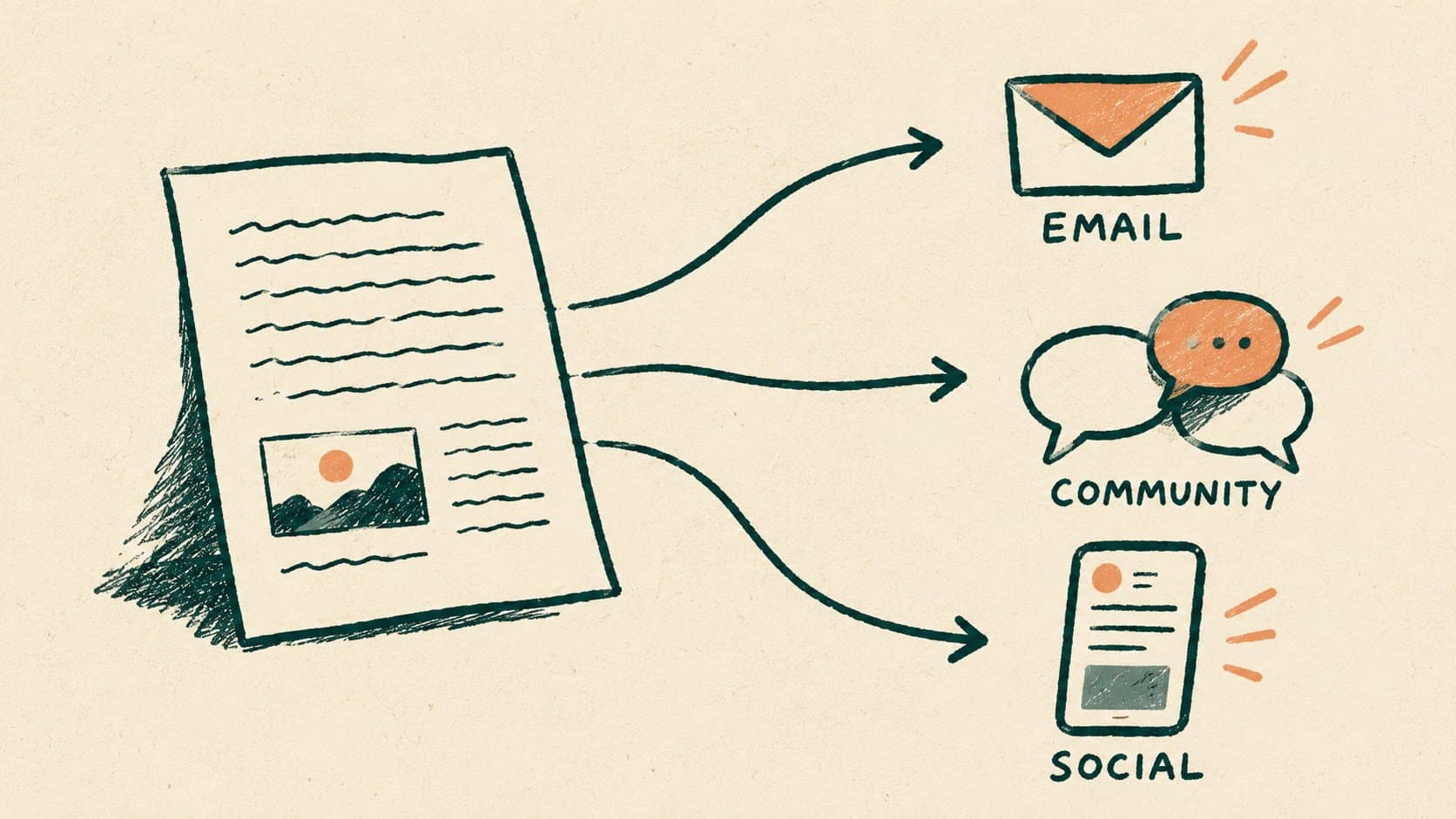
The "build it and they will come" era ended around 2018. Now, even excellent posts sit unread without active distribution. You need to bring readers to the content, especially in the first 12 months before organic search traffic kicks in.
The most effective early distribution strategies, in rough order of return:
Email list from day one. Set up a newsletter signup before you publish your first post. Even if it's just 10 people from your existing network, you have a warm audience to write for. Those 10 people become 50 through shares. This is how most successful blogs actually get their initial traction, not through Google.
One social channel, not five. Pick the platform where your audience actually hangs out. Write for that channel consistently, link back to your blog. Trying to maintain Twitter/X, LinkedIn, Instagram, and a YouTube channel simultaneously while also writing blog posts is a recipe for doing all of them badly.
Reddit and niche forums. Participate genuinely in communities related to your niche. When you publish something that actually answers a question people are asking in those spaces, share it. The key word is genuinely, not spamming links.
Repurposing with context. Take key insights from your posts and turn them into standalone social content. Don't just share the link with a caption. Extract the idea and make it stand on its own. Then point people to the full piece for depth.
The Timeline Nobody Warns You About
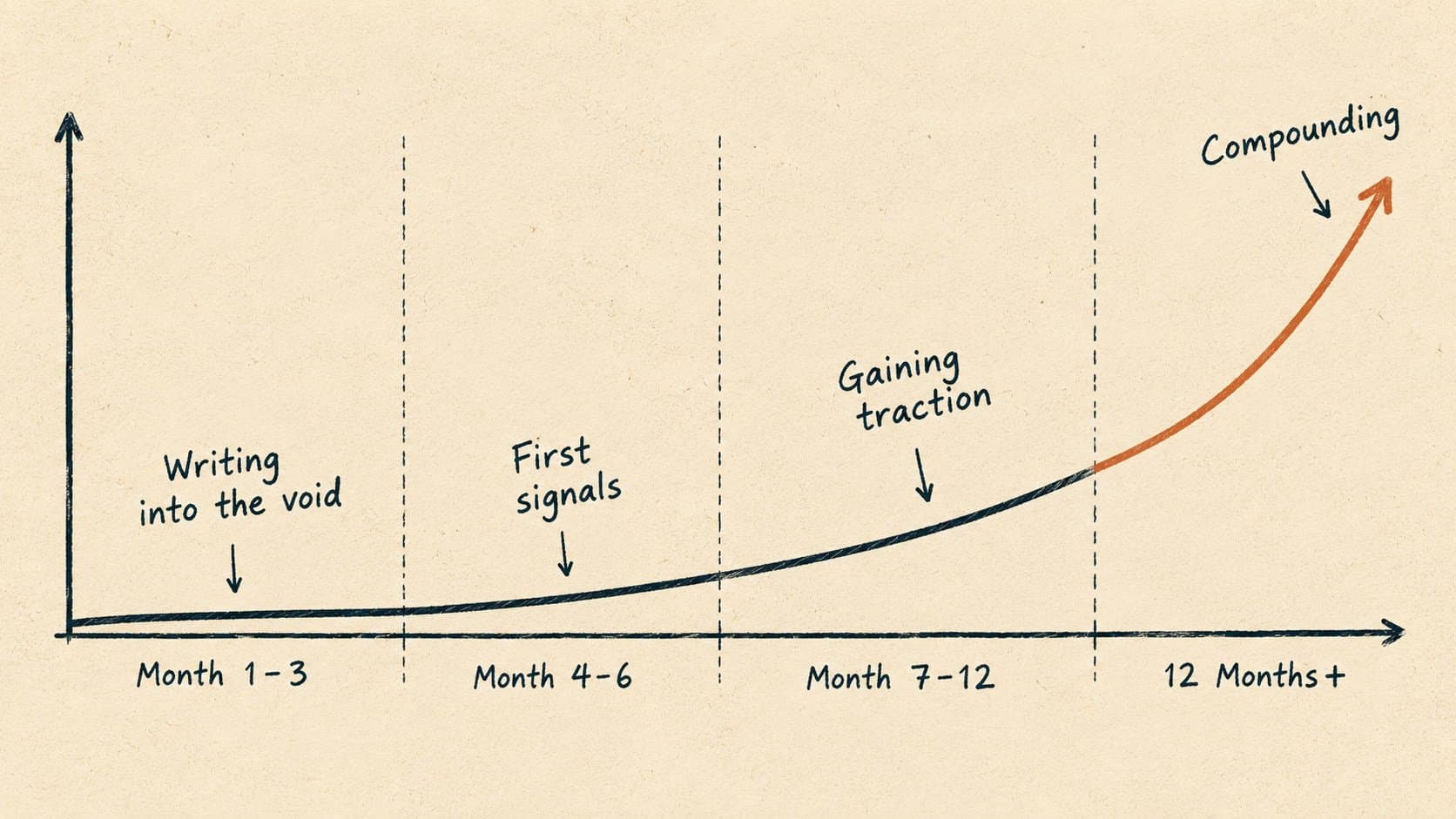
If you're starting a blog to build organic search traffic, you need to understand the realistic timeline before you start, because most people quit right before things actually start working.
Month 1 to 3: You're writing into the void. Minimal traffic, most of it from your own visits. This is normal. Google is still crawling and evaluating your content. Your job is to keep publishing.
Month 4 to 6: The first signs of organic traffic. Individual posts start appearing in position 20 to 50 for their target keywords. Encouraging, but not yet meaningful.
Month 7 to 12: Traffic compounds. Posts you published in month two start climbing. You start seeing patterns in what's working. This is when most people who stuck it out start feeling it.
Month 12 and beyond: If you've published consistently and built something with genuine point of view, you start seeing what compounding content actually means. Posts rank, generate backlinks, pull in related keywords, and grow without new effort.
The bloggers who succeed are almost always the ones who understood this timeline going in. They didn't expect traffic in month one. They measured progress by the quality of what they published and the consistency of their schedule, not by their analytics dashboard.
Putting It Together
Starting a successful blog in 2026 comes down to four things, in roughly this order of importance:
A clear definition of success. Know what you're optimizing for before you write a single word.
A genuine point of view. Something only you could say, from experience, observation, or a take you'll actually defend.
A narrow niche. Narrow enough that you can become the definitive source, not just another participant.
A distribution habit. The discipline to bring readers to your content while you wait for search to kick in.
The platform, the template, the posting schedule, the SEO checklist: those matter, but they're the easy part. They're table stakes. The hard part is the stuff above, and it's the part almost every guide skips.
Why Trust This
We've helped hundreds of bloggers and small businesses get their content live and growing through Outrank Blogs, our free hosted blog platform built for exactly this kind of audience: people who want to publish without managing infrastructure, who care about SEO basics being handled for them, and who want to focus on writing rather than WordPress plugins.
We've seen what separates the blogs that take off from the ones that quietly go dormant. The pattern is consistent, and it's what this article describes.
The steps in this guide were reviewed against current search behavior and platform realities as of late 2026.
Start Without the Setup Headache
If you want to get a blog live today without touching a server, Outrank Blogs gives you a free hosted blog (up to 10,000 visits a month, unlimited posts) with your own subdomain or custom domain, a block-based editor, and SEO basics (sitemap, RSS, structured data, IndexNow) built in from day one.
No hosting to manage. No plugin updates. No configuration rabbit holes. Just publish.
When you're ready to scale beyond what you can write yourself, the Organic Growth plan ($99/month) adds 30 SEO articles a month published for you, keyword research for the topics you can rank for, images and internal links added automatically, and backlinks from real sites in the Outrank network. But that's a problem for later. Start with getting something live and building the habit.
Not sure which free platform fits your situation? The best free blogging platforms roundup compares 13 options side by side, including what each free plan really includes and where it catches you.
Frequently Asked Questions
How long does it take for a blog to be successful?
Most blogs that reach meaningful organic traffic take 9 to 12 months of consistent publishing before search traffic becomes significant. Email and social distribution can bring readers earlier, but SEO compounds over time. Plan for at least a year before judging results.
Do I need to post every day to be successful?
No. Posting frequency matters less than posting quality and posting consistently. One well-researched, original post per week outperforms five thin posts chasing trending topics. Pick a cadence you can sustain for a year, not one that burns you out in month two.
What makes a blog post successful?
A successful blog post has a specific, searchable angle; provides something (a perspective, a data point, an experience) that the other results on that keyword don't offer; and is structured so readers can get value quickly. The best posts answer one question better than anything else on the topic.
How do I get my first readers?
Before SEO traffic arrives, your readers come from direct outreach: sharing posts in relevant online communities, building an email list from day one, and being active on one social platform where your audience lives. The first 100 readers almost never come from Google.
Is it too late to start a blog in 2026?
No, but the type of blog that succeeds has changed. Generic how-to content with no original angle is harder to rank and less likely to build an audience than it was five years ago. Blogs with a specific niche, a genuine voice, and real experience behind the content are still growing. The bar for what's worth publishing is higher. That's a good thing for anyone willing to clear it.
Which blogging platform is best for beginners?
The best platform is one you'll actually use. For total beginners who want to skip the technical setup entirely, a hosted platform like Outrank Blogs gets you live in minutes with SEO basics included, free up to 10,000 visits a month. For people who need maximum flexibility and plan to build a larger site eventually, self-hosted WordPress is the long-term standard. The difference matters less in the first six months than most advice implies. For a full comparison of free options, see the best free blogging platforms roundup.
How do I monetize a blog?
The main paths are display ads (low barrier, low revenue per reader), affiliate marketing (works well if your niche has relevant products), selling your own products or services (highest margin), and sponsored content (requires an established audience). Most successful blogs eventually use a mix. Don't optimize for monetization in the first six months; optimize for building a real audience first.